
Car-Free Market Street starts January 29

Car-Free Market Street starts January 29
By Phillip Pierce

Better Market Street is set to transform our city’s busiest street for people walking, biking and riding transit over the next few years, but we don’t need to wait for construction to make it safer and improve Muni.

Starting on January 29th through our Quick-build program, Market Street will become car-free eastbound from 10th to Main and westbound from Steuart to Van Ness. In addition to restricting private vehicles, the quick-build includes extending Muni only lanes, new loading zones and much-needed intersection safety improvements.
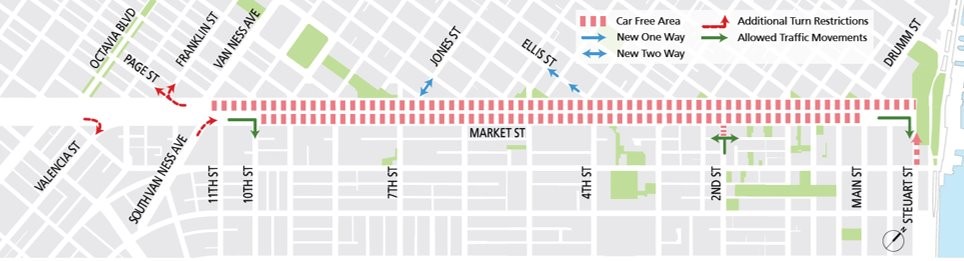
Map of changes coming late January 2020. Figure 4: Rendering including Better Market Street’s sidewalk level bike lane, new trees and improved streetscape elements.
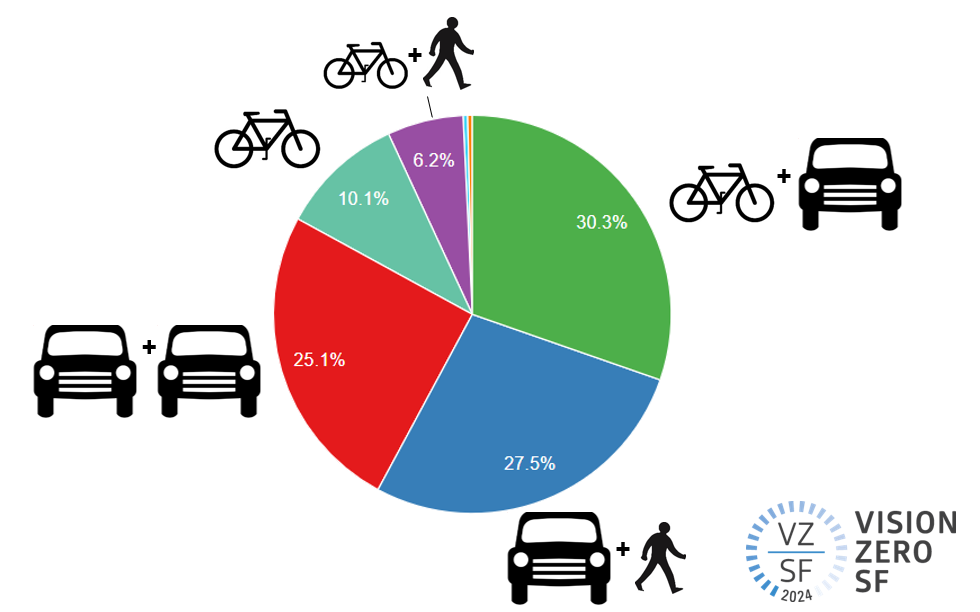
Figure 1: Map of changes coming late January 2020. Figure 4: Rendering including Better Market Street’s sidewalk level bike lane, new trees and improved streetscape elements.
 
These changes can’t come soon enough because unfortunately, Market Street is home to half of the top 10 intersections for pedestrian and bicycle collisions. In fact, each year since 2014 the area-averaged over 100 injury collisions per year -- 75 percent of them involving people walking or biking. By reducing conflicts with proven safety measures like turn restrictions, painted safety zones and safe-hit posts, we can get closer to our city’s Vision Zero goal of eliminating traffic deaths and serious injuries on San Francisco roads.
Pie chart showing share of injury collisions by travel mode on Market Street since 2014
Figure 2: Share of injury collisions by travel mode on Market Street since 2014

In addition to safety benefits, going car-free on Market will prioritize transit on a street that sees upwards of 200 buses per hour during peak times. With bus lines branching throughout San Francisco, boosting Muni's reliability on Market street will positively affect the whole city!
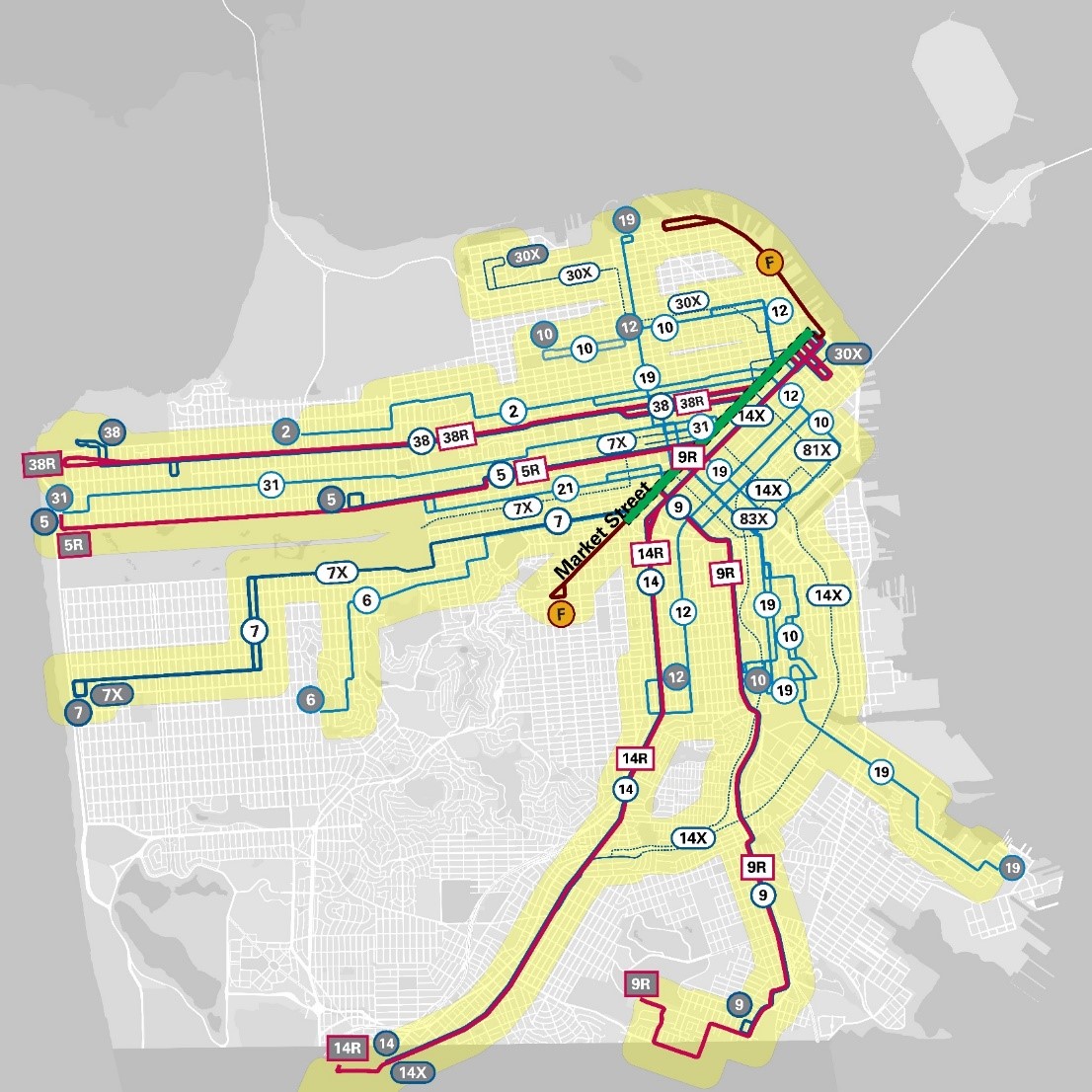
Map showing all surface Muni routes that use Market Street for a portion of their route. Improving the functionality of Market will help enhance transit to many parts of the City.
Figure 3: Map showing all surface Muni routes that use Market Street for a portion of their route. Improving the functionality of Market will help enhance transit to many parts of the City.

Quick-build Elements starting in January: Full Details

While Market Street officially becomes car-free on January 29th, other changes listed below are set to be implemented over the first few months of 2020.

Vehicle Changes

  • No private vehicles allowed on Market Street eastbound from 10th to Main and westbound from Steuart to Van Ness -- including app-based ride hail companies like Uber/Lyft.  
  • All traffic can continue to cross Market street at intersections.
  • Vehicles with commercial plates, taxis, emergency vehicles and paratransit will still be able to use Market Street. 
  • Vehicle direction changes for sections of Ellis, Jones, Second and Steuart streets to improve safety and vehicle circulation (see map in Figure 1 for details).
  • Right turns onto Valencia from eastbound Market Street will no longer be allowed, Page Street will become a bike-only connection to and from Market Street.

Transit Enhancements

  • Extending existing transit-only lane east from Third to Main Street, the segment of Market with the most transit service, and making it Muni-only (taxis and non-Muni buses will no longer be allowed in center lane)
  • Converting the existing red transit-only lane to Muni-only between 9th and Third streets
  • Converting the existing red transit-only lane to Muni & taxi only between 12th and 9th streets
  • Buses in the curb lane will benefit from the car-free restrictions as well

Loading Changes

  • 100 new cross-street passenger and commercial loading zones to accommodate safe loading
  • Peak hour loading restrictions on Market Street to reduce conflicts between people on bicycles, transit and commercial vehicles:
    • No southside loading in the eastbound direction (towards the Ferry Building) on weekdays 6:00 am to 9:30 am.
    • No northside loading in the westbound direction (towards Twin Peaks) on weekdays between 3:00 pm and 7:30 pm. 

Additional Safety Improvements

  • Installing painted safety zones at eight intersections to make crossing the street safer and shorter
  • New bicycle intersection improvements at Eighth, Page, Battery, and Valencia streets.

Project Information

Quick-build is just the first step in implementing Better Market Street, the City’s multi-agency project to transform 2.2 miles of Market Street from Octavia Boulevard to Steuart Street. The project’s goal is to enhance safety and accessibility, improve transit performance, replace aging infrastructure, and revitalize the corridor’s streetscape.

Construction on the full project will be managed by Public Works and is expected to start in late 2020 or early 2021. For project details, please visit bettermarketstreetSF.org
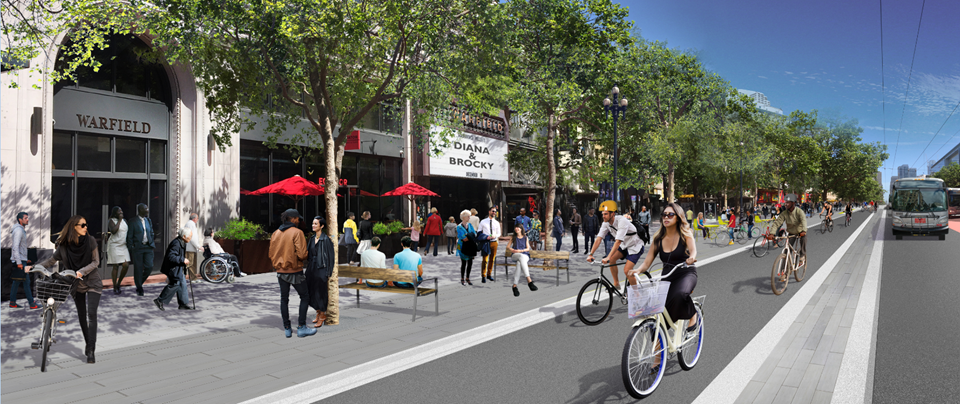
Rendering including Better Market Street’s sidewalk level bike lane, new trees and improved streetscape elements.
Figure 4: Rendering including Better Market Street’s sidewalk level bike lane, new trees and improved streetscape elements.


Published December 31, 2019 at 11:54PM
https://ift.tt/2QaLtD1

Comments

Popular posts from this blog

150 Years Ago Today – The Cable Car is Born

150 Years Ago Today – The Cable Car is Born By Kelley Trahan August 2, 2023, marks the 150th anniversary of the world’s first successful cable railway, born right here in San Francisco. To celebrate the occasion, we bring you the story of Andrew Hallidie and the very first cable car company, the Clay Street Hill Railroad.  Andrew Hallidie (1834-1900) was a pioneering inventor and entrepreneur who changed urban transportation. In 1852, at the age of 18, Hallidie emigrated with his father from the United Kingdom to San Francisco during the California Gold Rush. His father, an engineer and inventor, had a wire rope patent that played a crucial role in his son's future success.   Portrait of Andrew Smith Hallidie in 1890. Inspired by his father's wire rope business, Hallidie developed a steel cable mineral mine hauling system in 1857. About a decade later, he designed a wire rope aerial tramway for transporting materials over mountainous terrain. Then, after a stint in bridg...

Shared Spaces are Here to Stay. Permit Renewals are Due January 15, 2023.

Shared Spaces are Here to Stay. Permit Renewals are Due January 15, 2023. By Anne Yalon Shared Spaces, amongst many other benefits, allows our residents and families to enjoy safe and social outdoor dining. Seen here are the the owners of Tio Chilo’s Grill and their children in the restaurant’s parklet on 24th Street in the Mission.  San Francisco’s popular Shared Spaces program allows merchants, restaurants and arts and culture organizations to use the curbside, sidewalk and other public spaces to conduct local business activities and stay afloat. What emerged as an economic lifeline during the pandemic is making San Francisco’s streets more energized, engaged and activated. Many of the Shared Spaces parklets have become central gathering places for the local community. “ Our parklet makes me feel like when I go to Mexico, where outdoor seating is everywhere. People end up joining their friends in our parklet. It is a space for our customers and our community," said Liz V...

Virtual Parade and New Central Subway Art Ring in Lunar New Year

Virtual Parade and New Central Subway Art Ring in Lunar New Year By Sophia Scherr We are entering the year of the Ox, typically symbolizing hard work, positivity, and honesty. This year the SFMTA will continue the tradition of celebration with the virtual San Francisco Chinese New Year Parade   on February 20th at 6 pm on KTVU. Celebrating Lunar New Year and the San Francisco Chinese community has been a long-standing tradition for many of us. In 1849, San Francisco’s population swelled to 50,000 and many of the new residents were Chinese immigrants, coming to work in gold mines or on railroad lines. By the 1860’s, the Chinese were eager to share their culture with others and the annual tradition of parade and pageantry was born. A variety of other cultural groups throughout the city were invited to participate, and they marched down what today are Grant Avenue and Kearny Street with colorful flags, banners, lanterns, and drums and firecrackers to drive away evil spirits. The c...