
HeadsUp: Nightly Subway Maintenance Starting January 26

HeadsUp: Nightly Subway Maintenance Starting January 26
By Benjamin Barnett

The subway will be closing early each night at 9:30 p.m. starting January 26 and continuing for approximately one week for extended maintenance hours. Bus substitution service will connect to all stops.

On most nights, our teams have about two hours to get work done between evening and morning service. In order to complete critical maintenance tasks that cannot be completed during normal windows, we are planning this week of early subway closures, so crews have more hours each night to do vital work. This is our ongoing effort to maintain the subway infrastructure to ensure safety and reliability. The last early subway closures for maintenance took place in August 2019. 

What Are We Doing?

  • Track Maintenance. Installing new track hardware in a pilot segment to evaluate new technology.
  • Signal Maintenance. Perform cable tests and inspections to identify problems and future upgrades.
  • Overhead Lines. Replace worn overhead wire; Adjust system supports and tension to deliver better performance of pantographs and improve overhead wire life.
  • Custodial Services. Deep cleaning each station.
  • Station Maintenance. Address overdue or restricted access maintenance and preventative maintenance priorities.

When the subway closes, buses will run above ground to connect all stops through the normal end of train service. Owl service will remain unchanged. Trains will start regular morning service each day.

Transit Service Plan – 9:30 p.m. to 1 a.m.

  • Shuttle buses will serve all Muni Metro stops between Embarcadero & Brannan and St. Francis Circle
  • K – Train service between Balboa Park and St. Francis Circle
  • L – Train service between SF Zoo and West Portal
  • M – Train service between Balboa Park and West Portal
  • N – Train service between Ocean Beach and Church & Duboce
  • J – Train service between Balboa Park and Church & Duboce
  • T – Train service between Sunnydale and Embarcadero & Brannan

Inbound N Judah and outbound J Church trains will use the accessible stop entering the Duboce Portal to serve customers needing the ramp.

Plan extra travel time when riding Muni during subway closure. Regular bus fares will apply on bus shuttles and valid transfers will be accepted.
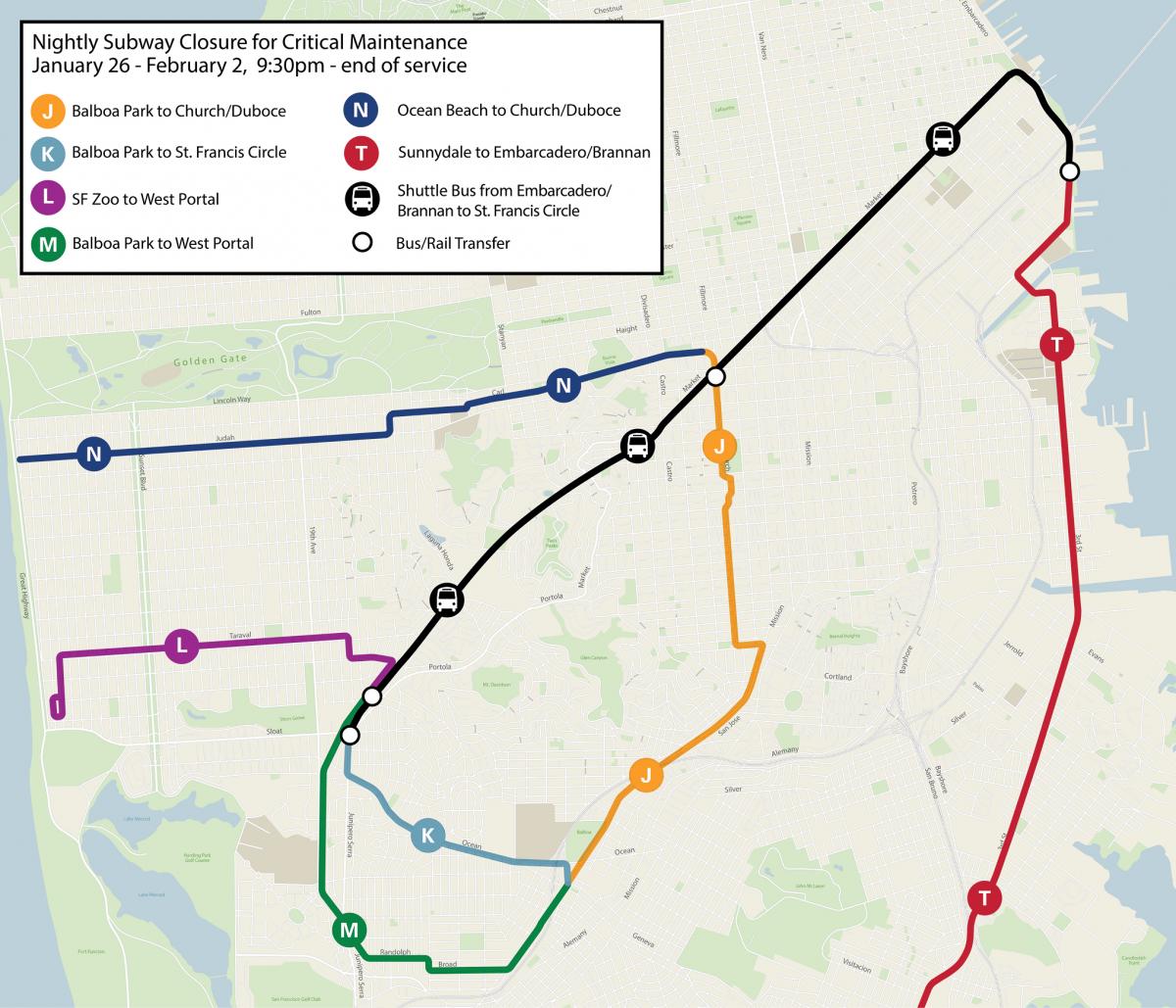
Early Subway Closure Map

What Did We Complete In August?

Track Maintenace

  • Replaced four worn switch points.
  • Removed and replaced two sections of corroded rail. 
  • Replaced two curved switch points at Duboce.

Signal Maintenace

  • Replaced batteries for the following relay rooms: Church, Civic Center, Castro, Embarcadero, Forest Hill and Powell Station.
  • Provided support to Track Maintenance to make final adjustments to the switches. 
  • Performed an end to end inspection of the ATCS (Automatic Train Control System) from West Portal to Castro Station.

Overhead Lines

  • Replaced a total of 4700 feet of overhead contact wire and support hardware at various locations.
  • Eliminated 30 wire splices
  • Removed, replaced and aligned five Section Breaks


Published January 22, 2020 at 11:25PM
https://ift.tt/2NQFbGY

Comments

Popular posts from this blog

150 Years Ago Today – The Cable Car is Born

150 Years Ago Today – The Cable Car is Born By Kelley Trahan August 2, 2023, marks the 150th anniversary of the world’s first successful cable railway, born right here in San Francisco. To celebrate the occasion, we bring you the story of Andrew Hallidie and the very first cable car company, the Clay Street Hill Railroad.  Andrew Hallidie (1834-1900) was a pioneering inventor and entrepreneur who changed urban transportation. In 1852, at the age of 18, Hallidie emigrated with his father from the United Kingdom to San Francisco during the California Gold Rush. His father, an engineer and inventor, had a wire rope patent that played a crucial role in his son's future success.   Portrait of Andrew Smith Hallidie in 1890. Inspired by his father's wire rope business, Hallidie developed a steel cable mineral mine hauling system in 1857. About a decade later, he designed a wire rope aerial tramway for transporting materials over mountainous terrain. Then, after a stint in bridg...

Shared Spaces are Here to Stay. Permit Renewals are Due January 15, 2023.

Shared Spaces are Here to Stay. Permit Renewals are Due January 15, 2023. By Anne Yalon Shared Spaces, amongst many other benefits, allows our residents and families to enjoy safe and social outdoor dining. Seen here are the the owners of Tio Chilo’s Grill and their children in the restaurant’s parklet on 24th Street in the Mission.  San Francisco’s popular Shared Spaces program allows merchants, restaurants and arts and culture organizations to use the curbside, sidewalk and other public spaces to conduct local business activities and stay afloat. What emerged as an economic lifeline during the pandemic is making San Francisco’s streets more energized, engaged and activated. Many of the Shared Spaces parklets have become central gathering places for the local community. “ Our parklet makes me feel like when I go to Mexico, where outdoor seating is everywhere. People end up joining their friends in our parklet. It is a space for our customers and our community," said Liz V...

Tenderloin Streets Transform During COVID-19

Tenderloin Streets Transform During COVID-19 By Kimberly Leung COVID-19 has disproportionately impacted people who live and work in the Tenderloin. As a result, the SFMTA has been working closely with District 6 Supervisor Matt Haney’s office, other city departments, the Tenderloin Traffic Safety Task Force and community members to address the public health issues and unique challenges in the neighborhood through innovative interventions.    The Tenderloin is home to many of our most vulnerable communities including historically marginalized groups such as people with disabilities, residents of SROs and supportive housing and limited-English proficient communities. With every single street in the Tenderloin on the city’s High Injury Network -- the 13 percent of San Francisco streets that account for 75 percent of severe traffic injury collision and fatalities -- thi...