By Victoria Chong
The Results Are In!
Over the course of 2019, the SFMTA implemented a record number of pedestrian, bicycle and traffic calming projects. But our goal is not only to deliver projects, but to make our streets safer and more comfortable for all San Franciscans. SFMTA’s Safe Streets Evaluation Program is sharing our annual Safe Streets Evaluation Report which takes stock of last year’s progress as well as lessons learned.
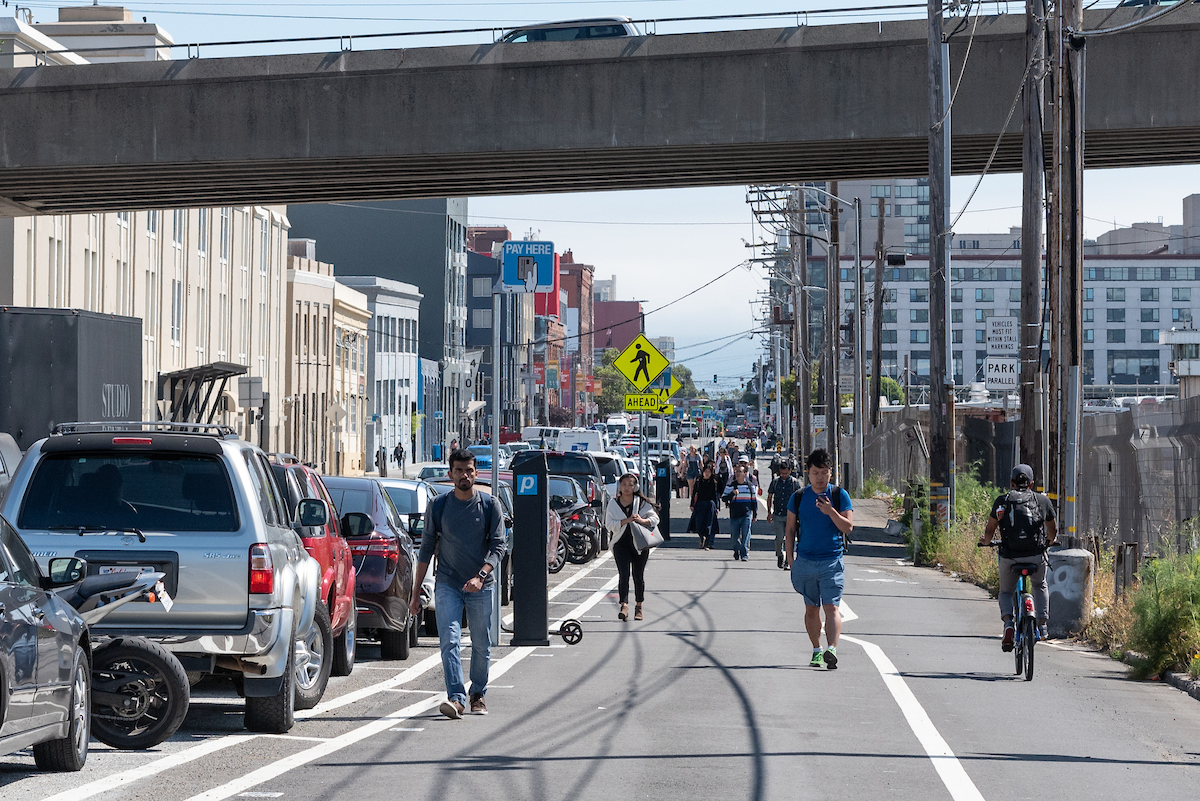
Pedestrians and bicyclist using the bike lane and pedestrian walkway along Townsend Street on June 13, 2019
Under the direction of Mayor London Breed, the SFMTA initiated the Vision Zero Quick-Build Program. This program represented reduced barriers for SFMTA to install pedestrian and bicycle safety improvements on the city’s High Injury Network.
Quick-build projects offer opportunities to take community feedback in real time and make design changes as needed. These projects can be put in the ground in as little as 10 percent of the time and cost as our traditional infrastructure projects, such as Masonic Avenue and 2nd Street.
A key part of the quick-build program is evaluating these fast-tracked projects so we can make the adjustments as we learn more; this report reviews some completed quick-build projects such as 7th Street, 6th Street and Taylor Street.
In addition to the quick build projects, we also evaluated the effectiveness of dozens of city-wide safety measures and corridor projects.
So…How Are We Doing?
Overwhelmingly, quick-builds, traditional corridor projects and citywide countermeasures completed in 2019 provide clear safety benefits:
- Corridor pedestrian safety projects reduce vehicle speeds and provide improved loading experiences.
- Proactive, neighborhood-wide traffic calming leads to reduced vehicle speeds on the City’s residential streets.
- Protected bike facilities decrease blockages of bike lanes, and nearly eliminate mid-block vehicle-bike conflicts such as near-dooring incidents.
- Separated bike signals keep turning vehicles from causing conflicts with bicyclists in protected lanes.
- Through our surveying efforts, we heard from community members from different demographic backgrounds. While we have some things to improve on, new and improved bicycle and pedestrian facilities make people feel safer and more comfortable.
Just as importantly, we are also learning what doesn’t work:
- While providing safety improvements in addition to public realm benefits, large capital streetscape projects have long timelines and high price tags. Large capital projects should be accompanied by quick-build efforts to implement changes as soon as possible.
- Partially raised bikeways, especially on commercial corridors, have issues such as bike lane blockage – partially raised bikeways do not provide enough of a barrier to deter cars from the bike lane.
- We need more reporting on equity. While we improved our survey methods and techniques to better represent a wider demographic and socio-economic range of users, our program must go further. We need metrics that specifically measure equity and inclusivity through the process through implementation.
What’s Next?
Given the many changing parts of the social and physical infrastructure in this year, our pedestrian and bicycle safety efforts in 2020 will need to be evaluated, analyzed, and assessed in very different ways than previous years. We are considering new evaluation goals to understand what works on our streets within the constraints and unique characteristics of the pandemic and the intersecting racial equity movement.
Published July 29, 2020 at 04:35AM
https://ift.tt/3g9mA5f
Comments
Post a Comment