By Kimberly Burrus
As Muni’s Transit Fare Inspectors return to service, the SFMTA is excited to share a new approach that we have for how we will check for fare payment and interact with our customers. Rather than focusing solely on enforcement, the priority will shift to helping customers comply with fare policies. To support this new approach, our Transit Fare Inspectors will be returning over multiple phases this fall and they will have a new look.
At the beginning of the public health emergency, Muni fare inspectors took on disaster service worker duties, but Muni never stopped collecting fares. Muni customer fares provide approximately 20% of our revenue and we depend on fares to provide transit service.
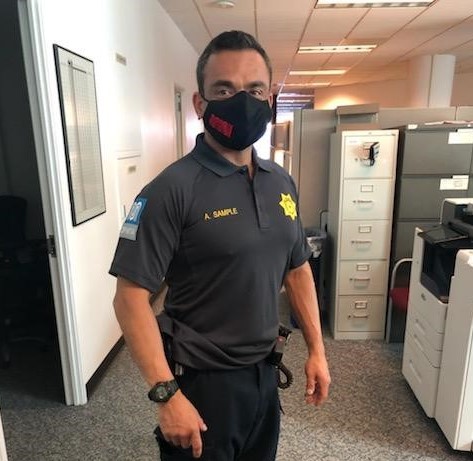
A Transit Fare Inspector models their new uniform.
Phased-in Return
This week Muni fare inspectors have joined SFMTA’s larger ambassador program to provide customer assistance throughout the system. This is the start of the phased-in process for Muni to resume fare inspection.
- The first phase includes providing Muni customers with service information, fare programs, kiosk location, physical distancing assistance and mask distribution when needed at stops and stations throughout the system.
- For the second phase, fare inspectors will return to being on Muni vehicles to continue providing customer assistance of phase one and conducting fare inspections without issuing citations. This is expected to begin in the latter part of October.
- The third and ultimate phase will see the inspectors continuing to provide the customer service assistance of phase one and with a return to full fare inspections, including issuing citations as needed later this year.
Inspectors have always been part of our incident response when direct customer service was needed, either during an emergency or a large public event, like a parade. Now, that customer service approach will be integrated into our inspectors’ daily work.
Fare inspectors will work to ensure quality customer service, a safe experience and support for our customers. In light of the COVID-19 public health emergency, inspectors will remind customers that masks are required while customers are waiting to board and to maintain physical distance.
We will be:
- Leveraging our innovative community-based Muni Transit Assistance Program as a model for our system-wide inspectors
- Reorganizing the Proof of Payment unit. The new approach will allow inspectors to:
- Support and coordinate better with each other and Muni operators
- Spend more time on vehicles
- Cover more of the city
Muni’s Proof of Payment system means that if you are onboard a vehicle or on a station platform, you are expected to have a tagged Clipper Card®, a transfer, a subway ticket or an active MuniMobile ticket – proof that you have paid your fare.
The changes we’re making to the Proof of Payment program will allow for larger reach and presence on the system. It will help us ensure that when there are inspections, they apply to all customers and that we prioritize visibility and compliance over enforcement.
Compliance Instead of Enforcement
As the Transit Fare Inspectors return, our inspectors’ priority will be helping customers comply with fare policies. They will eventually issue citations again, but the focus will be on service and compliance. The compliance model will help support our operators while helping to ensure that all our customers have financial access to Muni.
Here’s a summary of our new fare compliance approach:
- Data will inform fare inspector deployment. Inspectors will be deployed on routes with high ridership across the city—both those with few incidents of fare evasion and those with higher incidents. So, if you see Muni inspectors in the Mission, you will also see them in the Presidio. If they are on the 14 Mission, they will also be on a line like the 1 California.
- Inspectors will enter the vehicle in groups of three at the beginning of the line, or at a rest stop, and ride a segment of the line. One inspector will check on the operator while the other two will be in the passenger area for customer support and fare compliance reminders.
- Inspectors will remind customers to tag or show fare media as they enter the vehicle. This replaces the past practice of fare inspectors making an announcement, inspecting everyone onboard and removing customers that don’t have proof of payment. Inspectors will also have handouts to provide to customers about our discounted fare programs.
- We will be conducting periodic full inspections of all customers onboard a vehicle, including inspection announcements. This style of inspection will occur on a random schedule at most transfer points.
Please Tag!
Once fare inspectors are on vehicles and assisting customers to ensure compliance, you will see the same dedicated professionals in less formal uniforms. They will still ask to see proof of fare such as paper transfers, MuniMobile tickets and other types of Muni fares. They will also be looking for customers to tag their Clipper(R) cards as they board. Although you won’t get a citation for simply forgetting to tag your Clipper Card with your Muni Pass on it, tagging gives fare inspectors a less disruptive way to determine if you have paid your fare.
Perhaps even more important is the fact that tagging helps us make Muni better. We use the data from Clipper tagging to better understand the changing travel patterns in the city and the changing needs of Muni customers.
Published September 23, 2020 at 04:15AM
https://ift.tt/3kGmt2R
Comments
Post a Comment