By Benjamin Barnett
Click Here to Access the Virtual Open House
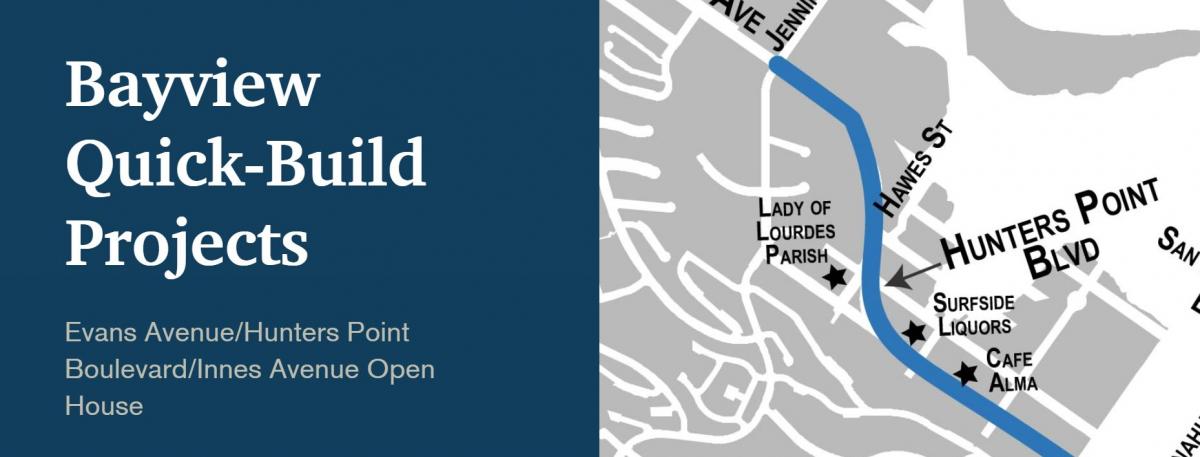
The SFMTA will be holding a Virtual Open House on the Bayview Hunters Point Quick-Build Project for Evans Avenue, Hunters Point Boulevard, and Innes Avenue. This project is an effort to improve pedestrian and cyclist visibility while reducing opportunities for reckless driving by implementing cost-effective and temporary design treatments that can be installed quickly. At the event you can learn more about the proposed changes, ask questions or make official public comments.
Virtual Open House Details
Join us online starting September 7- September 21. The interactive, online event can be accessed at any time during the two-week period. Like the SFMTA’s in-person project open houses, when you access the event you will be able to learn more about the project such as the schedule, project background, and other aspects through virtual informational boards. Community members will then have an opportunity to see the proposed design, ask questions via email, leave public comments about the project and provide feedback through our survey. Project staff will respond to questions and comments received and the responses will be posted back to the Virtual Open House web page in a couple of days. Office hours for community members to speak directly with the project team regarding concernswill also be held.
Proposed Quick-build Improvements
- Reducing travel lanes and installing edge lines to calm traffic, address excessive roadway capacity and to define roadway space for parking, walking, and biking
- Installing crosswalks, painted pedestrian median islands, and painted safety zones to increase visibility, safety and comfort for pedestrians
- Potential for extended pedestrian walkway and protected bicycle lanes to provide a buffer between vehicles and increase safety for non-motorized travel (walking, biking, etc.)
Project Background
The Bayview District is one of San Francisco's most diverse and distinct areas, with a rich history as a traditionally African American neighborhood. As the City moves forward, the Bayview continues to grow as well, but the streets have not changed with it to meet the community's evolving needs. Several residents, businesses, and community-based organizations have reached out calling for comprehensive changes to the streets that can support the community's transportation needs and priorities. Some of the most frequent issues raised include aggressive speeding, reckless driving, and unsafe behavior that place undue stress on the streets.
Bayview Quick-Build Transportation Projects seek to improve traffic safety for all roadway users. Recognizing the immediate need for transportation improvements in Bayview Hunters Point, locations for near term improvements were identified during the planning phase of the Bayview Community Based Transportation Plan (CBTP).
Language Assistance:
For free interpretation services, please submit your request 48 hours in advance of meeting to 311.
Para servicios de interpretación gratuitos, por favor haga su petición 48 horas antes de la reunión a 311.
如果需要免費口語翻譯,請於會議之前48小時提出要求 311.
Para sa libreng serbisyo sa interpretasyon, kailangan mag-request 48 oras bago ang miting 311.
Published September 04, 2020 at 10:38PM
https://ift.tt/31WAgf4
Comments
Post a Comment