By Emily Stefiuk
The SFMTA has responded to COVID-19 by working to minimize the risk of transmission and protect the health and safety of our employees and the public. Health and safety is SFMTA’s Transportation Recovery Plan’s number one priority.
To assess how we are doing, the SFMTA has been monitoring data through our Transportation Recovery Plan Dashboards. The Objective 1 dashboard compiles metrics associated with health and safety, including sanitizing vehicles and facilities, promoting physical distancing, and encouraging mask compliance. Here’s what we’re seeing:
-
As of December 6, operator reported mask-related incidents are down 92% from the peak in April.
-
Mask compliance on Muni is at an all-time high at 96% of observed passengers wearing masks.
-
We’ve upped our mask distribution – our Transit Information Program (TIP) staff distributed over 14,000 masks to customers the week of November 16.
-
To date, no COVID-19 positive cases have been traced to riding Muni.
These findings are even more important as the city and the region have been experiencing a surge in COVID-19 cases after the Thanksgiving holiday. While there is an alarming surge in cases, it's important to recognize that our science-based best practices paired with the public's embrace of critical interventions like wearing a face masks or face coverings allows us to keep our system running for those who need us during this unprecedent time. Additionally, we are maintaining a safe and healthy system so that when increased activity is permitted once again, Muni will be ready for you.
These numbers reflect efforts that have been underway since the beginning of the pandemic to protect operator and customer health and safety. Since March, SFMTA has implemented mitigation measures that limit the possibility of exposure to, and transmission of, COVID-19. To encourage customers to practice good public health behavior throughout their journey, we launched our Ambassador Program in April and expanded it as the TIP program in September. TIP staff provide information to customers on best practices and alternatives to Muni like our recently-launched Essential Trip Card discount taxi program. TIP staff also provide the public with information about COVID-19 Muni Core Service, help manage crowding and distribute masks to customers that may have forgotten theirs.
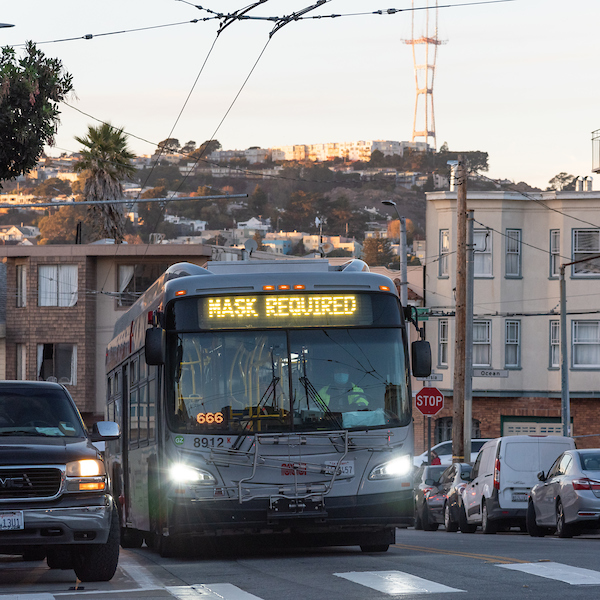
Other measures Muni has implemented include audio announcements and head signs on buses to remind customers that masks are required when riding Muni. We have also continued the sanitization practices we implemented at the onset of the pandemic. Vehicles return to our operating divisions at the end of each run, so each operator starts their shift with a sanitized vehicle.
The metrics show that these measures and added precautions to ensure the health and safety of our employees and the public are paying off. As the pandemic continues, the SFMTA is committed to using data to inform our COVID response, service delivery, and budget decisions.
Customer Reminders
Remember, we still need your help. Help reduce the risk of COVID-19 transmission by:
-
Staying home, except for essential trips.
-
Shopping locally and supporting your neighborhood businesses.
-
Wearing a face mask or face covering over your mouth and nose and maintaining physical distance such as leaving a seat open between you and anyone who is not in your household.
-
Use alternate transportation whenever possible – walk, bike or take a taxi – to save a seat on Muni for those who don’t have other options.
If you do need to travel on Muni:
-
Please respect your Muni operator. They are working hard for you.
-
Face coverings are required on Muni. To avoid getting passed up, cover your nose and mouth with face cover or mask while you are waiting for Muni and on Muni.
-
Board by the back door unless you require assistance.
-
Give yourself extra time just in case. Your fare is good for two hours across multiple routes.
Published December 19, 2020 at 06:30AM
https://ift.tt/2WAatFX
Comments
Post a Comment