By Erin McMillan
The SFMTA Board of Directors approved the temporary emergency transit lanes project for the 4th Street Bridge (4th Street between Berry and Channel Streets) on Tuesday, January 5, to support improved transit service on Muni’s T Third. Along with other proposed and planned key locations across the city, the SFMTA plans to install a temporary emergency transit lane on the 4th Street Bridge addressing a key bottleneck that delays the T Third line with work scheduled to begin as early as today, Monday, January 11.
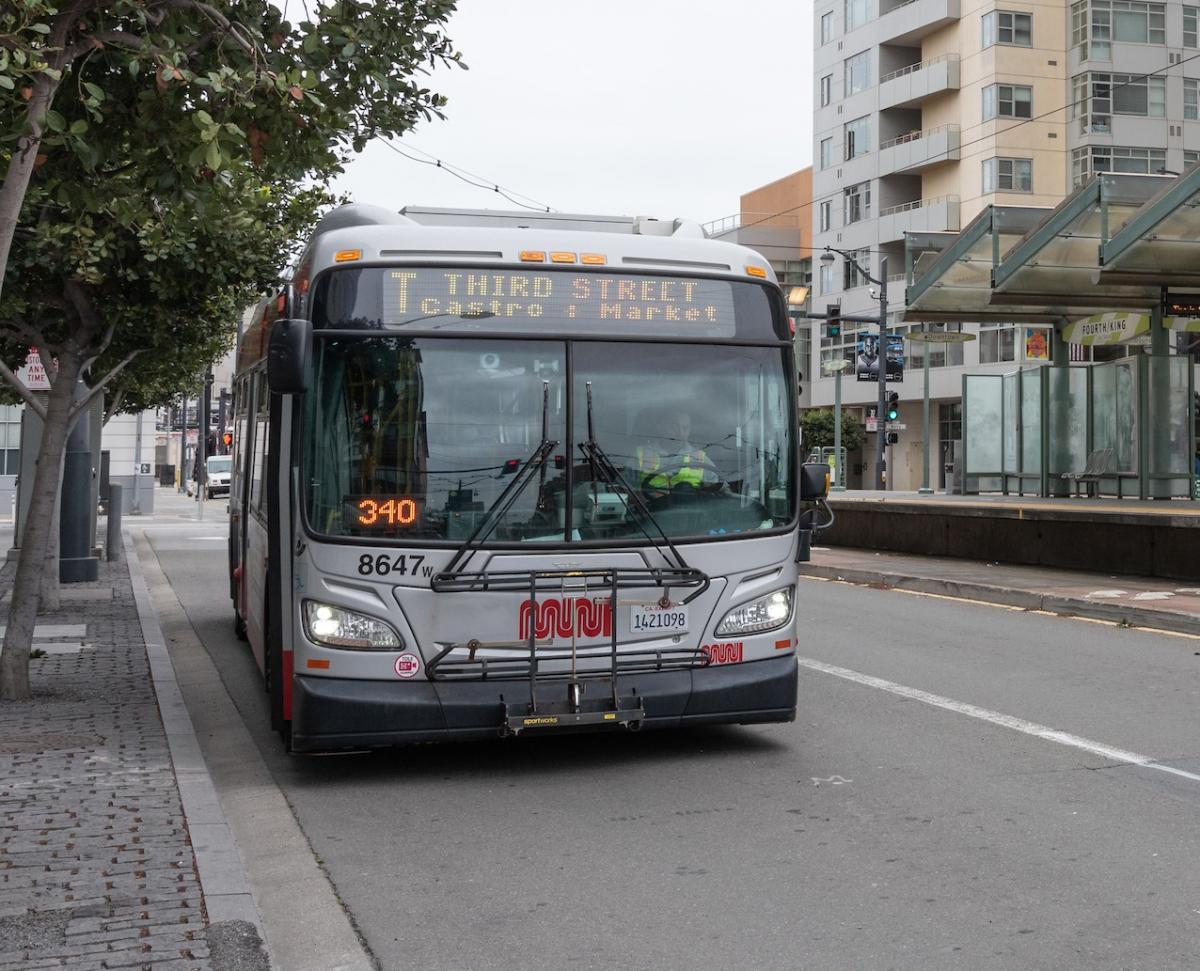
Installing the dedicated transit lane will allow the T Third trains to move more quickly over the bridge without getting stuck in traffic as the SFMTA prepares for the return of T Third light rail service later this month. Pre-COVID, the combined KT line carried over 42,000 customers daily. Additionally, this will help Muni provide more frequent T Third service and increase physically-distanced capacity with the same number of vehicles. Currently, there are one northbound and two southbound lanes on the 4th Street Bridge. Muni tracks share the lanes with traffic, meaning the T Third often gets stuck in congestion, contributing to delays and bunching throughout the entire line.
The SFMTA Board of Directors approved temporary emergency transit lanes on the 4th Street Bridge in both the northbound and southbound directions. In response to community input, southbound left turns from 4th Street onto Berry Street will continue to be allowed, and there will be a phased approach to implementation of the northbound transit lane depending on site conditions.
At first, northbound left turns will be restricted from 4th Street onto Berry Street. The left turn pocket at that location will be converted to a transit lane, and northbound traffic will continue to be allowed on the 4th Street Bridge. If northbound traffic still causes delays to the T Third despite these initial changes, a northbound temporary transit lane will be installed between Berry and Channel Streets. With this change, turn restrictions would be implemented at 4th and Channel to prevent vehicles from entering the northbound transit lane, and northbound traffic would be prohibited on the 4th Street Bridge. A summary of this phased approach is provided below.
Phase 1: To be implemented as early as the week of January 11 with evaluation of the changes at least 3-4 weeks after T Third begins service:
- Southbound transit lane will be installed in one of the two southbound lanes on the 4th Street Bridge
- Northbound left turns will be prohibited from 4th Street onto Berry Street
- The left turn pocket in the northbound direction at 4th onto Berry Street will be converted to a transit lane
Phase 2: If the evaluation of Phase 1 shows that auto traffic still causes transit delay on the 4th Street Bridge, despite the Phase 1 improvements, additional changes to be implemented:
- Northbound transit lane will be installed in the sole northbound lane on the 4th Street Bridge
- Northbound traffic will not be permitted on the 4th Street Bridge, making the bridge one-way southbound for general traffic
- Heading east on Channel, no left turn onto the 4th Street Bridge
- Heading west on Channel, no right turn onto the 4th Street Bridge
- Heading north on 4th Street at Channel, no through traffic onto the 4th Street Bridge (right or left turn required)
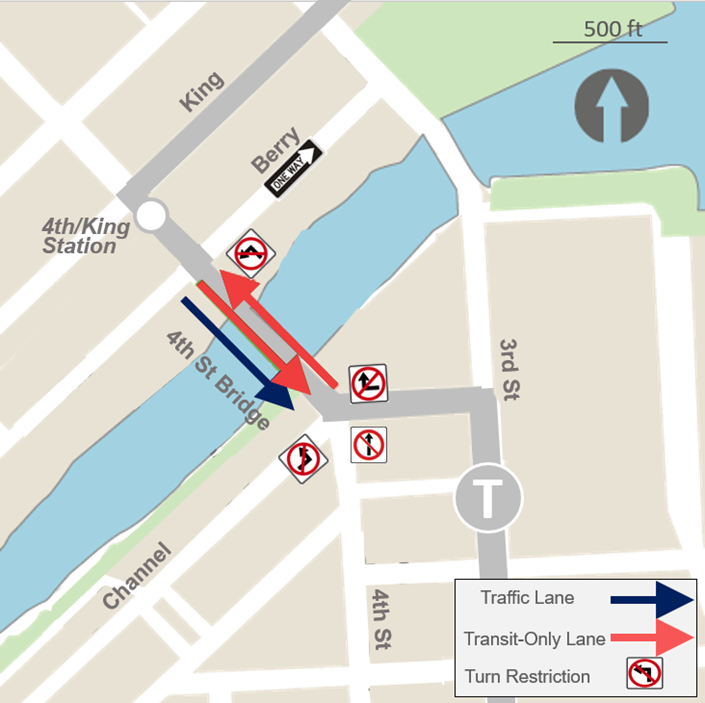
Map shows Phase 2 of the project which will be implemented if an evaluation shows that northbound traffic continues to delay transit service.
Evaluation of the phased approach
Once Phase 1 has been installed and the T Third resumes rail service, evaluation will include monitoring existing traffic cameras in the area to see if traffic blocks the northbound lane on the 4th Street Bridge more than 5% of the time. In addition to monitoring traffic, we will also monitor train travel times using location data from equipment that is onboard some of the trains to identify the times of day when trains experience the longest travel times on the 4th Street Bridge so that these causes of delay can be further investigated and addressed.
After the initial evaluation of this phased approach and the temporary project is fully in place, an additional evaluation of the full project will take place including a community survey and a technical evaluation of the effectiveness of the temporary transit lanes on the 4th Street Bridge.
Community requests for changes on nearby streets
Engineering staff are still working to determine the design feasibility of community members’ suggestions to allow left turns out of the One Mission Bay garage, conversion of Berry Street between 4th and 3rd to two-way or one-way in the opposite direction, and a dedicated right turn lane at Mission Bay Drive and Berry Street.
For additional information on this project, and to sign up for updates, check out the project webpage at SFMTA.com/TempLanesTThird.
Published January 12, 2021 at 03:17AM
https://ift.tt/3sarwNH
Comments
Post a Comment