
San Francisco Launches Safety - It’s Your Turn Campaign

San Francisco Launches Safety - It’s Your Turn Campaign
By Christine Osorio

In San Francisco, left turns are one of the top three crash factors in severe injuries and fatal collisions for people walking and biking. SFMTA is kicking off the new year with a city-wide education campaign designed to encourage safer driving behavior around left turns. The Safety - It’s Your Turn campaign will use multiple strategies, including grants to community organizations, to engage the public at different times and raise awareness about unsafe left turns.

Drivers especially will see the Safety - It’s Your Turn messaging on billboards and buses, hear about it on the radio, and read about it on social media and in newspapers. This community education program also accompanies the SFMTA’s Left-Turn Traffic Calming Project.  Under that project, launched in October 2020, the SFMTA installed safety infrastructure at 7 intersections on the High Injury Network.
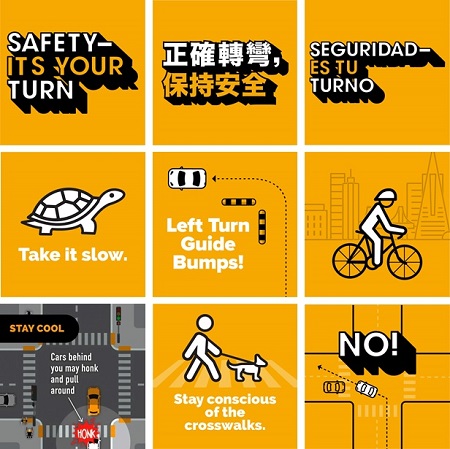
nine posters with these messages: "safety it's your turn" in english, chinese and spanish, "take it slow" with an image of a turtle, "left turn guide bumps" with an image of a car turning left by guide bumps, an image of a cyclist wearing a helmet, "stay cool" because "cars behind you may honk and pull around", an image of a human walking a dog with the message "stay conscious of the sidewalks", and an image of a car turning left encroaching the wrong lane with the message "no"

Community Grant Awardees

After a competitive application process, the SFMTA has awarded six grants to community organizations around the city to amplify the Safety It’s Your Turn campaign.  Community organizations are closer to the communities they serve and are better positioned to develop culturally-responsive outreach programs and materials. In addition to sharing safe left-turn messaging, another objective of the grant is to reach communities historically underserved by transportation projects. For many of the organizations, this is their first-time developing Vision Zero messaging, and the SFMTA is pleased to be expanding its engagement with community stakeholders and leaders. The selected grantees include:

These community groups plan to share safe left-turn messaging directly to food-delivery drivers, hard-to-reach communities along the High Injury Network, teen drivers, and vulnerable road-users. Examples of the deliverables include map booklets for the visually impaired, teen driver safety kits, and art-inspired public service announcements.

Remember that 40% of traffic fatalities in San Francisco involve drivers making left turns. Drivers can make a safe left turn by yielding to pedestrians and bicyclists, taking it slow at less than 5 mph, and making their turn nice and wide.
Image with the caption "anatomy of a left turn" with a link to video

Watch: Anatomy of a Left Turn

Vision Zero

San Francisco adopted Vision Zero (www.visionzerosf.org)as a policy in 2014, committing to build better and safer streets, educate the public on traffic safety, enforce traffic laws, and adopt policy changes that save lives. The result of this collaborative, citywide effort is safer, more livable streets as San Francisco works towards the Vision Zero goal of zero traffic fatalities. San Francisco is engineering inherently safer streets, enforcing traffic laws more effectively, and targeting traffic-safety education to reach its Vision Zero goals.


Published January 21, 2021 at 10:00PM
https://ift.tt/3c1gvbY

Comments

Popular posts from this blog

150 Years Ago Today – The Cable Car is Born

150 Years Ago Today – The Cable Car is Born By Kelley Trahan August 2, 2023, marks the 150th anniversary of the world’s first successful cable railway, born right here in San Francisco. To celebrate the occasion, we bring you the story of Andrew Hallidie and the very first cable car company, the Clay Street Hill Railroad.  Andrew Hallidie (1834-1900) was a pioneering inventor and entrepreneur who changed urban transportation. In 1852, at the age of 18, Hallidie emigrated with his father from the United Kingdom to San Francisco during the California Gold Rush. His father, an engineer and inventor, had a wire rope patent that played a crucial role in his son's future success.   Portrait of Andrew Smith Hallidie in 1890. Inspired by his father's wire rope business, Hallidie developed a steel cable mineral mine hauling system in 1857. About a decade later, he designed a wire rope aerial tramway for transporting materials over mountainous terrain. Then, after a stint in bridg...

Shared Spaces are Here to Stay. Permit Renewals are Due January 15, 2023.

Shared Spaces are Here to Stay. Permit Renewals are Due January 15, 2023. By Anne Yalon Shared Spaces, amongst many other benefits, allows our residents and families to enjoy safe and social outdoor dining. Seen here are the the owners of Tio Chilo’s Grill and their children in the restaurant’s parklet on 24th Street in the Mission.  San Francisco’s popular Shared Spaces program allows merchants, restaurants and arts and culture organizations to use the curbside, sidewalk and other public spaces to conduct local business activities and stay afloat. What emerged as an economic lifeline during the pandemic is making San Francisco’s streets more energized, engaged and activated. Many of the Shared Spaces parklets have become central gathering places for the local community. “ Our parklet makes me feel like when I go to Mexico, where outdoor seating is everywhere. People end up joining their friends in our parklet. It is a space for our customers and our community," said Liz V...

Tenderloin Streets Transform During COVID-19

Tenderloin Streets Transform During COVID-19 By Kimberly Leung COVID-19 has disproportionately impacted people who live and work in the Tenderloin. As a result, the SFMTA has been working closely with District 6 Supervisor Matt Haney’s office, other city departments, the Tenderloin Traffic Safety Task Force and community members to address the public health issues and unique challenges in the neighborhood through innovative interventions.    The Tenderloin is home to many of our most vulnerable communities including historically marginalized groups such as people with disabilities, residents of SROs and supportive housing and limited-English proficient communities. With every single street in the Tenderloin on the city’s High Injury Network -- the 13 percent of San Francisco streets that account for 75 percent of severe traffic injury collision and fatalities -- thi...