
Speed and Turn Limits to Boost Safety on Tenderloin Streets

Speed and Turn Limits to Boost Safety on Tenderloin Streets
By Benjamin Barnett

The SFMTA is undertaking two new traffic safety improvements as a part of our Tenderloin Traffic Safety project: (1) prohibiting vehicle turns on red at approximately 54 intersections and (2) reducing vehicle speed limits to 20 miles per hour on 17 corridors.
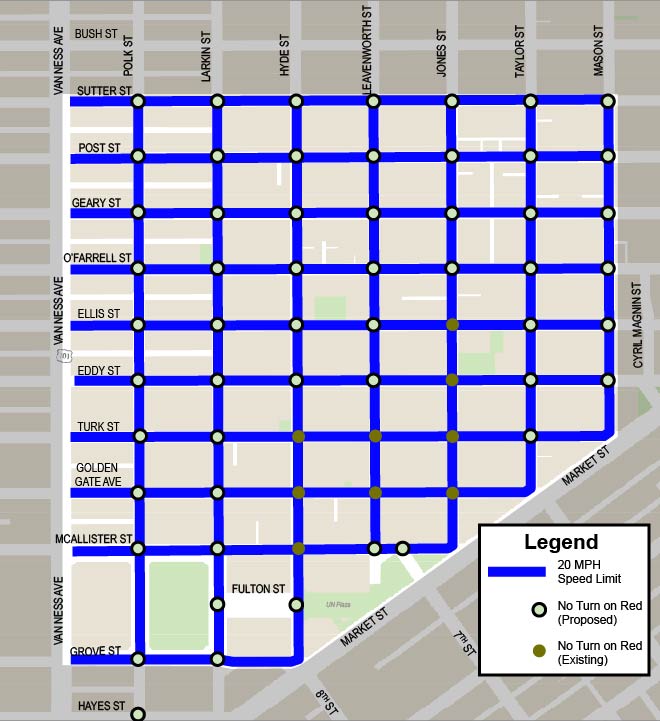
Map showing speed limit reduction to 20mph neighborhood-wide between: Grove Street (south), Sutter Street (north), Mason Street (east), and Van Ness (West). Showing no turn on red regulations neighborhood-wide inclusive of Grove Street (south), Sutter Street (north), Mason Street (east), and Polk Street (west)

(Accessible Engineering details)

Map identifying all Tenderloin corridors and intersections where 20 mph speed limits and No Turn on Red will be implemented.

The Tenderloin is home to many of our most vulnerable communities including historically marginalized groups such as people with disabilities, communities with limited-English proficiency and those living in single-room occupancy hotels (SROs) and supportive housing. At the same time, every single street in the Tenderloin is a part of the city’s High Injury Network -- the 13 percent of San Francisco streets that account for 75 percent of severe traffic injury collision and fatalities. The gravity of the situation in the Tenderloin means we cannot delay taking actions that will improve safety for everyone in this critical neighborhood.

No Turn On Red
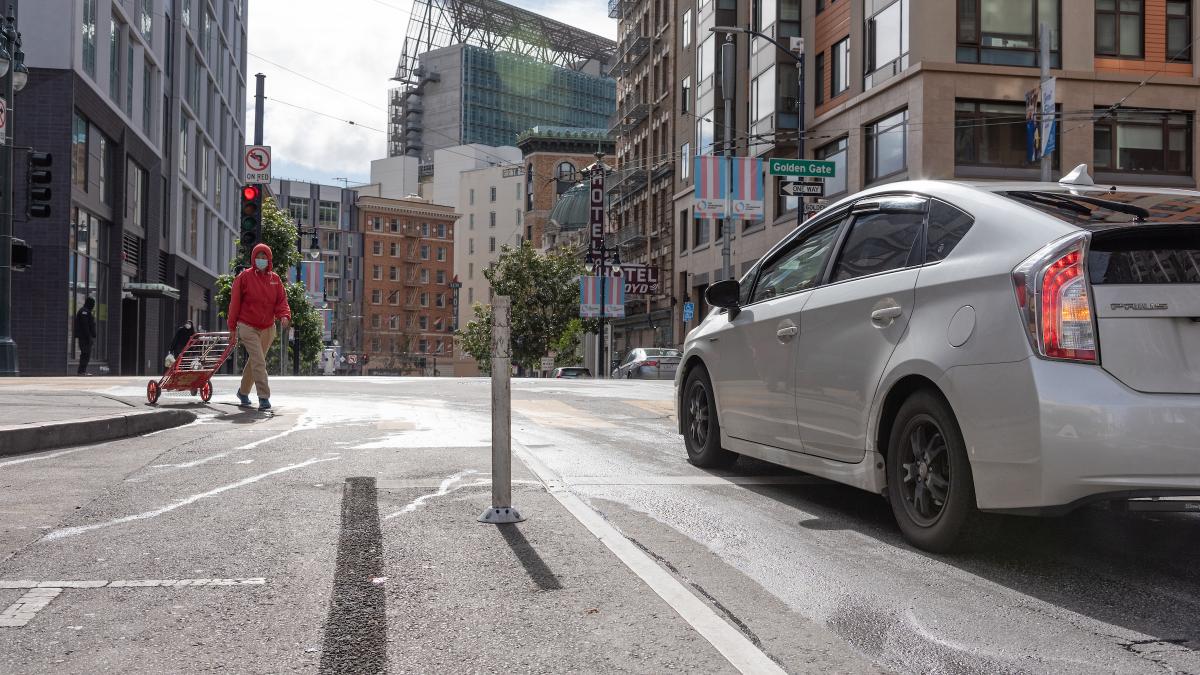
Photo of no turn on red sign at intersection of Golden Gate and Jones

Prohibiting turns while facing a red traffic signal is a proven method for reducing intersection conflicts. This includes both right turns and legal left turns from one one-way street to another. We will be piloting this new program at approximately 54 intersections in the Tenderloin. The program doesn’t include intersections that already have an existing turn prohibition, pedestrian scramble or are not signalized.

Turning on red may be the norm in many driving situations, but should not be on bustling Tenderloin streets. In a study conducted by Department of Public Health and SFMTA of crashes at signalized intersections, turns on red accounted for nearly 20% of turn-related crashes. These were largely clustered in the Tenderloin.

Heavy vehicular traffic in the Tenderloin provides little opportunity for drivers to safely make the turn on red, which leads to vehicles blocking crosswalks while drivers look left trying to find a gap in oncoming traffic. Drivers quickly executing their turn may fail to see a pedestrian legally crossing from the right which can result in an injury collision.

The legislative process for the No Turn on Red program will start in early 2021, with an expected Spring 2021 rollout. No Turn on Red signs will be posted on signal mast arms and poles notifying motorists of the prohibition.

20 mph Speed Limits

Another innovative approach we are taking to make the Tenderloin a safer place for pedestrians is lowering the speed limit from 25 mph to 20 mph. We will put this limit into effect on every corridor in the neighborhood. Vehicle speed is the number one predictor of crash severity. A pedestrian struck at 20 mph versus 25 mph has double the chance of survival. Lowering speed limits to better reflect conditions in the Tenderloin will provide tangible safety benefits in advance of any future engineering changes that can be made. For example, a recent study from Seattle, Washington demonstrated that posting new, lower limits led to reductions in speeds and collisions, even in the absence of streetscape or enforcement changes.

Learn More

For more details, please visit our project page, where you can also read about the community partners who were vital in planning these improvements.


Published February 10, 2021 at 10:14PM
https://ift.tt/3qleMlK

Comments

Popular posts from this blog

150 Years Ago Today – The Cable Car is Born

150 Years Ago Today – The Cable Car is Born By Kelley Trahan August 2, 2023, marks the 150th anniversary of the world’s first successful cable railway, born right here in San Francisco. To celebrate the occasion, we bring you the story of Andrew Hallidie and the very first cable car company, the Clay Street Hill Railroad.  Andrew Hallidie (1834-1900) was a pioneering inventor and entrepreneur who changed urban transportation. In 1852, at the age of 18, Hallidie emigrated with his father from the United Kingdom to San Francisco during the California Gold Rush. His father, an engineer and inventor, had a wire rope patent that played a crucial role in his son's future success.   Portrait of Andrew Smith Hallidie in 1890. Inspired by his father's wire rope business, Hallidie developed a steel cable mineral mine hauling system in 1857. About a decade later, he designed a wire rope aerial tramway for transporting materials over mountainous terrain. Then, after a stint in bridg...

Shared Spaces are Here to Stay. Permit Renewals are Due January 15, 2023.

Shared Spaces are Here to Stay. Permit Renewals are Due January 15, 2023. By Anne Yalon Shared Spaces, amongst many other benefits, allows our residents and families to enjoy safe and social outdoor dining. Seen here are the the owners of Tio Chilo’s Grill and their children in the restaurant’s parklet on 24th Street in the Mission.  San Francisco’s popular Shared Spaces program allows merchants, restaurants and arts and culture organizations to use the curbside, sidewalk and other public spaces to conduct local business activities and stay afloat. What emerged as an economic lifeline during the pandemic is making San Francisco’s streets more energized, engaged and activated. Many of the Shared Spaces parklets have become central gathering places for the local community. “ Our parklet makes me feel like when I go to Mexico, where outdoor seating is everywhere. People end up joining their friends in our parklet. It is a space for our customers and our community," said Liz V...

Tenderloin Streets Transform During COVID-19

Tenderloin Streets Transform During COVID-19 By Kimberly Leung COVID-19 has disproportionately impacted people who live and work in the Tenderloin. As a result, the SFMTA has been working closely with District 6 Supervisor Matt Haney’s office, other city departments, the Tenderloin Traffic Safety Task Force and community members to address the public health issues and unique challenges in the neighborhood through innovative interventions.    The Tenderloin is home to many of our most vulnerable communities including historically marginalized groups such as people with disabilities, residents of SROs and supportive housing and limited-English proficient communities. With every single street in the Tenderloin on the city’s High Injury Network -- the 13 percent of San Francisco streets that account for 75 percent of severe traffic injury collision and fatalities -- thi...