
Creating a Better Market Street: Car-free Enforcement to Resume

Creating a Better Market Street: Car-free Enforcement to Resume
By Mariana Maguire

It’s been over a year since Market Street went “car-free” on January 29, 2020, but shortly afterwards, the COVID-19 pandemic shut down our city and changed how people move through San Francisco. As the city begins to reopen and vehicle traffic is increasing, we are by stepping up compliance and enforcement efforts to keep Market Street car-free starting March 29, with the help of SFMTA’s Parking Control Officers (PCOs) and the San Francisco Police Department (SFPD).

Under the year-old car-free rules established as a part of Better Market Street, no private vehicles are allowed to travel along Market Street eastbound from 10th to Main streets or westbound from Steuart Street to Van Ness Avenue. Traffic is still allowed to cross Market Street, but there are no turns allowed onto the street in the car-free area. These restrictions apply to all private vehicles, including Uber, Lyft, Postmates, DoorDash, and other services whose drivers use personal vehicles without a commercial license plate.
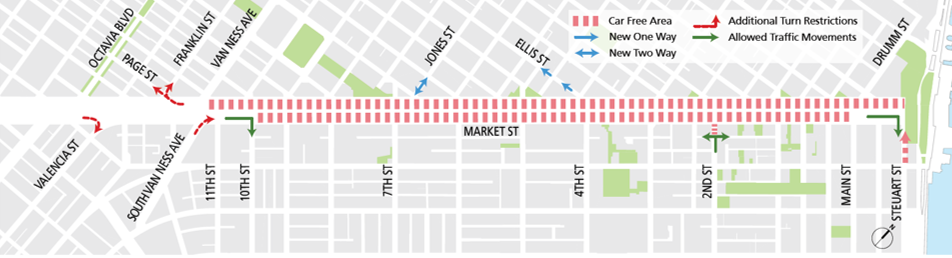
Map of Market Street showing car-free zone from Van Ness Avenue to Main Street eastbountd and from Van Ness Avenue to Steuart Street westbound. New one-way restrictions on Ellis from Market to ____, new two way traffic on Jones from Market to _____, and additional turn restrictions from Market to Valencia street, from Market to Page and Franklin Streets, from South Van Ness onto Market Street and northbound from Steuart to Market. New traffic movements will occur from 2nd Street northbound onto ___ and ____ and on Market Street to Steuart Street.

 Map: Car-free area on Market Street, implemented January 2020.

Enforcement of compliance will increase starting March 29 and will continue for about a month to help remind drivers of the restrictions. PCOs and police officers will monitor the street at various locations. PCOs will wave on vehicles attempting to turn onto Market Street within the restricted area. During the first week of the campaign the SFPD will issue warnings to drivers as we ramp up education efforts. Thereafter, they will issue citations to vehicles in violation of the car-free restrictions.

These efforts are in direct response to violations and concerns we’re heard from people that private vehicles are still driving in the car-free area. We also understand and appreciate concerns around police enforcement and we’re working hand in hand with SFPD to address those concerns.
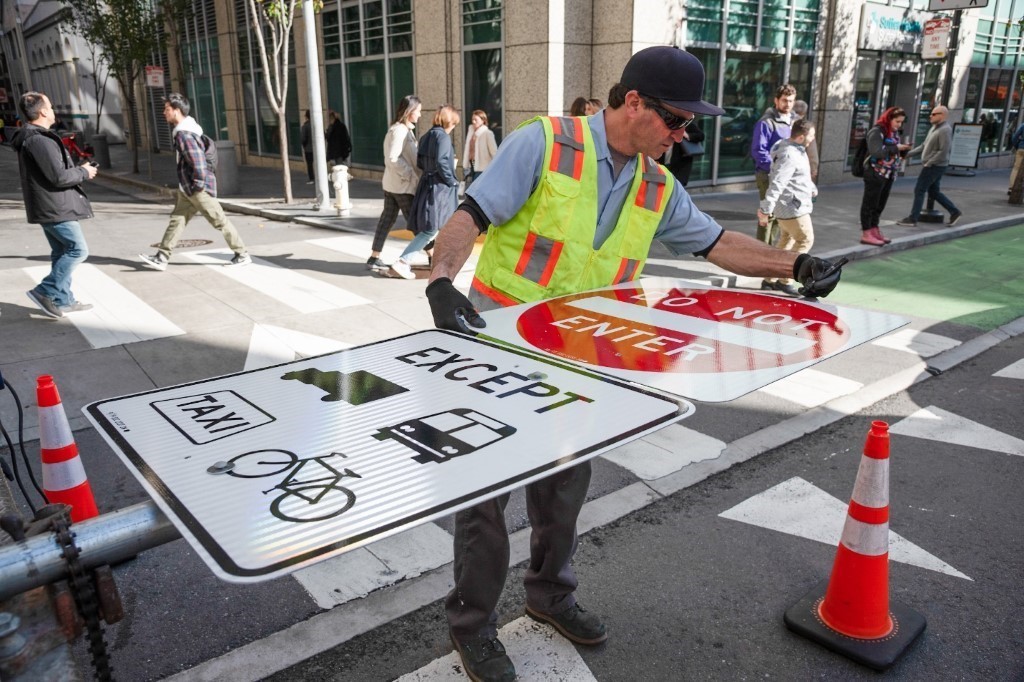
Photo of worker getting ready to put up a pole with new signs indicating that Market Street is restricted to non-private vehicles only.

Photo: Crew member installing new signage on Market Street in January 2020
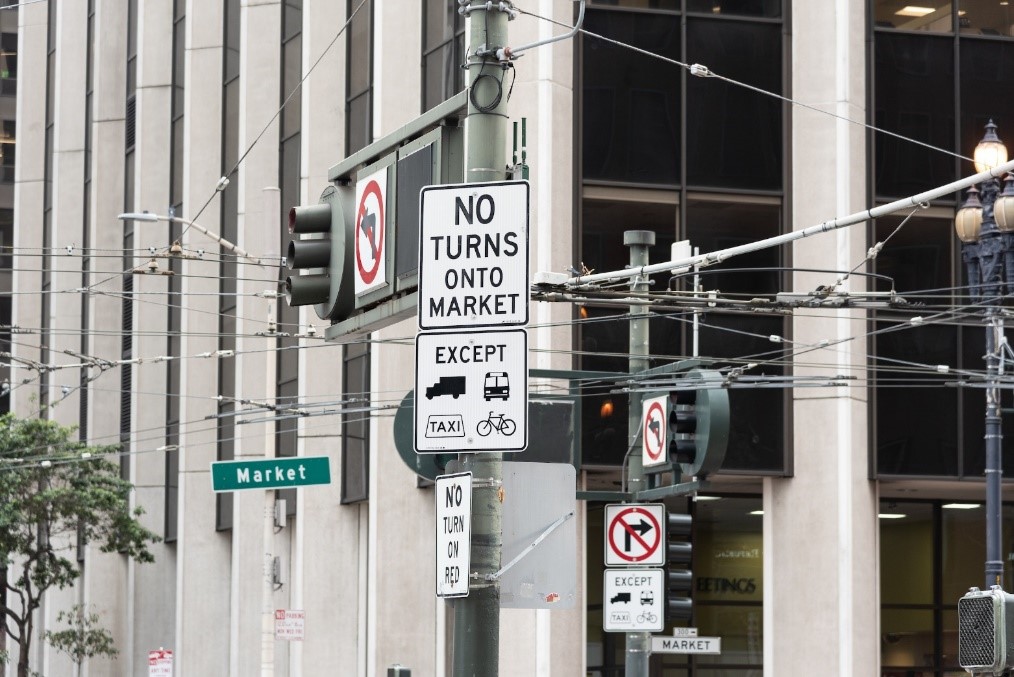
Photo of signs on Market Street indicating restrictions to private vehicles.

Photo: Car-free Market Street signs limiting private vehicles from driving on Market Street east of Van Ness Avenue.

Vehicles that are still allowed to use Market Street:

  • Muni and other transit service vehicles
  • Taxis
  • Paratransit
  • Licensed commercial vehicles
  • Emergency service vehicles
  • Bicycles
  • Scooters

Don’t get ticketed! If you’re not one of the vehicles above, don’t drive on Market Street east of Van Ness Avenue. Pay close attention to signage like those shown in the photos. If you’re using a navigation app it will route you around the car-free area.

Please help us spread the word to family, friends, neighbors and coworkers. Plan your trips accordingly. Consider alternate modes of travel if you’re going downtown. If you need to use your personal vehicle to reach destinations along Market Street, take alternate streets – they’re open!

Keep checking the COVID-19 Muni Core Service Plan website for the latest Muni service as we continue to expand and restore additional Muni rail routes which will improve transit service along Market Street.


Published March 23, 2021 at 05:08AM
https://ift.tt/3f75iIe

Comments

Popular posts from this blog

150 Years Ago Today – The Cable Car is Born

150 Years Ago Today – The Cable Car is Born By Kelley Trahan August 2, 2023, marks the 150th anniversary of the world’s first successful cable railway, born right here in San Francisco. To celebrate the occasion, we bring you the story of Andrew Hallidie and the very first cable car company, the Clay Street Hill Railroad.  Andrew Hallidie (1834-1900) was a pioneering inventor and entrepreneur who changed urban transportation. In 1852, at the age of 18, Hallidie emigrated with his father from the United Kingdom to San Francisco during the California Gold Rush. His father, an engineer and inventor, had a wire rope patent that played a crucial role in his son's future success.   Portrait of Andrew Smith Hallidie in 1890. Inspired by his father's wire rope business, Hallidie developed a steel cable mineral mine hauling system in 1857. About a decade later, he designed a wire rope aerial tramway for transporting materials over mountainous terrain. Then, after a stint in bridg...

Shared Spaces are Here to Stay. Permit Renewals are Due January 15, 2023.

Shared Spaces are Here to Stay. Permit Renewals are Due January 15, 2023. By Anne Yalon Shared Spaces, amongst many other benefits, allows our residents and families to enjoy safe and social outdoor dining. Seen here are the the owners of Tio Chilo’s Grill and their children in the restaurant’s parklet on 24th Street in the Mission.  San Francisco’s popular Shared Spaces program allows merchants, restaurants and arts and culture organizations to use the curbside, sidewalk and other public spaces to conduct local business activities and stay afloat. What emerged as an economic lifeline during the pandemic is making San Francisco’s streets more energized, engaged and activated. Many of the Shared Spaces parklets have become central gathering places for the local community. “ Our parklet makes me feel like when I go to Mexico, where outdoor seating is everywhere. People end up joining their friends in our parklet. It is a space for our customers and our community," said Liz V...

Tenderloin Streets Transform During COVID-19

Tenderloin Streets Transform During COVID-19 By Kimberly Leung COVID-19 has disproportionately impacted people who live and work in the Tenderloin. As a result, the SFMTA has been working closely with District 6 Supervisor Matt Haney’s office, other city departments, the Tenderloin Traffic Safety Task Force and community members to address the public health issues and unique challenges in the neighborhood through innovative interventions.    The Tenderloin is home to many of our most vulnerable communities including historically marginalized groups such as people with disabilities, residents of SROs and supportive housing and limited-English proficient communities. With every single street in the Tenderloin on the city’s High Injury Network -- the 13 percent of San Francisco streets that account for 75 percent of severe traffic injury collision and fatalities -- thi...