
Permanent Relief for Muni Customers in SoMa?

Permanent Relief for Muni Customers in SoMa?
By Erin McMillan

Shortly after the pandemic’s onset, the SFMTA implemented Temporary Emergency Transit Lanes to make sure essential trips on Muni wouldn’t get caught in traffic. On Mission Street from 11th to 3rd streets in SoMa, the transit lanes have proven effective at protecting Muni travel times while traffic has increased. Now, with the city’s reopening generating even more traffic, keeping these lanes on the road permanently is as important as ever.
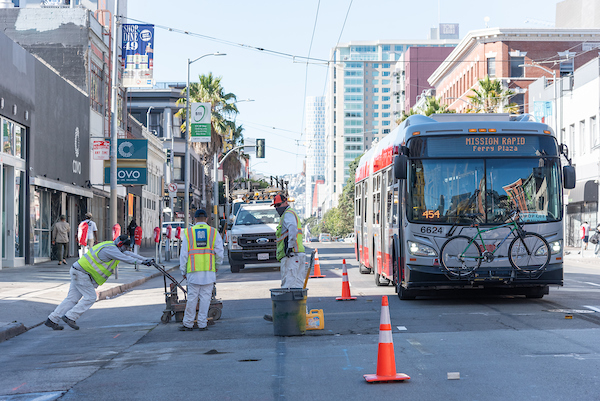
Paint Shop Crew Grinding Old Pavement Markings for Installation of Transit Only Lanes on Mission Street on September 23, 2020

Paint Shop Crew Removing Old Pavement Markings for Installation of Transit Only Lanes on Mission Street on September 23, 2020

What’s Next?

Given that the data shows the lanes are effective, the SFMTA is now pursing making the full-time transit lanes, and their benefits, permanent. Following up on our initial evaluation of the project, we are now inviting the community to learn about next steps for making the lanes permanent. We are hosting a two-week virtual open house where you can check out this information via an on-demand recorded presentation or by reviewing a PDF of the presentation at your own pace. Still have questions? Join us for virtual office hours this Thursday, April 29 from 4 to 6 p.m.

Travel on Mission Street South of Market

The SoMa segment of Mission Street from 11th to 3rd streets was the first corridor to get temporary emergency transit lanes. The project converted part-time, rush hour-only lanes into full-time lanes to help protect Muni customers from traffic congestion and a possible increased risk of exposure to COVID-19 on slower, more crowded buses. This better served the needs of the 14 Mission and 14R Mission Rapid that are busy all day, not just in the traditional peak commute hours. The corridor also serves regional transit from SamTrans and Golden Gate Transit, making these lanes important to regional as well as local travel.

Transit Lane Benefits

So far, the lanes on Mission Street have achieved their goal– keep transit moving even as traffic threatens to slow it down. Traffic has risen 20% since the summer of 2020, yet transit times are staying relatively consistent --meaning the transit lanes are effective in protecting buses from traffic. In addition to the transit data showing how effective the transit lanes are, 65% of community survey respondents said they wanted to keep the transit lanes permanently.

The project also helped simplify the street and traffic flow by widening the lanes that were previously too narrow to safely allow for buses. In addition, on some blocks parking shifted from one side of the street to the other, depending on the time of day. This new configuration is now easier and safer for all road users to navigate. Loading for businesses has also changed as part of the project, with the hours of when yellow zones are available increasing by over 40%.

For more information, visit SFMTA.com/TempLanes14, email us at TellMuni@SFMTA.com, or call (415) 646-2350.


Published April 29, 2021 at 02:44AM
https://ift.tt/3aPmhvP

Comments

Popular posts from this blog

150 Years Ago Today – The Cable Car is Born

150 Years Ago Today – The Cable Car is Born By Kelley Trahan August 2, 2023, marks the 150th anniversary of the world’s first successful cable railway, born right here in San Francisco. To celebrate the occasion, we bring you the story of Andrew Hallidie and the very first cable car company, the Clay Street Hill Railroad.  Andrew Hallidie (1834-1900) was a pioneering inventor and entrepreneur who changed urban transportation. In 1852, at the age of 18, Hallidie emigrated with his father from the United Kingdom to San Francisco during the California Gold Rush. His father, an engineer and inventor, had a wire rope patent that played a crucial role in his son's future success.   Portrait of Andrew Smith Hallidie in 1890. Inspired by his father's wire rope business, Hallidie developed a steel cable mineral mine hauling system in 1857. About a decade later, he designed a wire rope aerial tramway for transporting materials over mountainous terrain. Then, after a stint in bridg...

Shared Spaces are Here to Stay. Permit Renewals are Due January 15, 2023.

Shared Spaces are Here to Stay. Permit Renewals are Due January 15, 2023. By Anne Yalon Shared Spaces, amongst many other benefits, allows our residents and families to enjoy safe and social outdoor dining. Seen here are the the owners of Tio Chilo’s Grill and their children in the restaurant’s parklet on 24th Street in the Mission.  San Francisco’s popular Shared Spaces program allows merchants, restaurants and arts and culture organizations to use the curbside, sidewalk and other public spaces to conduct local business activities and stay afloat. What emerged as an economic lifeline during the pandemic is making San Francisco’s streets more energized, engaged and activated. Many of the Shared Spaces parklets have become central gathering places for the local community. “ Our parklet makes me feel like when I go to Mexico, where outdoor seating is everywhere. People end up joining their friends in our parklet. It is a space for our customers and our community," said Liz V...

Tenderloin Streets Transform During COVID-19

Tenderloin Streets Transform During COVID-19 By Kimberly Leung COVID-19 has disproportionately impacted people who live and work in the Tenderloin. As a result, the SFMTA has been working closely with District 6 Supervisor Matt Haney’s office, other city departments, the Tenderloin Traffic Safety Task Force and community members to address the public health issues and unique challenges in the neighborhood through innovative interventions.    The Tenderloin is home to many of our most vulnerable communities including historically marginalized groups such as people with disabilities, residents of SROs and supportive housing and limited-English proficient communities. With every single street in the Tenderloin on the city’s High Injury Network -- the 13 percent of San Francisco streets that account for 75 percent of severe traffic injury collision and fatalities -- thi...