By Amy Fowler
The verdict is in: transit lanes on Geary Boulevard are keeping riders moving apace, despite citywide trends of increasing traffic.
Muni has remained critical for San Franciscans making essential trips throughout the pandemic. The Temporary Emergency Transit Lanes program quickly installed temporary transit lanes on key routes across San Francisco to help preserve the travel time gains we saw during the early days of the pandemic. Since emergency transit lanes were installed in the Richmond neighborhood last winter, we have been able to lock in 50-75% of those travel time savings for 38 Geary customers where transit lanes were added.
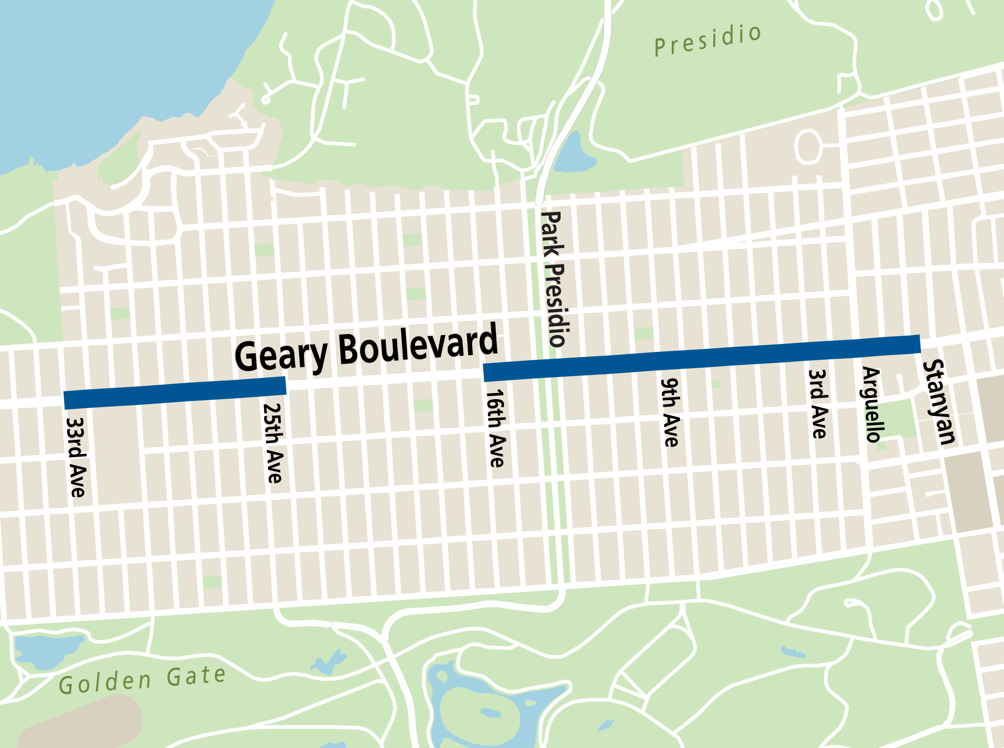
Emergency transit lanes and other transit improvements were installed along segments of Geary Boulevard between 33rd Avenue and Stanyan Street.
Geary is one of the busiest bus corridors in North America. The new transit lanes are building on the success of the Geary Rapid Project, which is making much-needed transit and safety improvements between Market and Stanyan streets and is now close to wrapping up construction --on time and on budget. Combined with the emergency transit lanes in the Richmond, 75% of the Geary corridor now has transit lanes.
The Geary corridor also features new wooden sidewalk extensions at some of the 38R Geary Rapid’s busiest bus stops. These temporary extensions allow buses to stay in the transit lane when picking up and dropping off passengers, making them more accessible and reliable.
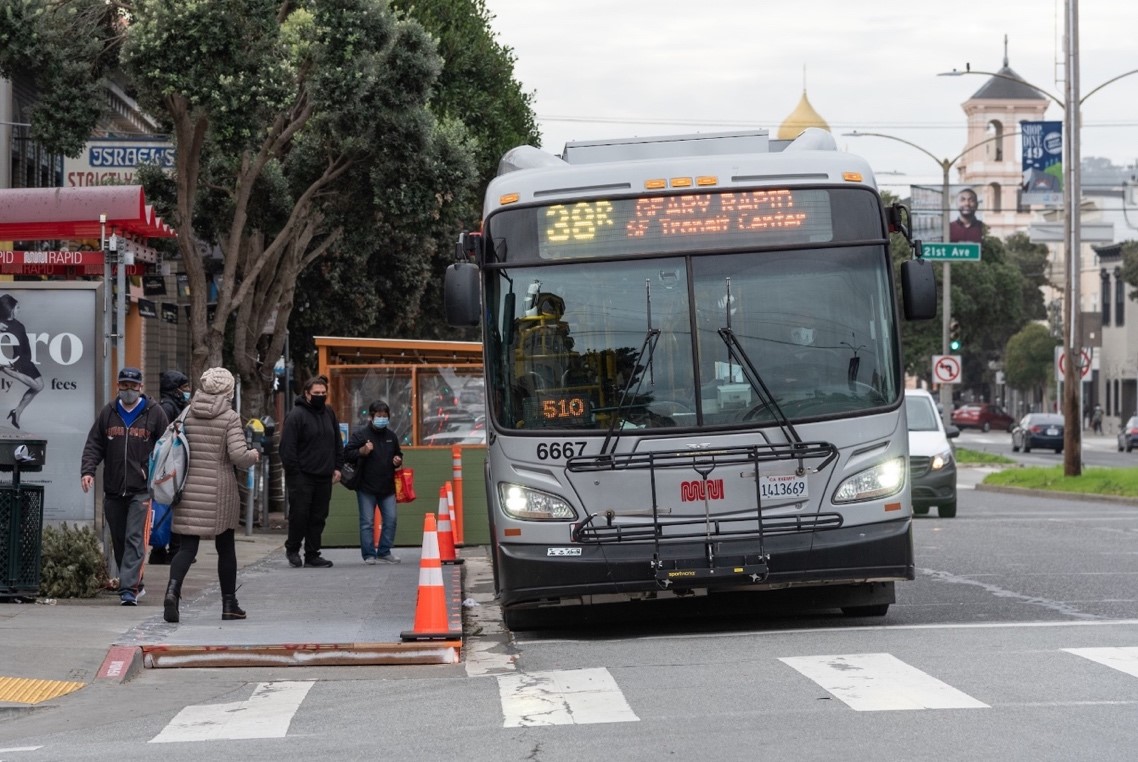
Passengers board a 38R Geary Rapid in the Richmond District with the help of a temporary wooden "bus bulb."
After the temporary emergency transit lanes were installed, they were evaluated using several criteria, including recommendations we heard from the community to ensure that the improvements aren’t creating unintended problems. Metrics we looked at included bus travel times, bus crowding and effects on vehicle traffic.
Some of the key takeaways are:
- Transit lanes have improved 38 Geary bus performance despite increasing traffic. In spring 2021, after transit lanes were installed, 38/38R Geary travel times were up to 4% quicker than in fall 2020 just before the lanes were installed, and up to 13% quicker compared with pre-COVID levels.
- Minimal traffic impacts to Geary Boulevard or parallel streets. While we did see reduced traffic speeds on Geary Boulevard between fall 2020 (before the lanes were installed) and spring 2021 (after lanes were installed), those reductions were similar to speed changes we observed on control streets 25th Avenue and Arguello Boulevard. Notably, streets parallel to Geary Boulevard experienced even smaller speed reductions, indicating that diversions to other streets have likely been minimal.
- A majority of people who took our evaluation survey support making the transit lanes permanent. 52% of the over 700 people surveyed supported maintaining the lanes; 15% were neutral or unsure; while 33% were opposed.
Considering the positive evaluation findings and support for maintaining the transit lanes, we are proposing to make them permanent. The legislation for doing so will be presented to the SFMTA Board of Directors, likely in July 2021.
Learn more about the evaluation results and next steps on the project webpage.
Project staff will also host a “Virtual Office Hours” session on Wednesday, June 30 between 4 p.m. to 6 p.m. to answer questions about the evaluation results and next steps.
Revised Geary Boulevard Improvement Project design
The Geary Boulevard Improvement Project (Phase 2 of Geary BRT) had previously envisioned transit lanes in the center of the street between Arguello Boulevard and 28th Avenue. In light of the emergency transit lane evaluation results and other factors, the SFMTA is now pursuing a revised side-running design, which could include additional transit lanes, bus stop modifications and safety improvements. Outreach to seek input on these changes is planned for later this year.
Published June 17, 2021 at 01:31AM
https://ift.tt/2S6kuMK
Comments
Post a Comment