By Tracey Lin
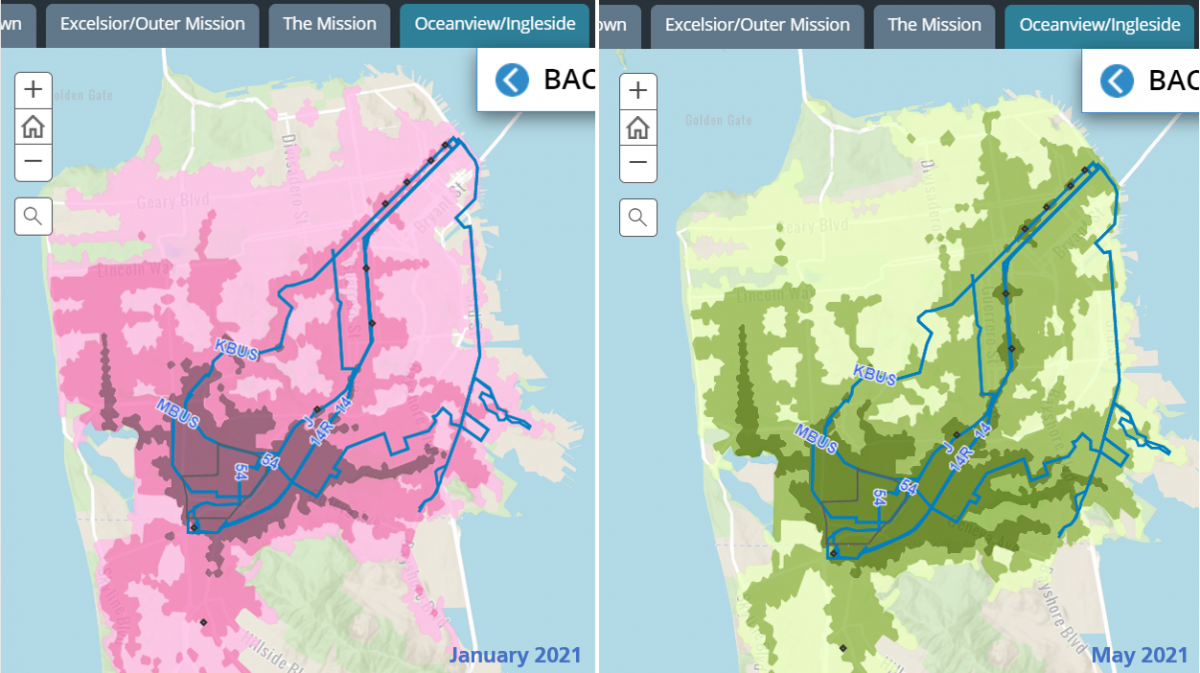
Side by side Graphics from the SFMTA Equity Toolkit showing an increase in job access from January service changes and May service changes for the Excelsior/Ocean View neighborhood.
With the implementation of Muni’s service changes May 15, 2021, and service adjustments made since by regional transit agencies, access to essential jobs via transit has gone up since January 2021, including some significant increases, in all nine neighborhoods identified in the Muni Service Equity Strategy. The Muni Service Equity Strategy focuses on improving transit performance in San Francisco neighborhoods that were selected based on the percentage of households with low incomes (below 200% of the federal poverty level), private vehicle ownership and race and ethnicity demographics.
The Muni service in effect as of May 15, 2021 is the most robust since the Shelter-in-Place order took effect in March of 2020. The reopening of all subway stations improved job access for Muni customers. And, the F Market & Wharves historic streetcar line also returned to service in May, bringing connections to Fisherman’s Wharf, a large employment center.
Over the course of the pandemic, equity neighborhoods overall performed better than more affluent areas in terms of access to jobs via transit. This was the result of deliberate SFMTA planning work to ensure that residents living in equity areas have consistent and improved access to jobs and other critical resources even with significant constraints due to the pandemic.
From January to May 2021, all service equity neighborhoods experienced increases in job access – some by small amounts and some by significant leaps. Here are a few neighborhood snapshots:
Bayview Hunters Point
|
Commute Time |
Access via Transit to Essential Jobs Compared to Pre-Pandemic Service |
||
|
Pre-COVID |
Jan 2021 |
May 2021 |
|
|
30 mins |
100% |
154% |
229% |
|
45 mins |
100% |
126% |
127% |
|
60 mins |
100% |
100% |
100% |
Increases in Bayview-Hunter’s Point to above pre-pandemic levels can be traced to the addition of the community-driven 15 Bayview-Hunters Point Express in January 2021, which connects to downtown. Also, the T Third Street Metro returned to provide rail service to Embarcadero in January. And once the T Third was interlined with the K Ingleside Metro in May, Muni access was expanded even further.
Excelsior and Outer Mission
|
Commute Time |
Access via Transit to Essential Jobs Compared to Pre-Pandemic Service |
||
|
Pre-COVID |
Jan 2021 |
May 2021 |
|
|
30 mins |
100% |
30% |
83% |
|
45 mins |
100% |
62% |
86% |
|
60 mins |
100% |
90% |
95% |
As service has increased, more connections from routes like the 14 Mission, 14R Mission Rapid and 49 Van Ness to downtown likely helped boost job access via transit. With the return of the M Ocean View Metro to Embarcadero and multiple bus routes in August 2021, we expect to see job access further increase.
Oceanview and Ingleside
|
Commute Time |
Access via Transit to Essential Jobs Compared to Pre-Pandemic Service |
||
|
Pre-COVID |
Jan 2021 |
May 2021 |
|
|
30 mins |
100% |
64% |
97% |
|
45 mins |
100% |
22% |
71% |
|
60 mins |
100% |
58% |
95% |
As mentioned above, in May, the K Ingleside and T Third lines were interlined into the KT Ingleside-Third, which allows for increased service between Balboa Park and Sunnydale.
Other neighborhoods experienced more modest, but still consistent, increases in job access. Neighborhoods like Western Addition and the Tenderloin are more centrally located near several key routes that were part of Muni’s original 17-route COVID-19 Muni Core Service Network, like the 5 Fulton, 22 Fillmore, 38 Geary and 38R Geary Rapid, as well as cross-town and connector routes that were steadily added back into service.
Western Addition
|
Commute Time |
Access via Transit to Essential Jobs Compared to Pre-Pandemic Service |
||
|
Pre-COVID |
Jan 2021 |
May 2021 |
|
|
30 mins |
100% |
94% |
94% |
|
45 mins |
100% |
94% |
96% |
|
60 mins |
100% |
94% |
95% |
Tenderloin
|
Commute Time |
Access via Transit to Essential Jobs Compared to Pre-Pandemic Service |
||
|
Pre-COVID |
Jan 2021 |
May 2021 |
|
|
30 mins |
100% |
91% |
94% |
|
45 mins |
100% |
94% |
95% |
|
60 mins |
100% |
96% |
96% |
Learn more about the SFMTA’s Equity Toolkit and explore the Toolkit in ArcGIS. We are encouraged to see how service changes have made a difference for our customers and recognize that there are still more improvements to be made to increase job access via Muni from service equity neighborhoods. Additional service changes are coming August 14, which are anticipated to further expand access to essential jobs. Stay tuned for our next analysis!
Published August 11, 2021 at 04:13AM
https://ift.tt/2VLcvpz
Comments
Post a Comment