New Law Brings Safer Speed Limits to San Francisco

New Law Brings Safer Speed Limits to San Francisco
By Eillie Anzilotti

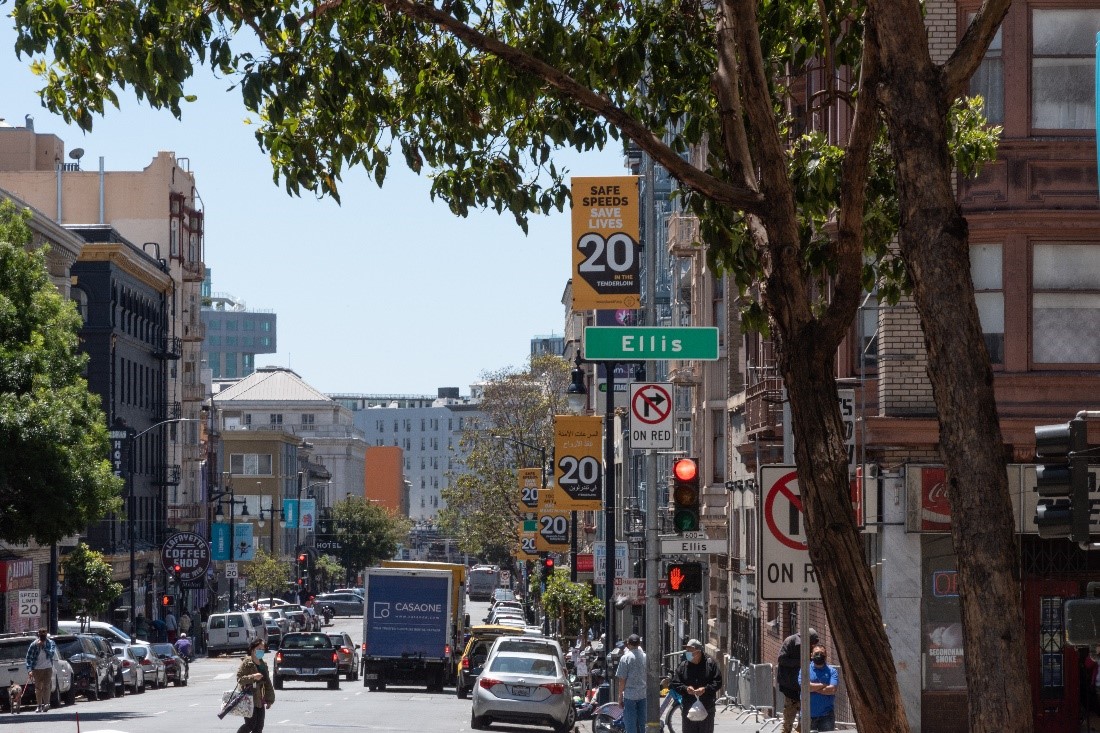
Photo of Ellis Street showing 20 mph speed limit

With the passage of California Assembly Bill 43 (Friedman)—which allows local jurisdictions to reduce speed limits in key areas—San Francisco is poised to make major progress toward our goal of achieving Vision Zero – eliminating traffic-related fatalities.

Because speed is the leading cause of serious and fatal crashes in San Francisco, reducing speeds is the single most effective tool for achieving Vision Zero. Before AB43, cities across California—including San Francisco—were limited in their ability to adjust local speed limits. Even slowing traffic down by 5 mph can make a difference of whether or not someone survives a crash, and AB43 will enable SFMTA to set speeds that promote safer streets for all along key corridors.
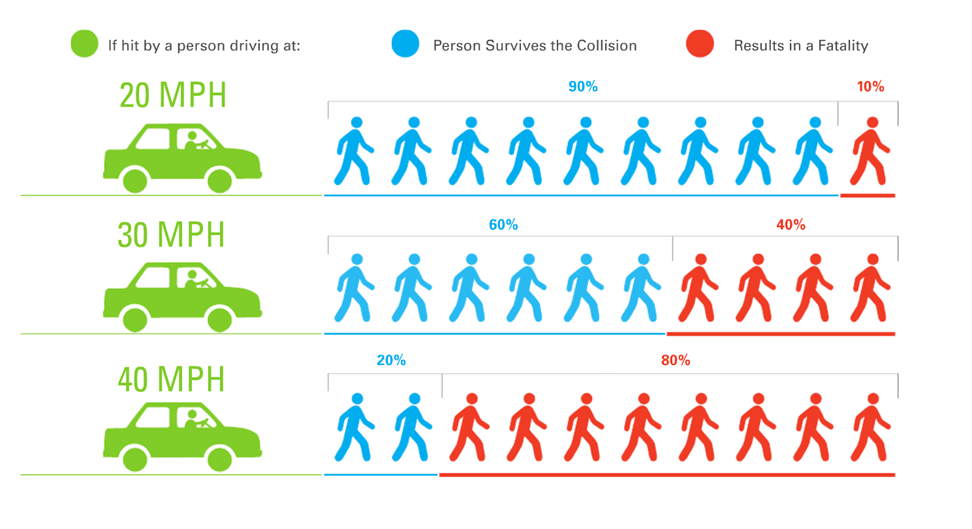
Image shows that if a person is struck by a vehicle driving 20 mph, there is a 90 percent chance that the person survives the collision, and a 10 percent chance that it results in a fatality. If a person is struck by a vehicle driving 30 mph, there is a 60 percent chance that they survive, and a 40 percent chance that the collision results in a fatality. If a person is struck by a vehicle driving 40 mph, there is a 20 percent chance that they survive, and an 80 percent chance that the collision results in a fatality.

The SFMTA will implement the changes authorized through AB43 in two phases. First, under the provision that goes into effect in January 2022, the SFMTA will move to lower speed limits by 5 mph (from 25 mph to 20 mph, or 30 mph to 25 mph) in key business activity districts (streets where at least half of the property uses are dining or retail).

We have mapped out key corridors where these speed reductions will come into effect next year—including Haight, Polk, and Valencia streets—as well as other areas for future consideration. These speed limit changes still require SFMTA Board approval, and staff will be bringing them a proposal with an implementation plan for the first seven corridors in December. These first seven corridors for speed limit reductions from 25 to 20 mph include:

  • 24th Street, from Diamond to Chattanooga streets and from Valencia to San Bruno Avenue;
  • Fillmore Street, from Chestnut to Union streets and from Jackson to McAllister streets;
  • Haight Street, from Stanyan Street to Central Avenue and from Webster to Steiner streets;
  • Polk Street, from Filbert to Sutter streets;
  • Ocean Avenue, from Geneva Avenue to Victoria Street and from Junipero Serra Boulevard to 19th Avenue;
  • San Bruno Avenue, from Silver to Paul avenues; and
  • Valencia Street, from Cesar Chavez to Market streets

We plan to accompany the rollout of the new speed limits along the streets with public education and outreach campaign on the importance of slow speeds for saving lives. We will return to the SFMTA Board in 2022 with additional proposed speed limit reductions that are eligible as business activity districts.
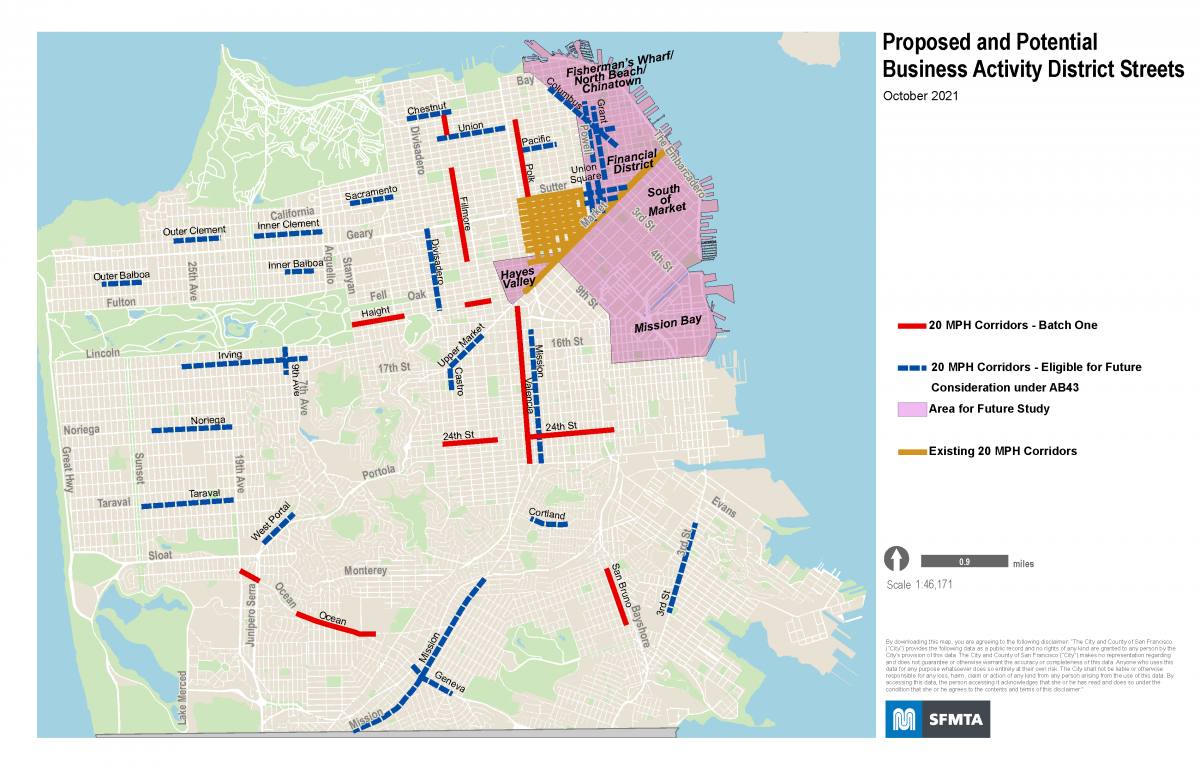
Map of proposed and potential business activity district streets. 20 MPH corridors identified as Batch One include stretches of Fillmore, Haight, 24th, Polk and Valencia streets, Sn Bruno Avenue, Ocean Avenue. 20 MPH corridors identified as "eligible for future consideration under AB43" include sections of inner and outer Clement, inner and outer Balboa, Chestnut, Union, Pacific, Columbus, Grant, Powell, Geary, O'Farrell, Divisadero, 9th Avenue, Upper Market, inner Mission, Irving, Noriega, Taraval, West Portal, outer Mission, Cortland, Geneva and Third Street. Neighborhoods marked on the map as "Area for Future Study" include Fisherman's Wharf/North Beach/Chinatown, Financial District, South of Market, Hayes Valley, and Mission Bay. Areas on the map marked as "Existing 20 MPH corridors" include Market Street, and all streets in the Tenderloin bounded west by Van Ness Avenue, north by Sutter Street, East by Mason, and south by Market Street.

The second phase will be implementing another portion of the bill that authorizes the city to lower speeds by 5 mph on streets that are designated as “safety corridors”—streets that have the highest number of serious injuries and fatalities. In San Francisco, 75% of serious and fatal collisions occur on just 13% of city streets.  This is especially important for advancing equity in San Francisco, as over half of corridors on the High Injury Network are in a Community of Concern. This particular aspect of the bill does not come into effect until June 2024, though, and requires the California Department of Transportation (Caltrans) to establish definitions of “safety corridors” through its roadway standards manual.

We have already implemented 20 mph limits throughout the Tenderloin, where every street is on the High Injury Network, and will continue to prioritize improvements in Communities of Concern.

In our upcoming 2021 Vision Zero Action Strategy, the SFMTA is committing San Francisco to a comprehensive approach to lowering speeds on key corridors across the city. We will continue to pair speed limit reductions with our existing strategies, like the Vision Zero Quick-Build Program, to slow speeds on our streets.

We appreciate the leadership of Assembly Transportation Committee Chair Laura Friedman, along with San Francisco co-sponsors Assemblymember David Chiu and Assemblymember Phil Ting in introducing this transformative legislation.  Their leadership along with Mayor Breed, the Board of Supervisors,  WalkSFSF Bike Coalition, and San Francisco Bay Area Families for Safe Streets and all the many citizens who wrote letters, called into hearings and tweeted their support for this important step to address speeding on our streets, were essential to its success.  We stand committed to safer streets in SF and will work urgently to reduce speed limits to save lives.


Published October 29, 2021 at 04:03AM
https://ift.tt/2ZEDB4b

Comments

Popular posts from this blog

150 Years Ago Today – The Cable Car is Born

150 Years Ago Today – The Cable Car is Born By Kelley Trahan August 2, 2023, marks the 150th anniversary of the world’s first successful cable railway, born right here in San Francisco. To celebrate the occasion, we bring you the story of Andrew Hallidie and the very first cable car company, the Clay Street Hill Railroad.  Andrew Hallidie (1834-1900) was a pioneering inventor and entrepreneur who changed urban transportation. In 1852, at the age of 18, Hallidie emigrated with his father from the United Kingdom to San Francisco during the California Gold Rush. His father, an engineer and inventor, had a wire rope patent that played a crucial role in his son's future success.   Portrait of Andrew Smith Hallidie in 1890. Inspired by his father's wire rope business, Hallidie developed a steel cable mineral mine hauling system in 1857. About a decade later, he designed a wire rope aerial tramway for transporting materials over mountainous terrain. Then, after a stint in bridg...

Shared Spaces are Here to Stay. Permit Renewals are Due January 15, 2023.

Shared Spaces are Here to Stay. Permit Renewals are Due January 15, 2023. By Anne Yalon Shared Spaces, amongst many other benefits, allows our residents and families to enjoy safe and social outdoor dining. Seen here are the the owners of Tio Chilo’s Grill and their children in the restaurant’s parklet on 24th Street in the Mission.  San Francisco’s popular Shared Spaces program allows merchants, restaurants and arts and culture organizations to use the curbside, sidewalk and other public spaces to conduct local business activities and stay afloat. What emerged as an economic lifeline during the pandemic is making San Francisco’s streets more energized, engaged and activated. Many of the Shared Spaces parklets have become central gathering places for the local community. “ Our parklet makes me feel like when I go to Mexico, where outdoor seating is everywhere. People end up joining their friends in our parklet. It is a space for our customers and our community," said Liz V...

Tenderloin Streets Transform During COVID-19

Tenderloin Streets Transform During COVID-19 By Kimberly Leung COVID-19 has disproportionately impacted people who live and work in the Tenderloin. As a result, the SFMTA has been working closely with District 6 Supervisor Matt Haney’s office, other city departments, the Tenderloin Traffic Safety Task Force and community members to address the public health issues and unique challenges in the neighborhood through innovative interventions.    The Tenderloin is home to many of our most vulnerable communities including historically marginalized groups such as people with disabilities, residents of SROs and supportive housing and limited-English proficient communities. With every single street in the Tenderloin on the city’s High Injury Network -- the 13 percent of San Francisco streets that account for 75 percent of severe traffic injury collision and fatalities -- thi...