Slow Streets Become Spooky (Safe) Streets for Halloween

Slow Streets Become Spooky (Safe) Streets for Halloween
By Eillie Anzilotti

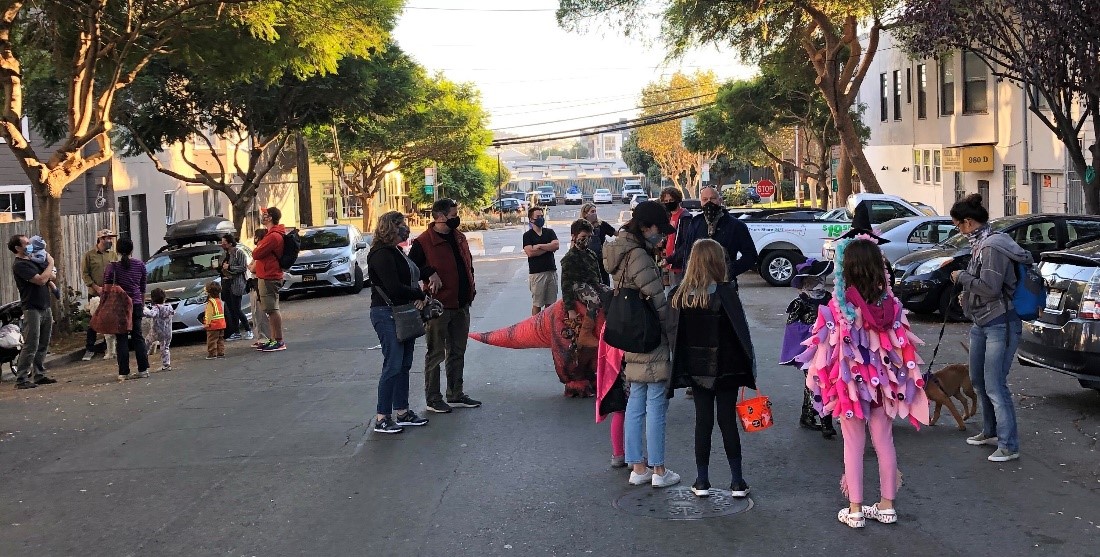
Photo of children in Halloween costumes on Minnesota Street in 2020

Halloween festivities on Minnesota Slow Street in 2020

This Halloween season, Slow Streets are becoming Spooky Streets. All across San Francisco, community groups are transforming their local Slow Streets into neighborhood gathering places for trick-or-treating, costume parties and more.

On October 31 from 3 to 6 p.m., organizers from Kid Safe SF and the Great Highway Park Initiative are turning the Great Highway into The Great Hauntway, a beachside block party with a costume contest, arts and crafts and a “spooky disco.” That same day, neighbors in Sunnyside are gathering on Slow Hearst Street for a Halloween party at 4 p.m. On Minnesota Street, the Dogpatch Neighborhood Association is hosting their second annual MinneSLOWta Spooky Slow Street Stroll on October 30—the same day that Slow Sanchez Street will host a Halloween Stroll.

Safe, car-light spaces for people to walk, bike and roll are essential every day, but especially on Halloween. Statistically, this holiday that revolves around children being out in the streets, often later in the evening, is the most dangerous day of the year for young pedestrians. To create safer conditions on San Francisco streets for little vampires, ghosts and witches, the SFMTA encourages people to bike, walk or take Muni on Halloween—and for people who do have to drive to use extra caution. Because Outside Lands falls during Halloween weekend this year, the SFMTA is offering expanded, coordinated service between Muni and BART to enable people to opt for transit and keep streets safer.

Slow Streets add an additional layer of safety—which explains their popularity as Halloween gathering places. On Slow Streets corridors, vehicle traffic is designed to be limited to local access and through traffic is discouraged. Just recently, the Slow Streets team released its Evaluation Summary Report containing data on the past year of the program, which was launched initially as an emergency response to the COVID-19 pandemic, but supports SFMTA’s larger Vision Zero goals of ending traffic fatalities on city streets. Around 71% of San Francisco residents surveyed reported that their street became safer after being designated as a Slow Streets street. Programmatic data analysis shows that Slow Streets see a 35% decrease in daily traffic and a 14% decrease in vehicle speeds—along with a 36% decrease, on average, in collisions across the Slow Streets network. As conditions on Slow Streets corridors improved, more and more people--especially kids--felt safe biking and walking along them.

Last Halloween was the first year that neighborhoods had the option to celebrate with Slow Streets—and so many did. We’re thrilled to see the tradition continue this year, and hope everyone has a safe, spooky Halloween!

Hosting or attending a Halloween event on a Slow Street near you? We would love to learn about it and see pictures from the celebration! Get in touch at SlowStreets@SFMTA.com


Published October 29, 2021 at 08:59PM
https://ift.tt/3vWCoRn

Comments

Popular posts from this blog

150 Years Ago Today – The Cable Car is Born

150 Years Ago Today – The Cable Car is Born By Kelley Trahan August 2, 2023, marks the 150th anniversary of the world’s first successful cable railway, born right here in San Francisco. To celebrate the occasion, we bring you the story of Andrew Hallidie and the very first cable car company, the Clay Street Hill Railroad.  Andrew Hallidie (1834-1900) was a pioneering inventor and entrepreneur who changed urban transportation. In 1852, at the age of 18, Hallidie emigrated with his father from the United Kingdom to San Francisco during the California Gold Rush. His father, an engineer and inventor, had a wire rope patent that played a crucial role in his son's future success.   Portrait of Andrew Smith Hallidie in 1890. Inspired by his father's wire rope business, Hallidie developed a steel cable mineral mine hauling system in 1857. About a decade later, he designed a wire rope aerial tramway for transporting materials over mountainous terrain. Then, after a stint in bridg...

Shared Spaces are Here to Stay. Permit Renewals are Due January 15, 2023.

Shared Spaces are Here to Stay. Permit Renewals are Due January 15, 2023. By Anne Yalon Shared Spaces, amongst many other benefits, allows our residents and families to enjoy safe and social outdoor dining. Seen here are the the owners of Tio Chilo’s Grill and their children in the restaurant’s parklet on 24th Street in the Mission.  San Francisco’s popular Shared Spaces program allows merchants, restaurants and arts and culture organizations to use the curbside, sidewalk and other public spaces to conduct local business activities and stay afloat. What emerged as an economic lifeline during the pandemic is making San Francisco’s streets more energized, engaged and activated. Many of the Shared Spaces parklets have become central gathering places for the local community. “ Our parklet makes me feel like when I go to Mexico, where outdoor seating is everywhere. People end up joining their friends in our parklet. It is a space for our customers and our community," said Liz V...

Tenderloin Streets Transform During COVID-19

Tenderloin Streets Transform During COVID-19 By Kimberly Leung COVID-19 has disproportionately impacted people who live and work in the Tenderloin. As a result, the SFMTA has been working closely with District 6 Supervisor Matt Haney’s office, other city departments, the Tenderloin Traffic Safety Task Force and community members to address the public health issues and unique challenges in the neighborhood through innovative interventions.    The Tenderloin is home to many of our most vulnerable communities including historically marginalized groups such as people with disabilities, residents of SROs and supportive housing and limited-English proficient communities. With every single street in the Tenderloin on the city’s High Injury Network -- the 13 percent of San Francisco streets that account for 75 percent of severe traffic injury collision and fatalities -- thi...