Street Transformations to Address COVID-19 Keep San Francisco Moving

Street Transformations to Address COVID-19 Keep San Francisco Moving
By Eillie Anzilotti

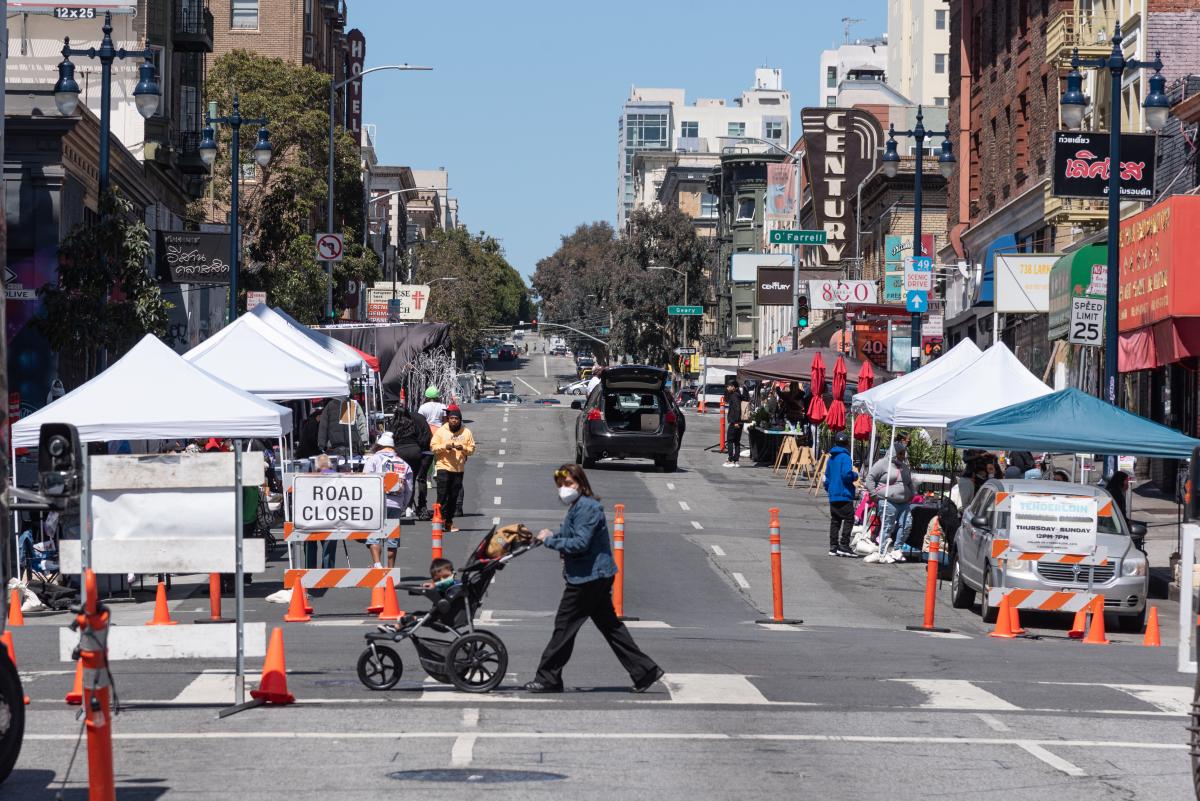
Photo of a slow street in the Tenderloin neighborhood

A street closure in the Tenderloin as part of the COVID-19 response efforts.

Since the start of the COVID-19 pandemic in March 2020, many aspects of people’s lives have changed – including how we get around town. To reflect this new reality, the SFMTA pivoted in the way we design and operate our streets. From streets that prioritized people walking and bicycling in some of San Francisco’s major parks to Temporary Transit Lanes (TETLs) that protected Muni lines from the return of traffic congestion, San Francisco reimagined how streets could be used for people.

We have documented some of these transformations in a new report that highlights emergency street operations, Temporary Emergency Transit Lanes, the Slow Streets Program, Tenderloin street closures and reusing streets within or close to parks for recreational purposes. Within each effort, the report touches on the ways in which city programs have been responsive, equitable and people-centered.

Some highlights of our COVID-19 response work over the last year include:

  • The SFMTA implemented over 700 street changes to remove parking and close streets based on the request of essential service providers, including medical care, food banks, testing sites and more. The majority of these requests were filled in less than three days.
  • 12.5 miles of Temporary Emergency Transit Lanes (TETLs) were installed, significantly reducing travel times for tens of thousands of riders. For instance, after transit lanes were installed, transit travel times on Mission Street in the South of Market neighborhood stayed constant, even as traffic volumes increased by 20%. Travel times on the 14 Mission and 14R Mission Rapid are now 20% faster than pre-pandemic.
  • The SFMTA installed 45 lane miles of Slow Streets during the pandemic. On average, traffic volumes decreased by over 50% after Slow Streets treatments were installed, while bicycle ridership increased by over 70%.
  • Two miles of safer and calmer street treatments were implemented in the Tenderloin, including block closures for essential services, physical distancing lanes for increased walking space, shared spaces and play streets.

In response to unprecedented circumstances, the SFMTA has delivered a suite of responsive, innovative programs and projects within short timelines. Some aspects of these new programs and projects, such as Slow Street corridors, have demonstrated benefits beyond emergency response and are now moving towards a permanent, post-pandemic future.

Additional programs will continue to be monitored for their value and effectiveness within a rapidly evolving environment. As the pandemic continues and the needs of our streets and residents continue to shift, the SFMTA is committed to keeping San Francisco moving.


Published October 20, 2021 at 03:08AM
https://ift.tt/3n8e5Mo

Comments

Popular posts from this blog

150 Years Ago Today – The Cable Car is Born

150 Years Ago Today – The Cable Car is Born By Kelley Trahan August 2, 2023, marks the 150th anniversary of the world’s first successful cable railway, born right here in San Francisco. To celebrate the occasion, we bring you the story of Andrew Hallidie and the very first cable car company, the Clay Street Hill Railroad.  Andrew Hallidie (1834-1900) was a pioneering inventor and entrepreneur who changed urban transportation. In 1852, at the age of 18, Hallidie emigrated with his father from the United Kingdom to San Francisco during the California Gold Rush. His father, an engineer and inventor, had a wire rope patent that played a crucial role in his son's future success.   Portrait of Andrew Smith Hallidie in 1890. Inspired by his father's wire rope business, Hallidie developed a steel cable mineral mine hauling system in 1857. About a decade later, he designed a wire rope aerial tramway for transporting materials over mountainous terrain. Then, after a stint in bridg...

Shared Spaces are Here to Stay. Permit Renewals are Due January 15, 2023.

Shared Spaces are Here to Stay. Permit Renewals are Due January 15, 2023. By Anne Yalon Shared Spaces, amongst many other benefits, allows our residents and families to enjoy safe and social outdoor dining. Seen here are the the owners of Tio Chilo’s Grill and their children in the restaurant’s parklet on 24th Street in the Mission.  San Francisco’s popular Shared Spaces program allows merchants, restaurants and arts and culture organizations to use the curbside, sidewalk and other public spaces to conduct local business activities and stay afloat. What emerged as an economic lifeline during the pandemic is making San Francisco’s streets more energized, engaged and activated. Many of the Shared Spaces parklets have become central gathering places for the local community. “ Our parklet makes me feel like when I go to Mexico, where outdoor seating is everywhere. People end up joining their friends in our parklet. It is a space for our customers and our community," said Liz V...

Virtual Parade and New Central Subway Art Ring in Lunar New Year

Virtual Parade and New Central Subway Art Ring in Lunar New Year By Sophia Scherr We are entering the year of the Ox, typically symbolizing hard work, positivity, and honesty. This year the SFMTA will continue the tradition of celebration with the virtual San Francisco Chinese New Year Parade   on February 20th at 6 pm on KTVU. Celebrating Lunar New Year and the San Francisco Chinese community has been a long-standing tradition for many of us. In 1849, San Francisco’s population swelled to 50,000 and many of the new residents were Chinese immigrants, coming to work in gold mines or on railroad lines. By the 1860’s, the Chinese were eager to share their culture with others and the annual tradition of parade and pageantry was born. A variety of other cultural groups throughout the city were invited to participate, and they marched down what today are Grant Avenue and Kearny Street with colorful flags, banners, lanterns, and drums and firecrackers to drive away evil spirits. The c...