
Bus Testing on the New Van Ness BRT Corridor a Success

Bus Testing on the New Van Ness BRT Corridor a Success
By Nehama Rogozen

Muni and Golden Gate Transit staff recently conducted important bus operations testing that is an important step towards the Van Ness Bus Rapid Transit (BRT) corridor opening this spring. This testing included emergency turns and maneuvers, repositioning buses, verifying signals are working, clearances between passing buses and safe turns while bike racks are deployed.  

The training also included several staff. Traffic engineers made sure traffic and transit signals were working and reviewed street markings. Transportation planners coordinated closely with operations, training, engineering and construction staff to make necessary adjustments. Outreach staff and ambassadors answered questions and made sure customers knew testing was taking place. Field managers and operators provided suggestions for improvements based on experience.  

Since most Muni operators are new to operating a bus on a BRT corridor, operators will be trained on the new system over the coming weeks. To ensure that their training is as robust as possible, trainers from Muni and Golden Gate Transit participated in the testing activities to see what additional skills operators will need to learn.  

The Van Ness Improvement Project is bringing San Francisco’s first BRT corridor that will improve transit service and address traffic congestion on Van Ness Avenue, in addition to providing extensive utility upgrades, civic improvements and safety enhancements.  

We know that this project has been a long ride for the community, and we are eagerly preparing for several opening activities to celebrate the new BRT corridor. These will include a ribbon-cutting, lighting of the public light sculpture, family-friendly activities and ways to support Van Ness businesses.  

During testing, our ambassadors heard lots of positive feedback from people walking. A parent remarked that it would be easier to take her daughter to school on the bus, while someone else noted that an ambulance successfully used the red lanes to cut through traffic, saying, “Wow! I didn’t think about it until now, but I see how this is not only good for those of us riding the bus, but also really good for emergency services!” Someone else commented that the BRT system, despite delays, “was well worth the wait.” 

In the meantime, there remain a few more specific turns that need to be tested, so if you see buses in the median, please do not attempt to board them. Sidewalk signage is directing customers to the correct stops that are currently boarding from the sidewalk curb. We look forward to welcoming you aboard buses in the BRT corridor in just a couple of months.  
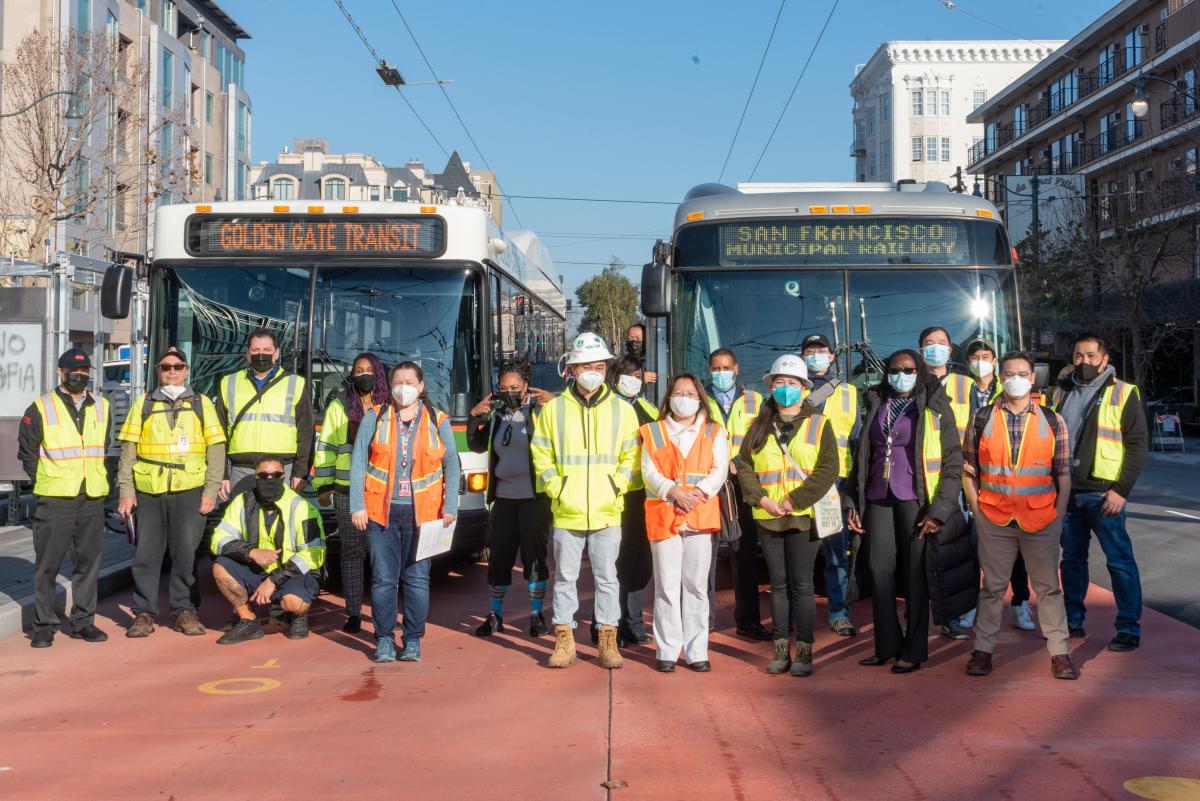
 Approximately twenty folks wearing yellow and orange safety vests pose in front of a Golden Gate Transit bus and a Muni bus on the red lanes. Van Ness buildings are visible in the background.

Staff from Muni and Golden Gate Transit in front of revenue vehicles before testing begins. 
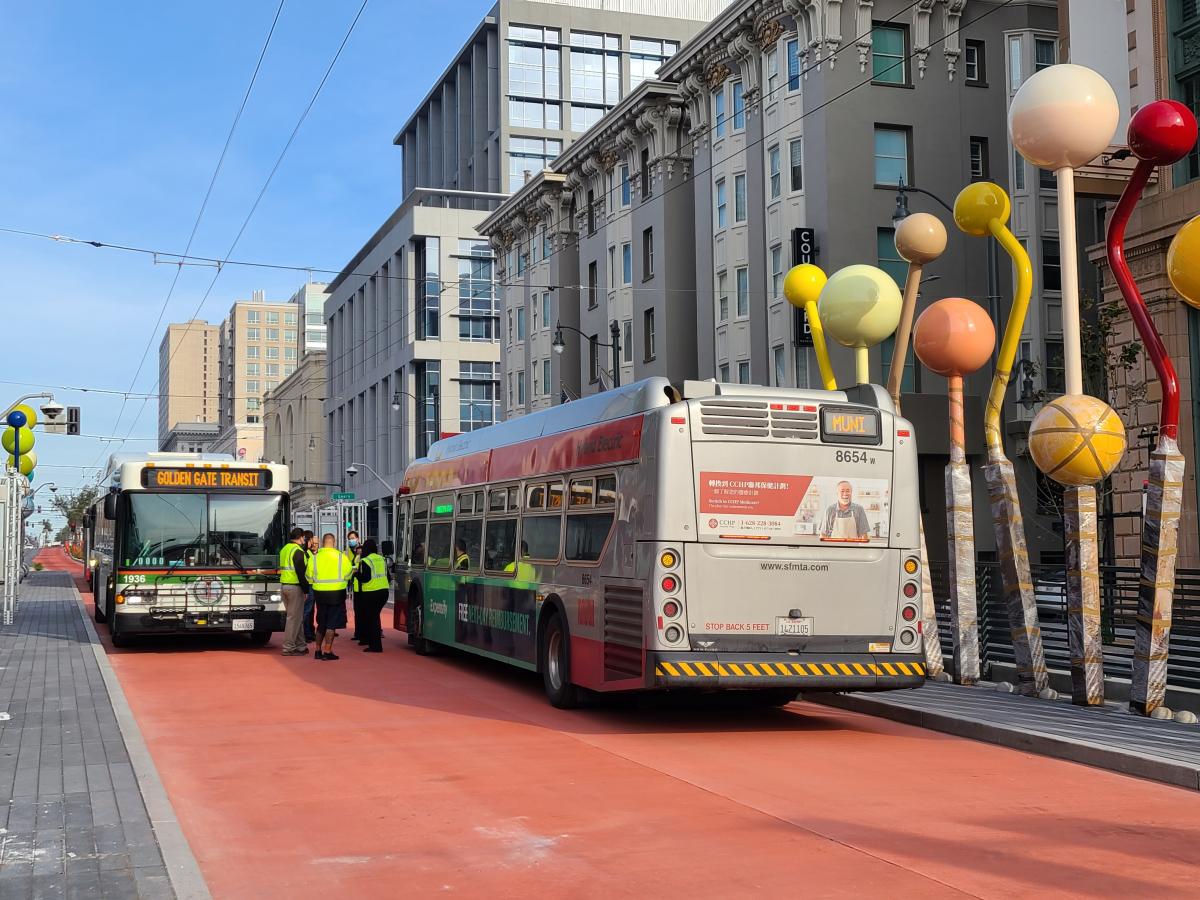
A Golden Gate Transit bus and a Muni bus are parked next to each other in a red transit lane, with staff standing between the two buses. On each side of the platform, public artwork is visible. The public artwork is composed of tall balls in various colors attached to poles, curving in various directions. In the background are mostly housing complexes.

Staff measure passing distances between a Golden Gate Transit bus and a Muni bus at the Geary-O'Farrell BRT stop, where public artwork is being installed. 
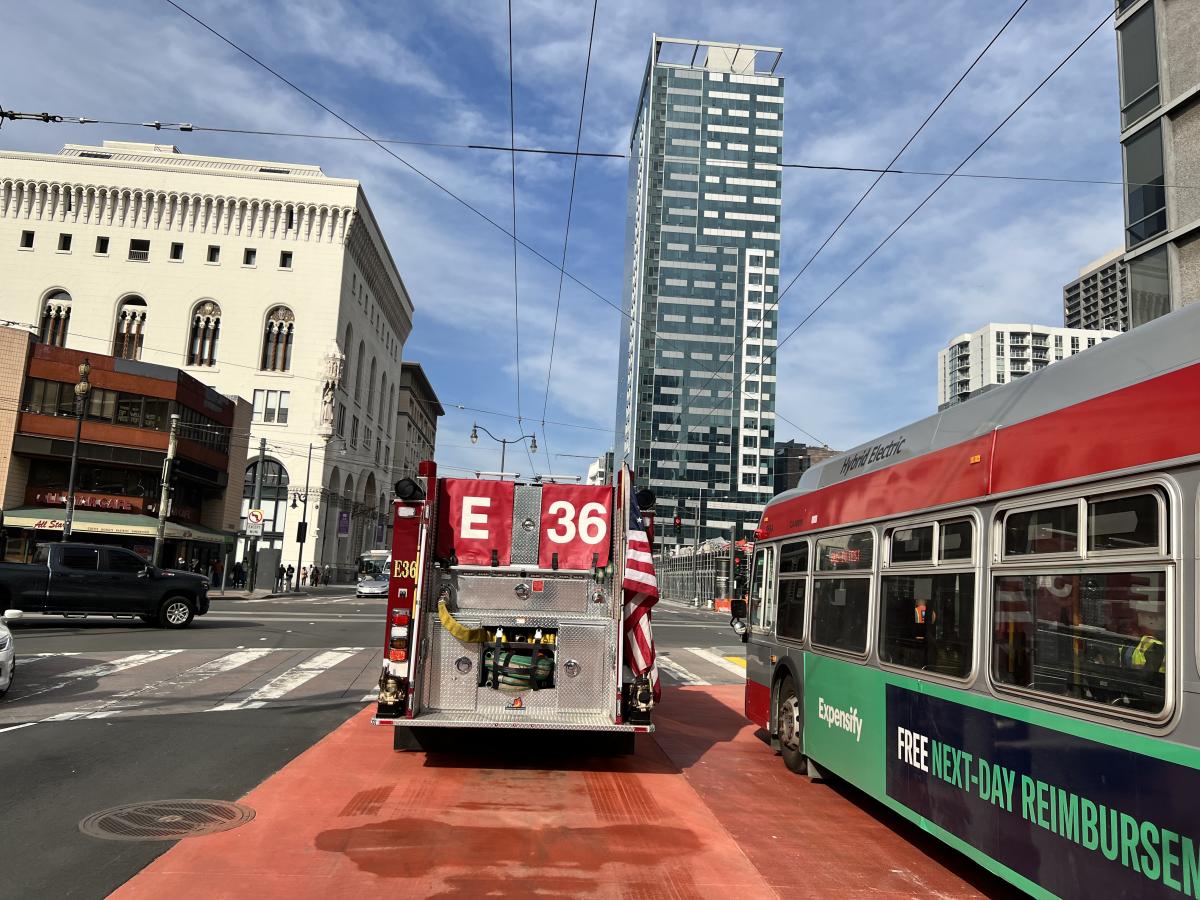
The back of a firetruck is shown passing the side of a Muni bus at the intersection of Van Ness and Market.

A fire truck uses the red lanes to bypass traffic on Van Ness. 


Published January 26, 2022 at 03:35AM
https://ift.tt/3tYnE5D

Comments

Popular posts from this blog

150 Years Ago Today – The Cable Car is Born

150 Years Ago Today – The Cable Car is Born By Kelley Trahan August 2, 2023, marks the 150th anniversary of the world’s first successful cable railway, born right here in San Francisco. To celebrate the occasion, we bring you the story of Andrew Hallidie and the very first cable car company, the Clay Street Hill Railroad.  Andrew Hallidie (1834-1900) was a pioneering inventor and entrepreneur who changed urban transportation. In 1852, at the age of 18, Hallidie emigrated with his father from the United Kingdom to San Francisco during the California Gold Rush. His father, an engineer and inventor, had a wire rope patent that played a crucial role in his son's future success.   Portrait of Andrew Smith Hallidie in 1890. Inspired by his father's wire rope business, Hallidie developed a steel cable mineral mine hauling system in 1857. About a decade later, he designed a wire rope aerial tramway for transporting materials over mountainous terrain. Then, after a stint in bridg...

Shared Spaces are Here to Stay. Permit Renewals are Due January 15, 2023.

Shared Spaces are Here to Stay. Permit Renewals are Due January 15, 2023. By Anne Yalon Shared Spaces, amongst many other benefits, allows our residents and families to enjoy safe and social outdoor dining. Seen here are the the owners of Tio Chilo’s Grill and their children in the restaurant’s parklet on 24th Street in the Mission.  San Francisco’s popular Shared Spaces program allows merchants, restaurants and arts and culture organizations to use the curbside, sidewalk and other public spaces to conduct local business activities and stay afloat. What emerged as an economic lifeline during the pandemic is making San Francisco’s streets more energized, engaged and activated. Many of the Shared Spaces parklets have become central gathering places for the local community. “ Our parklet makes me feel like when I go to Mexico, where outdoor seating is everywhere. People end up joining their friends in our parklet. It is a space for our customers and our community," said Liz V...

Tenderloin Streets Transform During COVID-19

Tenderloin Streets Transform During COVID-19 By Kimberly Leung COVID-19 has disproportionately impacted people who live and work in the Tenderloin. As a result, the SFMTA has been working closely with District 6 Supervisor Matt Haney’s office, other city departments, the Tenderloin Traffic Safety Task Force and community members to address the public health issues and unique challenges in the neighborhood through innovative interventions.    The Tenderloin is home to many of our most vulnerable communities including historically marginalized groups such as people with disabilities, residents of SROs and supportive housing and limited-English proficient communities. With every single street in the Tenderloin on the city’s High Injury Network -- the 13 percent of San Francisco streets that account for 75 percent of severe traffic injury collision and fatalities -- thi...