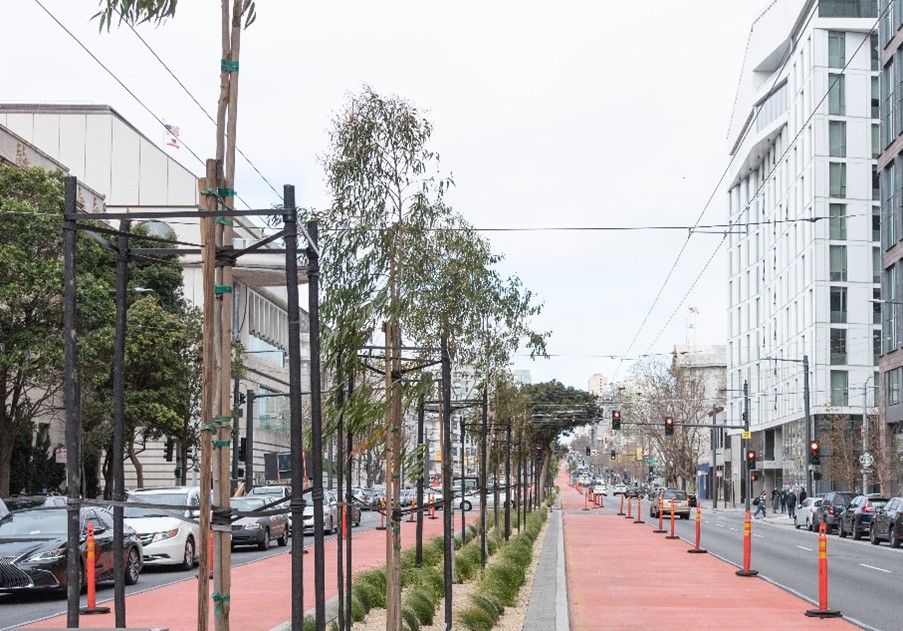
The Van Ness BRT Will Soon Welcome You

The Van Ness BRT Will Soon Welcome You
By John Gravener

New Van Ness Avenue transit lanes open to Muni and Golden Gate Transit buses April 1, 2022.

We will be celebrating the new Van Ness Bus Rapid Transit system with a ribbon-cutting ceremony at the War Memorial on April 1, at 9:15 a.m., and you are invited!

This immense civic improvement project has not only brought the first Bus Rapid Transit corridor to San Francisco, it also presented the opportunity to do much-needed underground and utilities work. This project looks towards San Francisco’s future with an eye towards climate resiliency and transit efficiency

The Bus Rapid Transit corridor provides a globally proven solution to improve transit service and address traffic congestion on Van Ness Avenue. With the new, physically-separated transit lanes along the Van Ness corridor, buses will be able to travel without getting caught up in traffic and passengers will be able to board buses more easily. Other benefits include improved lighting, sidewalk extensions (bulb-outs), new countdown signals for people crossing Van Ness and improved accessibility for those with mobility needs.

As great as the street-level improvements are for Van Ness Avenue, the work that has been completed underground is just as important. The construction that has been completed allowed for extensive utility maintenance which included the replacement of sewer pipes and water mains, some that had not been replaced in more than 100 years! This work prepares San Francisco for the next major earthquake and the effects of climate change with stronger infrastructure. The emergency water supply system dating back to the early 1900s was also part of the overhaul, providing firefighters adequate water pressure and volume throughout the city to fight fires, a hard-learned lesson from the 1906 earthquake and fires: Fires ripped through the city after the 1906 earthquake because the water mains had been severely damaged and there was no water pressure. The emergency water supply system was implemented soon after to prevent history from repeating itself.

We look forward to seeing you on Van Ness. We appreciate your patience as we revitalize the historic corridor. We hope you’ll enjoy it.

For details about the ribbon-cutting and to RSVP, go to SFMTA.com/VanNess.


Published March 18, 2022 at 09:19PM
https://ift.tt/4zEQxZP

Comments

Popular posts from this blog

150 Years Ago Today – The Cable Car is Born

150 Years Ago Today – The Cable Car is Born By Kelley Trahan August 2, 2023, marks the 150th anniversary of the world’s first successful cable railway, born right here in San Francisco. To celebrate the occasion, we bring you the story of Andrew Hallidie and the very first cable car company, the Clay Street Hill Railroad.  Andrew Hallidie (1834-1900) was a pioneering inventor and entrepreneur who changed urban transportation. In 1852, at the age of 18, Hallidie emigrated with his father from the United Kingdom to San Francisco during the California Gold Rush. His father, an engineer and inventor, had a wire rope patent that played a crucial role in his son's future success.   Portrait of Andrew Smith Hallidie in 1890. Inspired by his father's wire rope business, Hallidie developed a steel cable mineral mine hauling system in 1857. About a decade later, he designed a wire rope aerial tramway for transporting materials over mountainous terrain. Then, after a stint in bridg...

Shared Spaces are Here to Stay. Permit Renewals are Due January 15, 2023.

Shared Spaces are Here to Stay. Permit Renewals are Due January 15, 2023. By Anne Yalon Shared Spaces, amongst many other benefits, allows our residents and families to enjoy safe and social outdoor dining. Seen here are the the owners of Tio Chilo’s Grill and their children in the restaurant’s parklet on 24th Street in the Mission.  San Francisco’s popular Shared Spaces program allows merchants, restaurants and arts and culture organizations to use the curbside, sidewalk and other public spaces to conduct local business activities and stay afloat. What emerged as an economic lifeline during the pandemic is making San Francisco’s streets more energized, engaged and activated. Many of the Shared Spaces parklets have become central gathering places for the local community. “ Our parklet makes me feel like when I go to Mexico, where outdoor seating is everywhere. People end up joining their friends in our parklet. It is a space for our customers and our community," said Liz V...

Tenderloin Streets Transform During COVID-19

Tenderloin Streets Transform During COVID-19 By Kimberly Leung COVID-19 has disproportionately impacted people who live and work in the Tenderloin. As a result, the SFMTA has been working closely with District 6 Supervisor Matt Haney’s office, other city departments, the Tenderloin Traffic Safety Task Force and community members to address the public health issues and unique challenges in the neighborhood through innovative interventions.    The Tenderloin is home to many of our most vulnerable communities including historically marginalized groups such as people with disabilities, residents of SROs and supportive housing and limited-English proficient communities. With every single street in the Tenderloin on the city’s High Injury Network -- the 13 percent of San Francisco streets that account for 75 percent of severe traffic injury collision and fatalities -- thi...