
This Day in History: McAllister Street 1909

This Day in History: McAllister Street 1909
By Jeremy Menzies

Here’s a look back to April 29,1909 with two photos showing an important change to McAllister Street in the Western Addition. McAllister has been served by a transit line since at least the 1880s. Beginning with a cable car run by the Market Street Cable Railway, McAllister served as an important part of the city’s east-west transit system. 

These two photos show construction work to remove the old cable car tracks and replace them with electric streetcar rails:
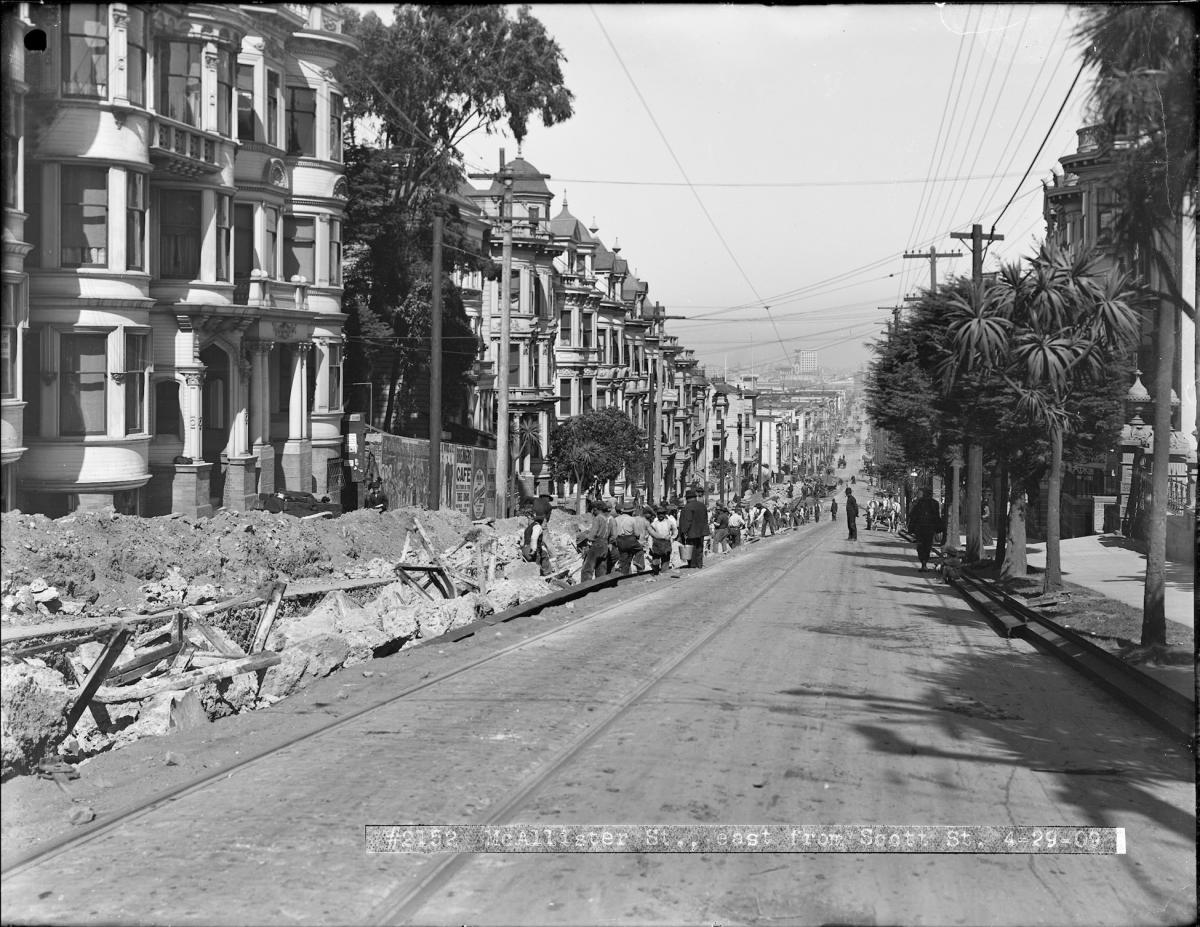
Laborers dig cable car “yokes” out of the street on McAllister between Scott and Pierce streets. Yokes are heavy steel frames that support both the rails and the cable channel on a cable car trackway.

Laborers dig cable car “yokes” out of the street on McAllister between Scott and Pierce streets. Yokes are heavy steel frames that support both the rails and the cable channel on a cable car trackway.

Prior to the 1906 Earthquake and Fires, San Francisco’s transit system was largely made up of cable car lines, which made navigating the steep hills easy. However, the cable cars were slow and costly to operate compared to newer electric streetcars.  Following the ‘06 disaster, in an effort to rebuild and modernize the system, nearly all cable car lines were replaced by electric streetcar lines.  
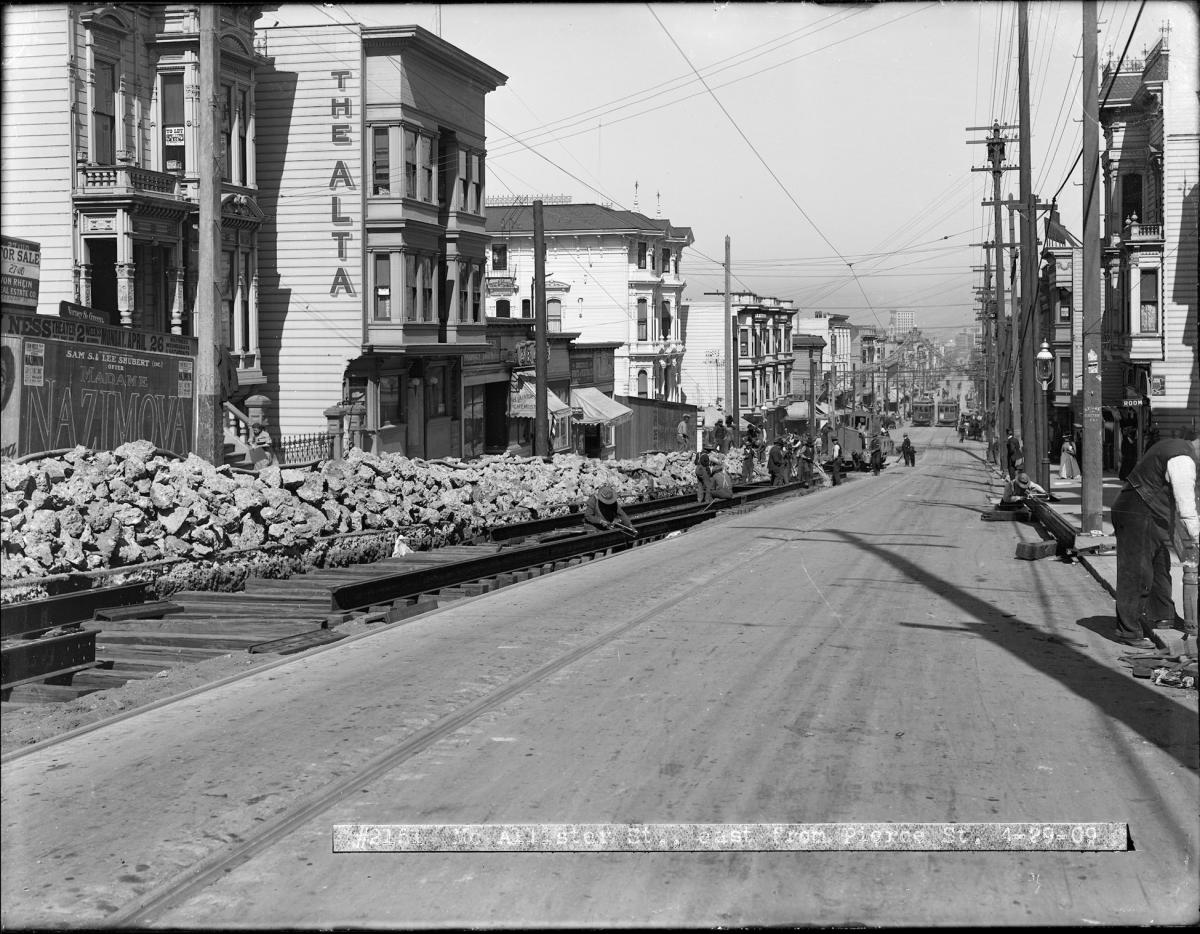
Workers install ties and rails to run the 5 McAllister Streetcar Line on McAllister and Pierce.

Workers install ties and rails to run the 5 McAllister Streetcar Line on McAllister and Pierce. 

As can be seen in the photos, the work to replace the cable tracks was labor intensive and difficult. Due to the way cable car lines were built, the work to remove them had to be done almost entirely by hand with picks, prybars, and shovels. Laying streetcar tracks was marginally easier with the help of special work streetcars. All the work to lay and align the new tracks was done by hand. 

Today, the 5 and 5R routes carry on the legacy of these cable and streetcar predecessors by continuing to serve this same stretch of McAllister.


Published April 30, 2022 at 02:41AM
https://ift.tt/RVq19KC

Comments

Popular posts from this blog

150 Years Ago Today – The Cable Car is Born

150 Years Ago Today – The Cable Car is Born By Kelley Trahan August 2, 2023, marks the 150th anniversary of the world’s first successful cable railway, born right here in San Francisco. To celebrate the occasion, we bring you the story of Andrew Hallidie and the very first cable car company, the Clay Street Hill Railroad.  Andrew Hallidie (1834-1900) was a pioneering inventor and entrepreneur who changed urban transportation. In 1852, at the age of 18, Hallidie emigrated with his father from the United Kingdom to San Francisco during the California Gold Rush. His father, an engineer and inventor, had a wire rope patent that played a crucial role in his son's future success.   Portrait of Andrew Smith Hallidie in 1890. Inspired by his father's wire rope business, Hallidie developed a steel cable mineral mine hauling system in 1857. About a decade later, he designed a wire rope aerial tramway for transporting materials over mountainous terrain. Then, after a stint in bridg...

Shared Spaces are Here to Stay. Permit Renewals are Due January 15, 2023.

Shared Spaces are Here to Stay. Permit Renewals are Due January 15, 2023. By Anne Yalon Shared Spaces, amongst many other benefits, allows our residents and families to enjoy safe and social outdoor dining. Seen here are the the owners of Tio Chilo’s Grill and their children in the restaurant’s parklet on 24th Street in the Mission.  San Francisco’s popular Shared Spaces program allows merchants, restaurants and arts and culture organizations to use the curbside, sidewalk and other public spaces to conduct local business activities and stay afloat. What emerged as an economic lifeline during the pandemic is making San Francisco’s streets more energized, engaged and activated. Many of the Shared Spaces parklets have become central gathering places for the local community. “ Our parklet makes me feel like when I go to Mexico, where outdoor seating is everywhere. People end up joining their friends in our parklet. It is a space for our customers and our community," said Liz V...

Tenderloin Streets Transform During COVID-19

Tenderloin Streets Transform During COVID-19 By Kimberly Leung COVID-19 has disproportionately impacted people who live and work in the Tenderloin. As a result, the SFMTA has been working closely with District 6 Supervisor Matt Haney’s office, other city departments, the Tenderloin Traffic Safety Task Force and community members to address the public health issues and unique challenges in the neighborhood through innovative interventions.    The Tenderloin is home to many of our most vulnerable communities including historically marginalized groups such as people with disabilities, residents of SROs and supportive housing and limited-English proficient communities. With every single street in the Tenderloin on the city’s High Injury Network -- the 13 percent of San Francisco streets that account for 75 percent of severe traffic injury collision and fatalities -- thi...