
Public Artwork Unveiled Inside New Station in Yerba Buena

Public Artwork Unveiled Inside New Station in Yerba Buena
By Enrique Aguilar

Have you had a chance to explore the Central Subway's new stations? Special weekend service is Saturdays and Sundays, from 8 a.m. to 12 a.m. midnight, through the end of the year. Ride the trains and be mesmerized by beautiful artwork at each new station. 

Muni customers will encounter public art when using the four new Central Subway stations to reach their destinations. The art was commissioned by the San Francisco Arts Commission and funded by the City’s Art Enrichment Ordinance, which allocates 2% of the total eligible costs of public works projects for public art. Public art helps draw out the identity of a space, aids in understanding a neighborhood's historical or cultural significance, and builds a connection between the visitor and surrounding community. 

The Yerba Buena/Moscone Station includes artwork by Catherine Wagner, Leslie Shows and Roxy Paine. The installations can be found on the station's surface and concourse levels. 

  • Catherine Wagner transformed photographs she took in the late 1970s that document the monumental construction of the George Moscone Convention Center, and focus on ideas of transformation. Titled Arc Cycle, the artwork reproduces several iconic images from this photographic series, translating them into laser-etched granite at the concourse level, and art glass at the station’s entry.  

  • Leslie Shows created Face C/Z, installed in the ticketing hall on the concourse level. Based on an image of iron pyrite made with a consumer grade scanner, the artwork was hand fabricated in a unique style combining mirrored, fused, painted, and engraved glass, sheet metal, and other permanent materials The pyrite (or "fool's gold") image speaks to ever-shifting notions of value in industry and aesthetics, the many historical "gold rushes" of California, and the idea that anything might be made valuable under the right circumstances.  

  • Roxy Paine created a monumental, 110 feet tall sculpture for the public plaza at 4th and Clementina streets outside of the station. Titled Node, the artwork is conceived to emerge from the complex manmade structures existing beneath the sidewalk, including the subway, communication networks, electrical and water supply, and waste systems that are all lifelines of a functioning city. According to Paine, the sculpture is "an elegant line connecting earth to sky, people to underground systems, and sculpture to city." Node is expected to be installed in early 2023. 
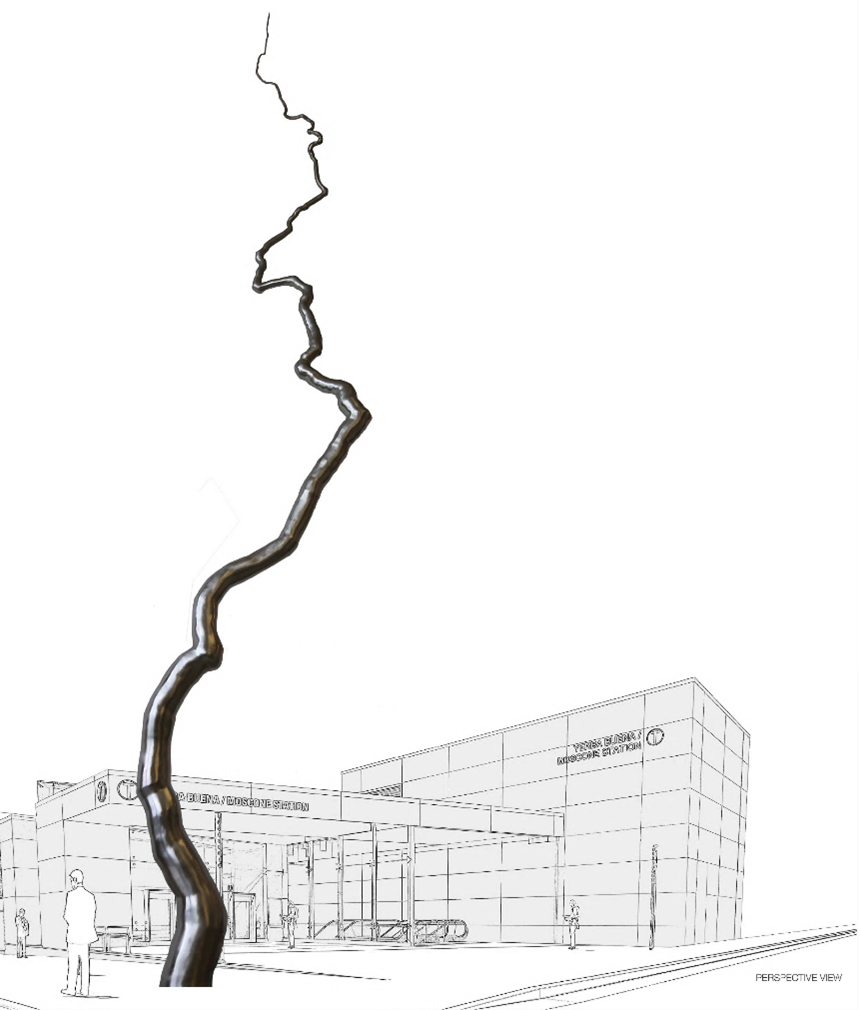
Rendered image of an art node piece in front of a building with a person in the foreground

Mockup of art installation on the station's plaza

Watch an interview video with artists Leslie Shows and Catherine Wagner to learn more about their inspiration for their work on display at the new Yerba Buena/Moscone station. A special thank you to the San Francisco Arts Commission for making public art possible at the four new stations. 

Full revenue service will begin January 7, Monday through Friday, 6 a.m. to midnight and Saturdays and Sundays, 8 a.m. to midnight. 

Stay tuned for additional blogs showcasing public art at the other new Central Subway stations. 

For more artist information:


Published December 10, 2022 at 05:05AM
https://ift.tt/5xJ6lHv

Comments

Popular posts from this blog

150 Years Ago Today – The Cable Car is Born

150 Years Ago Today – The Cable Car is Born By Kelley Trahan August 2, 2023, marks the 150th anniversary of the world’s first successful cable railway, born right here in San Francisco. To celebrate the occasion, we bring you the story of Andrew Hallidie and the very first cable car company, the Clay Street Hill Railroad.  Andrew Hallidie (1834-1900) was a pioneering inventor and entrepreneur who changed urban transportation. In 1852, at the age of 18, Hallidie emigrated with his father from the United Kingdom to San Francisco during the California Gold Rush. His father, an engineer and inventor, had a wire rope patent that played a crucial role in his son's future success.   Portrait of Andrew Smith Hallidie in 1890. Inspired by his father's wire rope business, Hallidie developed a steel cable mineral mine hauling system in 1857. About a decade later, he designed a wire rope aerial tramway for transporting materials over mountainous terrain. Then, after a stint in bridg...

Shared Spaces are Here to Stay. Permit Renewals are Due January 15, 2023.

Shared Spaces are Here to Stay. Permit Renewals are Due January 15, 2023. By Anne Yalon Shared Spaces, amongst many other benefits, allows our residents and families to enjoy safe and social outdoor dining. Seen here are the the owners of Tio Chilo’s Grill and their children in the restaurant’s parklet on 24th Street in the Mission.  San Francisco’s popular Shared Spaces program allows merchants, restaurants and arts and culture organizations to use the curbside, sidewalk and other public spaces to conduct local business activities and stay afloat. What emerged as an economic lifeline during the pandemic is making San Francisco’s streets more energized, engaged and activated. Many of the Shared Spaces parklets have become central gathering places for the local community. “ Our parklet makes me feel like when I go to Mexico, where outdoor seating is everywhere. People end up joining their friends in our parklet. It is a space for our customers and our community," said Liz V...

Tenderloin Streets Transform During COVID-19

Tenderloin Streets Transform During COVID-19 By Kimberly Leung COVID-19 has disproportionately impacted people who live and work in the Tenderloin. As a result, the SFMTA has been working closely with District 6 Supervisor Matt Haney’s office, other city departments, the Tenderloin Traffic Safety Task Force and community members to address the public health issues and unique challenges in the neighborhood through innovative interventions.    The Tenderloin is home to many of our most vulnerable communities including historically marginalized groups such as people with disabilities, residents of SROs and supportive housing and limited-English proficient communities. With every single street in the Tenderloin on the city’s High Injury Network -- the 13 percent of San Francisco streets that account for 75 percent of severe traffic injury collision and fatalities -- thi...