By Jeanne Brophy
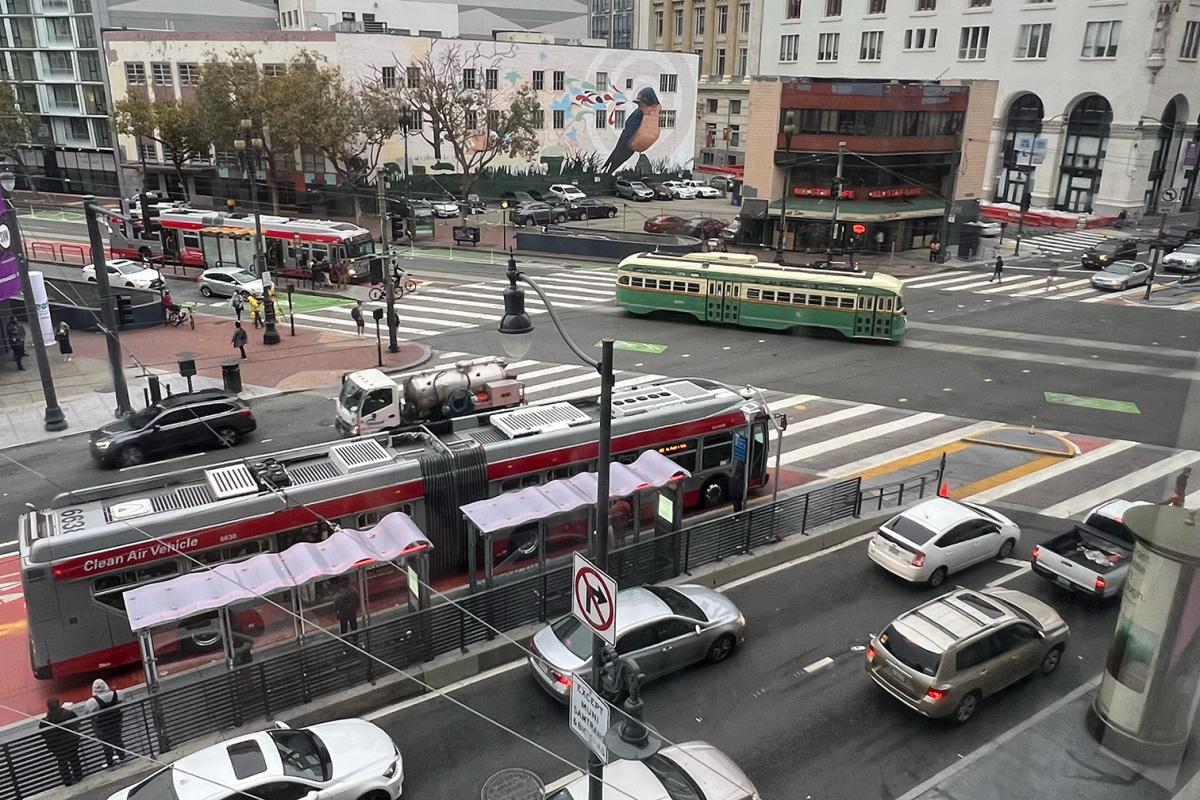
Almost 100% of San Franciscans have access to Muni service within two or three blocks of their home or work.
The results of the 2022 Muni Rider Survey indicate that our continuing efforts to deliver fast, reliable and frequent service are benefiting riders and they appreciate it. Over half of respondents, 66%, rate Muni service as “good” or “excellent” – a 9% increase from 2021 and the strongest increase since 2018.
Since 2021, riders’ ratings of individual attributes of Muni have generally increased or stayed the same: The greatest increases were:
-
Trips take a reasonable amount of time (65% in 2022 vs. 57% in 2021)
-
Frequency of service (51% in 2022 vs. 45% in 2021)
-
Reliability/On-time performance (47% in 2022 vs. 42% in 2021).
We expect that some of these improvements have to do with the fact that since the last survey in 2021, we restored the Muni network so that almost 100% of San Franciscans have access to Muni service within two or three blocks of their home or work. Between July 2021 and June 2022 alone, we restored 20 Muni lines and extended 8 others.
Our ongoing investments in reliability improvements such as transit lanes, bus bulbs and smart traffic signals have also paid off. During the pandemic, we implemented over 21 miles of new transit lanes, bringing our transit lane network to more than 70 miles! With this expansion, Muni is quicker and more reliable than is has been in decades. For example:
- 14/14R Mission downtown travel times are up to 31% quicker
-
38 Geary travel times are up to 20% quicker
-
49 Van Ness/Mission travel times are up to 35% quicker, and with the completion of the Van Ness BRT, ridership was up 13% and continues to see growth
-
The Temporary Emergency Transit Lane program improved reliability on lines serving 40% of all Muni riders.
We also reduced major delays on the Muni Metro by 81% since the Metro reopened in May 2021 through a new subway maintenance initiative called Fix It! Week.
Improvements to the customer experience can be seen through the ongoing implementation of our new Next Generation Customer Information System. The new system-wide Liquid Crystal Display (LCD) signs displaying real-time information at all transit shelters offer:
- Americans with Disabilities Act (ADA) compliant text-to-speech capability
-
Larger and clearer text
-
Ability to offer enhanced multilingual and accessible content to promote inclusivity
-
Increased real-time communication for arrival predictions and occupancy levels
Low-income riders continue to rate Muni service higher than prior to the pandemic indicating our data-driven equity delivery continues to be aligned with public needs:
-
Riders in the < $25,000 income category rate Muni service as “excellent/good:” 73% up 10% vs. 2021.
-
Riders in the $25,000-$50,000 income category rate Muni service as “excellent/good:” 80% up 6% vs. 2021.
In 2022, nearly two-thirds (64%) of riders said they rode Muni at least once a week. This has increased since 2021 when just over half (52%) said they rode once a week but remains lower than 2019 when nearly three-quarters (72%) of riders rode at least once a week.
-
81% rate Muni’s accessibility for people with disabilities as “excellent” or “good” – an increase of 2% from 2021 – which continues to be Muni’s best rated attribute by respondents.
Nearly three-quarters (73%) of riders rated transit operator helpfulness as “excellent” or “good” – up 3% since the last survey; our front-line operators continue to be our most valuable employees for their ongoing service delivery.
How We Gather Results
The 2022 survey project used a hybrid approach, blending both telephone interviews and online surveys to collect feedback from adult San Francisco residents. A total of 533 interviews were conducted during the period of August 4 to October 23, 2022. This survey was established to track the level of satisfaction that Muni riders have with our service. This tool allows us to track our progress and measure the impacts of changes that have been implemented to improve service.
For more information, please visit: 2022 Muni Customer Satisfaction Survey Supporting Documentation or 2022 Muni Customer Satisfaction Survey Supporting Documentation - Accessible Materials.
Published February 06, 2023 at 10:39PM
https://ift.tt/Oow01EK
Comments
Post a Comment