By Andrea Buffa
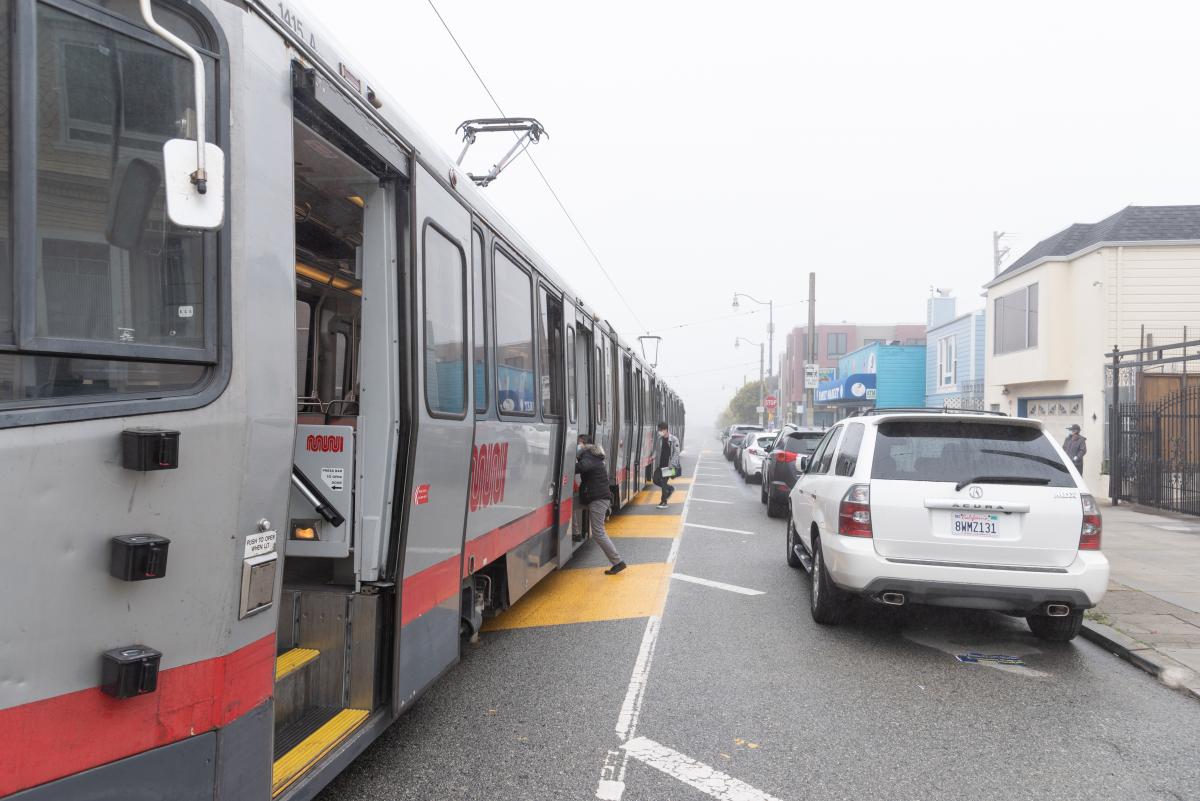
Implementing red curb "clear zones" occurs in two phases. Read more below. If you would like for us to prioritize a particular bus stop for conversion, please make a request through 311.
In late November 2021, the San Francisco Board of Supervisors unanimously passed a resolution calling for us to “promote unobstructed pedestrian access for boarding public transit by eliminating parking in bus stops.” There are more than 3,500 Muni stops in San Francisco, and about 1,200 are stops at which there isn’t enough dedicated curb space for the bus to pull to the curb for riders to board. Instead, Muni vehicles stop in the travel lane, and riders often must walk in between parked cars to get on and off.
These stops are mostly in residential neighborhoods and on lower-frequency transit lines, but they potentially can be unsafe for riders and are particularly problematic for seniors and people with disabilities. The Board of Supervisors resolution urged the SFMTA to develop a plan to provide- unobstructed access to Muni at stops and paint all Muni stop curbs red to prevent parking. We will begin this work in 2023.
The SFMTA’s bus stop guidelines call for bus stops featuring box zones, transit bulbs and boarding in specific situations including:
-
Locations servicing major traffic generators such as senior centers, schools and hospitals
-
Stops with a pattern of boardings by wheelchair users, other people with disabilities or seniors
-
Stops with a minimum of 100 riders per day
-
Stops with a combined boarding and alighting average of two passengers per scheduled trip
The guidelines allow “flag stops,” bus stops where there isn’t an unobstructed zone for the bus to pull over to the curb, on lower-frequency routes where boarding/alighting are low so that the curb can be used for other purposes, such as bike corrals, car parking and parklets. Flag stops are also allowed in circumstances where Muni vehicles are making turns or other special maneuvers.
To comply with the Board of Supervisors resolution, the SFMTA Board of Directors approved adding this language to the bus stop guidelines at its December 13, 2022, meeting:
“Each stop in the system should have at least 20’ red curb to provide unobstructed access to the front door of a bus or train. When applicable, SFMTA Accessible Services shall request, and prioritize, locations for front door transit bulbs that have a pattern of boarding by wheelchair users, other disabled persons or seniors.”
Implementing red curb “clear zones,” phase one
During phase one, we will implement 20-foot red curb “clear zones” at all flag stops that come right before an intersection. These are known as “near side” bus stops. There are approximately 900 of them throughout the city. We anticipate addressing 50-75 of these stops a month, beginning in late February. Twenty feet is enough space to provide unobstructed access to the front door of the bus and is about the size of one parking spot. Making this change will also improve safety and visibility for people walking at intersections.
Work on painting these zones red will be carried out in this order:
-
Bus stops on citywide accessibility routes identified in the Muni Service Equity Strategy. These routes are heavily used by seniors and people with disabilities and include the 8 Bayshore, 9 and 9R Fulton, 14 and 14R Mission, 30 Stockton, 31 Balboa, 38 Geary and 49 Van Ness/Mission.
-
Bus stops on Muni’s remaining rapid and frequent routes (10 minutes service or less).
-
The remaining near-side flag stops that are not along accessibility routes, rapid routes or frequent routes.
Within this framework, we will work closely with the San Francisco supervisors on which routes to prioritize in their districts. If you would like for us to prioritize a particular bus stop for conversion, please make a request through 311, and we will take that into account when possible.
Although the prospect of losing parking spaces will likely raise concerns, it’s important to keep in mind that there are many competing interests vying for the limited curb space in San Francisco. Right now, 90% of curb space in the city is allocated to parking. Only 1% of curb space is dedicated to transit boardings or accommodating pick-ups/drop-offs and shared-mobility services.
Implementing red curb “clear zones,” phase two
During phase two of this work, which we expect will begin in mid-2024, we’ll paint the curb red and remove parking at the remaining flag stops. There are about 300 flag stops that are on the far side of the street (after the intersection) or in the middle of the block. These stops may require changes beyond a 20-foot red clear zone, which will take more time and include a full public outreach process.
Our priorities during this phase will be:
-
Stops with more than 100 boardings per day
-
Stops with significant wheelchair ramp deployments
-
Stops with passenger requests for stop upgrades to improve access or complaints about lack of access
-
Commercial areas
-
Stops with existing transit shelters
As we propose changes to curb usage that prioritize safety, equity and low-carbon transportation options, we will all need to come together to support what’s best for each neighborhood, as well as the entire city. You can find more information about how the SFMTA manages curb space in our Curb Management Strategy. We thank the San Francisco Board of Supervisors, San Francisco Youth Commission, SFMTA Citizen’s Advisory Council and SFMTA Multimodal Accessibility Advisory Committee for urging us to prioritize this work.
Published February 02, 2023 at 01:08AM
https://ift.tt/whJq53t
Comments
Post a Comment