By Kate McCarthy
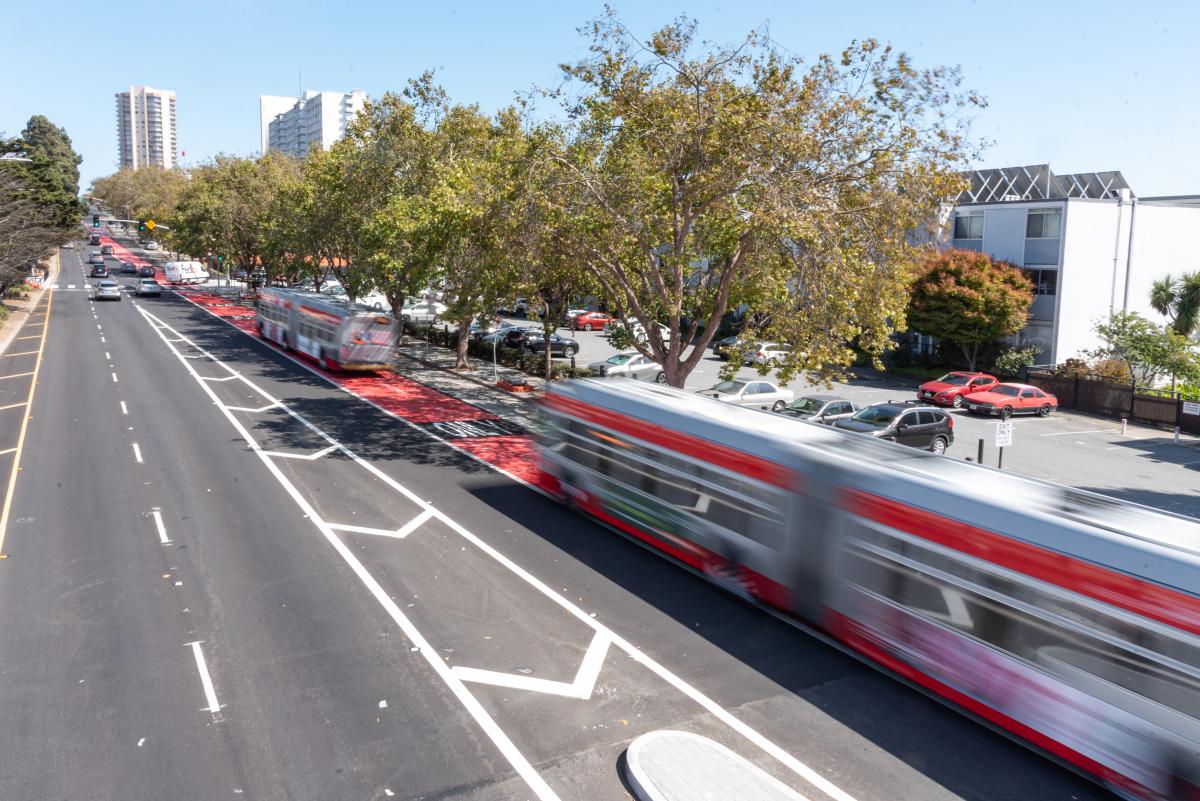
38 Geary buses zip downtown on new transit lanes that improve travel times for Muni riders.
As Earth Day approaches and we think about how to encourage more people to take non-car trips, recent Muni improvement projects are drawing increased ridership across the city. While Muni ridership downtown has not yet rebounded to pre-pandemic levels, ridership has gone up on Muni lines where we have improved speed and frequency of Muni service.
Muni is a lifeline for many of our riders: 70% of Muni riders have an annual income of less than $50,000. As we restored and added Muni service after the start of the pandemic, we invested in the routes that serve people who rely on transit and need it most. For example, after we installed transit lanes, increased frequency and re-routed the 22 Fillmore to bring people to their jobs and medical appointments in Mission Bay, ridership increased to 107% of pre-pandemic levels on weekdays and 118% on weekends.
Since the start of the pandemic, we’ve implemented more than 21 miles of new transit priority lanes, growing our transit lane network (https://ift.tt/qlxmDBj) to over 70 miles. These transit lanes are improving travel times for Muni riders across the city. After transit lanes were installed on Mission Street in downtown, travel times on the 14 Mission and 14R Mission Rapid are now 31% quicker.
Ridership numbers on the 49 Van Ness-Mission also blossomed to 109% of pre-pandemic ridership on weekdays and 114% on weekends after construction on the Van Ness BRT corridor was completed last April. With physically-separated transit lanes and transit signal priority that gives the green light to Muni and Golden Gate Transit buses, riders there are seeing travel times reduced by 35%.
A similar story has emerged on San Francisco’s busiest transit boulevard — Geary. Like other lines that serve downtown, the 38 Geary hasn’t fully recovered to pre-pandemic ridership levels. But the route did nab a spot in the top 10 highest recovered routes in the Muni system. The 38 Geary’s 36,000 daily riders have recently seen travel time savings of up to 18% since we installed three miles of new transit lanes, bus stop changes and other improvements as part of the Geary Rapid Project. We plan similar improvements on the western end of the corridor as part of the Geary Boulevard Improvement Project.
Muni riders have noticed that improvements to our busiest Muni lines are making service faster and more reliable than it has been in decades. Two-thirds (66%) of Muni riders who took our Annual Muni Rider Survey last fall rated Muni service as “good” or “excellent” — a 9% increase from 2021 and the strongest increase since 2018.
These improvements can’t come soon enough. Most of San Francisco’s greenhouse gas emissions come from cars and trucks. As the urgency to address climate change mounts, so does the need to get the most out of our Muni system. To inspire riders to come back to Muni, we’re working hard to bring back the Muni system our city deserves: One that is thriving with the better frequency, improved reliability and better connections that these projects are delivering.
Published April 21, 2023 at 02:24AM
https://ift.tt/2wWAuVT
Comments
Post a Comment