
Track Work Through the Years

Track Work Through the Years
By Jeremy Menzies

San Francisco’s unique rail system brings together 150-year-old cable cars, historic electric streetcars of all shapes and sizes and modern light rail vehicles.  

Many trades across the SFMTA play a critical role in keeping the system moving. This month we look back in time at the work of one such group, the Track Department. While the lines and technologies of SF’s street railway have changed over the years, some of the base-level work, tools and skills needed to maintain our tracks are the same today as they were over 100 years ago. 

A decade before Muni was founded, the United Railroads Company (URR) dominated San Francisco’s transit system. URR owned and operated nearly 400 miles of street and cable car track all over the city. To keep this network in service, their track department was fully equipped to handle any possible construction or repair job. 
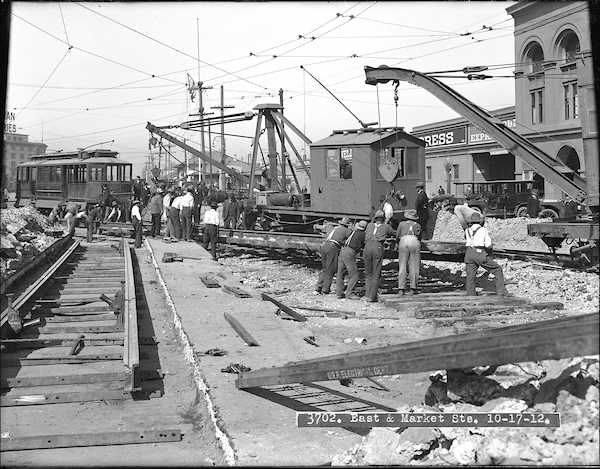
Black and white photo of group of people moving section of tracks with cranes

All hands were on deck for this job outside the Ferry Building in 1912. Here, two special work streetcars equipped with cranes lift an entire section of track in one piece. 

The Municipal Railway was built in 1912 and expanded over the next 16 years to include multiple lines and two dedicated tunnels. The city relied on its own team to maintain this system on a daily basis.  

Following World War II, many streetcar lines were converted to bus routes, but Muni retained the J, K, L, M, and N streetcar lines. With those core lines still in service, the work of the Track Dept. continued. 
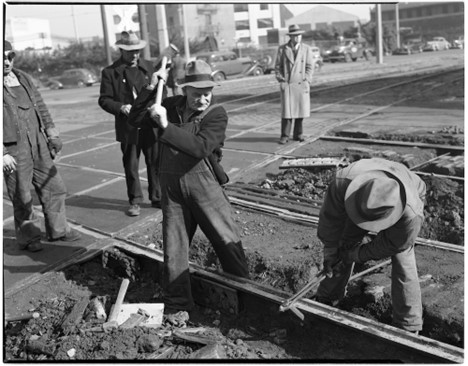
Black and white photo of two people working on tracks. One holds a rail spike while the other strikes it with a large hammer

Taken on January 31, 1947, this photo shows Muni track workers Pat Kellerher and Con Maloney at Division and Bryant Streets.

In the 1970s, construction of the Market Street Subway transformed the city’s streetcar lines into the Muni Metro system. Miles of tracks were rebuilt to handle light rail vehicle (LRV) traffic, and an automatic train control system was introduced for subway operations.
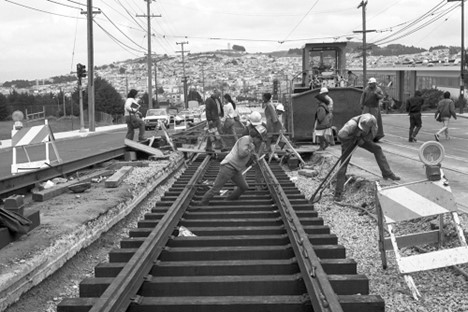
Group of people working on tracks, one pushes a rail while the other lifts a tie into place

In this 1977 shot, a crew replaces K Line tracks on Ocean Avenue just outside Lick-Wilmerding High School.

Today the SFMTA Track Department is primarily responsible for maintaining and repairing our rail infrastructure. Outside of this, they take on other jobs moving cable cars to and from the cable car carpentry shop, hauling heavy equipment in the subway, and supporting the work of the teams that maintain and repair our stations. With the skilled labor, know-how, and equipment to do a variety of heavy jobs, the department plays a critical role in keeping Muni moving.
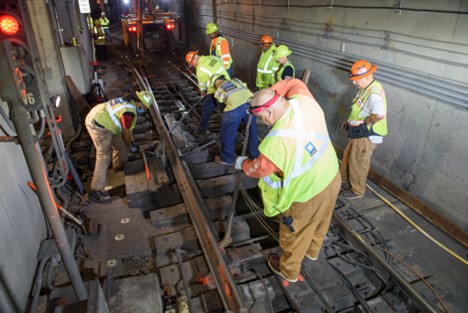
Photo of group of people lifting rail with a jack and pry bars

Whether it’s 1903 or 2023, track work is a team effort. This photo was taken during the March 2023 Fix-It Week when the Track team replaced sections of rail in the Van Ness Crossover.


Published April 27, 2023 at 03:53AM
https://ift.tt/cghko98

Comments

Popular posts from this blog

150 Years Ago Today – The Cable Car is Born

150 Years Ago Today – The Cable Car is Born By Kelley Trahan August 2, 2023, marks the 150th anniversary of the world’s first successful cable railway, born right here in San Francisco. To celebrate the occasion, we bring you the story of Andrew Hallidie and the very first cable car company, the Clay Street Hill Railroad.  Andrew Hallidie (1834-1900) was a pioneering inventor and entrepreneur who changed urban transportation. In 1852, at the age of 18, Hallidie emigrated with his father from the United Kingdom to San Francisco during the California Gold Rush. His father, an engineer and inventor, had a wire rope patent that played a crucial role in his son's future success.   Portrait of Andrew Smith Hallidie in 1890. Inspired by his father's wire rope business, Hallidie developed a steel cable mineral mine hauling system in 1857. About a decade later, he designed a wire rope aerial tramway for transporting materials over mountainous terrain. Then, after a stint in bridg...

Shared Spaces are Here to Stay. Permit Renewals are Due January 15, 2023.

Shared Spaces are Here to Stay. Permit Renewals are Due January 15, 2023. By Anne Yalon Shared Spaces, amongst many other benefits, allows our residents and families to enjoy safe and social outdoor dining. Seen here are the the owners of Tio Chilo’s Grill and their children in the restaurant’s parklet on 24th Street in the Mission.  San Francisco’s popular Shared Spaces program allows merchants, restaurants and arts and culture organizations to use the curbside, sidewalk and other public spaces to conduct local business activities and stay afloat. What emerged as an economic lifeline during the pandemic is making San Francisco’s streets more energized, engaged and activated. Many of the Shared Spaces parklets have become central gathering places for the local community. “ Our parklet makes me feel like when I go to Mexico, where outdoor seating is everywhere. People end up joining their friends in our parklet. It is a space for our customers and our community," said Liz V...

Tenderloin Streets Transform During COVID-19

Tenderloin Streets Transform During COVID-19 By Kimberly Leung COVID-19 has disproportionately impacted people who live and work in the Tenderloin. As a result, the SFMTA has been working closely with District 6 Supervisor Matt Haney’s office, other city departments, the Tenderloin Traffic Safety Task Force and community members to address the public health issues and unique challenges in the neighborhood through innovative interventions.    The Tenderloin is home to many of our most vulnerable communities including historically marginalized groups such as people with disabilities, residents of SROs and supportive housing and limited-English proficient communities. With every single street in the Tenderloin on the city’s High Injury Network -- the 13 percent of San Francisco streets that account for 75 percent of severe traffic injury collision and fatalities -- thi...