
Three Golden Rules to Improve Scooter Safety

Three Golden Rules to Improve Scooter Safety
By Mona Chiu

The SFMTA has some exciting news for all who use the sidewalk in the city! Starting May 1, 2023, we'll be launching a new safety campaign to promote safe and responsible electric scooter use for both permitted scooter share devices and privately operated scooters. The campaign will focus on three key safety rules that every rider should keep in mind while riding: no sidewalk riding, no speeding and no double riding (two people riding one device). By educating riders about the dangers of sidewalk riding, unsafe speeding and riding, and improper parking, we hope to make the city safer for everyone.    
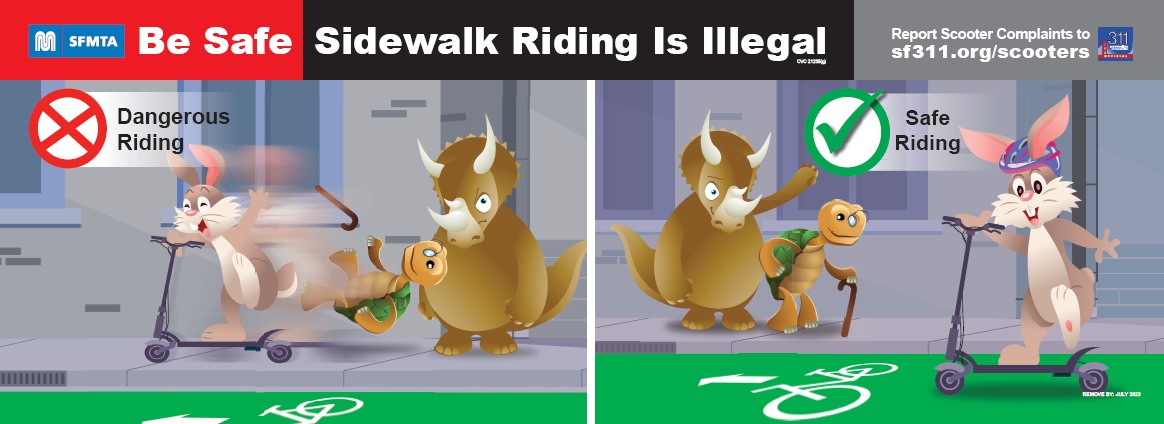
Animation images of cartoon animals riding a scooter. There are two images side by side. The left image shows a rabbit riding a scooter on the sidewalk with a turtle falling and a rhinoceros standing. The right image shows the same rabbit on a stationery scooter with the turtle and rhinoceros standing and smiling.

Sidewalk riding has been a major concern for pedestrians in San Francisco, and it's illegal to ride an electric scooter on the sidewalk.   
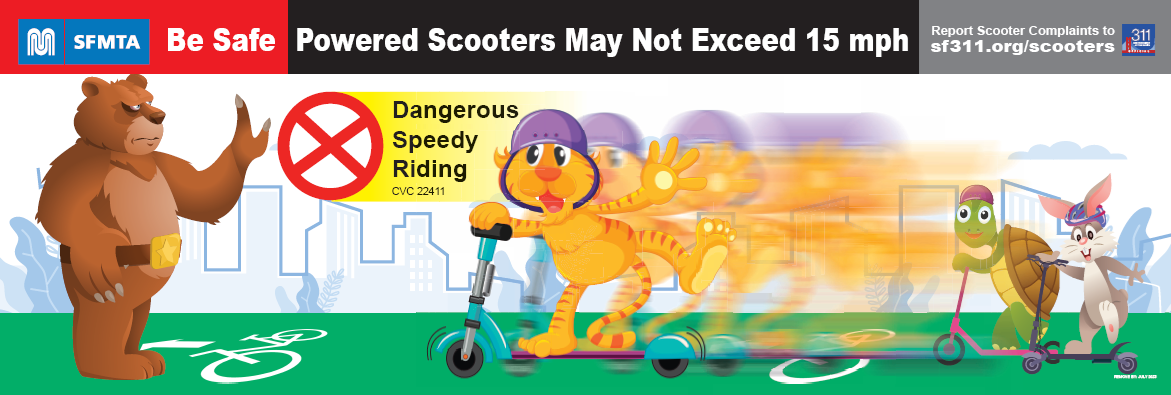
Animated image of a cat, turtle and rabbit on a scooter with a bear holding up their hand attempting to the stop the riders.

 Electric scooters can travel at speeds of up to 15 miles per hour, which can be dangerous if riders aren't paying attention to their surroundings. The SFMTA's safety campaign will encourage riders to be mindful of their speed (riding over 15 miles per hour is illegal) and to obey traffic laws

The campaign will also focus on emphasizing double riding is illegal. By law, only one rider should ride a scooter at a time.  

Animated image of a rabbit on the scooter with a bottle. They are confused and distraught.

To spread the word about this safety campaign, we will be placing posters on Muni buses, displaying ads in Muni bus stops and running ads on social media. This should help us reach as many scooter riders as possible and encourage them to prioritize safety while riding. 
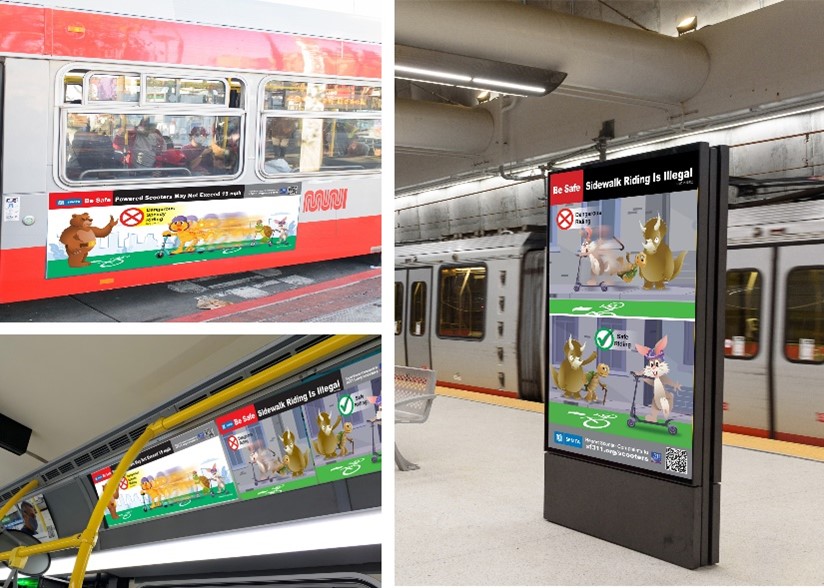
Three images showing the side of a bus, a station platform sign and a close up of a car car inside a bus.

The SFMTA already has been actively working to improve scooter safety in San Francisco. We have implemented several policies and regulations, including: 

  • Requiring permitted scooter companies to provide a lock-to system to keep parked scooters out of the accessible path of travel  
  • Requiring permitted scooter companies to develop and implement a plan for safe riding. These plans include rider training, in-app messages with safety messages and sidewalk detection technology on their devices.  
  • Encouraging scooter permittees to adopt an escalating penalty structure for improper riding and parking 
  • Working with the Port of San Francisco to reduce sidewalk riding on the Embarcadero.  

The agency has also worked to improve infrastructure for scooter riders. We have installed: 

  • 3,000+ racks installed since the beginning of scooter permit program in 2018 
  • 11,000+ bike racks available citywide for scooter parking  
  • 465 miles of bikeways in San Francisco 
  • 78 miles off-street paths 
  • 139 miles of bike lanes (Class II) 
  • 43 miles of separated bikeways (Class IV)  
  • 45 miles of bike lanes and separated bikeways added since 2018 
  • 33 miles of Slow Streets 

The agency is also working to expand the active transportation network in the city through our new Active Communities Plan

If you want to report any complaints related to scooter riding, you can call 311 or visit the 311 website.  

To learn more about what the SFMTA is doing to promote a safe and useful scooter share system, visit our scooter share permit project page and view our data dashboards


Published May 01, 2023 at 10:02PM
https://ift.tt/x7L83ov

Comments

Popular posts from this blog

150 Years Ago Today – The Cable Car is Born

150 Years Ago Today – The Cable Car is Born By Kelley Trahan August 2, 2023, marks the 150th anniversary of the world’s first successful cable railway, born right here in San Francisco. To celebrate the occasion, we bring you the story of Andrew Hallidie and the very first cable car company, the Clay Street Hill Railroad.  Andrew Hallidie (1834-1900) was a pioneering inventor and entrepreneur who changed urban transportation. In 1852, at the age of 18, Hallidie emigrated with his father from the United Kingdom to San Francisco during the California Gold Rush. His father, an engineer and inventor, had a wire rope patent that played a crucial role in his son's future success.   Portrait of Andrew Smith Hallidie in 1890. Inspired by his father's wire rope business, Hallidie developed a steel cable mineral mine hauling system in 1857. About a decade later, he designed a wire rope aerial tramway for transporting materials over mountainous terrain. Then, after a stint in bridg...

Shared Spaces are Here to Stay. Permit Renewals are Due January 15, 2023.

Shared Spaces are Here to Stay. Permit Renewals are Due January 15, 2023. By Anne Yalon Shared Spaces, amongst many other benefits, allows our residents and families to enjoy safe and social outdoor dining. Seen here are the the owners of Tio Chilo’s Grill and their children in the restaurant’s parklet on 24th Street in the Mission.  San Francisco’s popular Shared Spaces program allows merchants, restaurants and arts and culture organizations to use the curbside, sidewalk and other public spaces to conduct local business activities and stay afloat. What emerged as an economic lifeline during the pandemic is making San Francisco’s streets more energized, engaged and activated. Many of the Shared Spaces parklets have become central gathering places for the local community. “ Our parklet makes me feel like when I go to Mexico, where outdoor seating is everywhere. People end up joining their friends in our parklet. It is a space for our customers and our community," said Liz V...

Tenderloin Streets Transform During COVID-19

Tenderloin Streets Transform During COVID-19 By Kimberly Leung COVID-19 has disproportionately impacted people who live and work in the Tenderloin. As a result, the SFMTA has been working closely with District 6 Supervisor Matt Haney’s office, other city departments, the Tenderloin Traffic Safety Task Force and community members to address the public health issues and unique challenges in the neighborhood through innovative interventions.    The Tenderloin is home to many of our most vulnerable communities including historically marginalized groups such as people with disabilities, residents of SROs and supportive housing and limited-English proficient communities. With every single street in the Tenderloin on the city’s High Injury Network -- the 13 percent of San Francisco streets that account for 75 percent of severe traffic injury collision and fatalities -- thi...