By Michael Delia
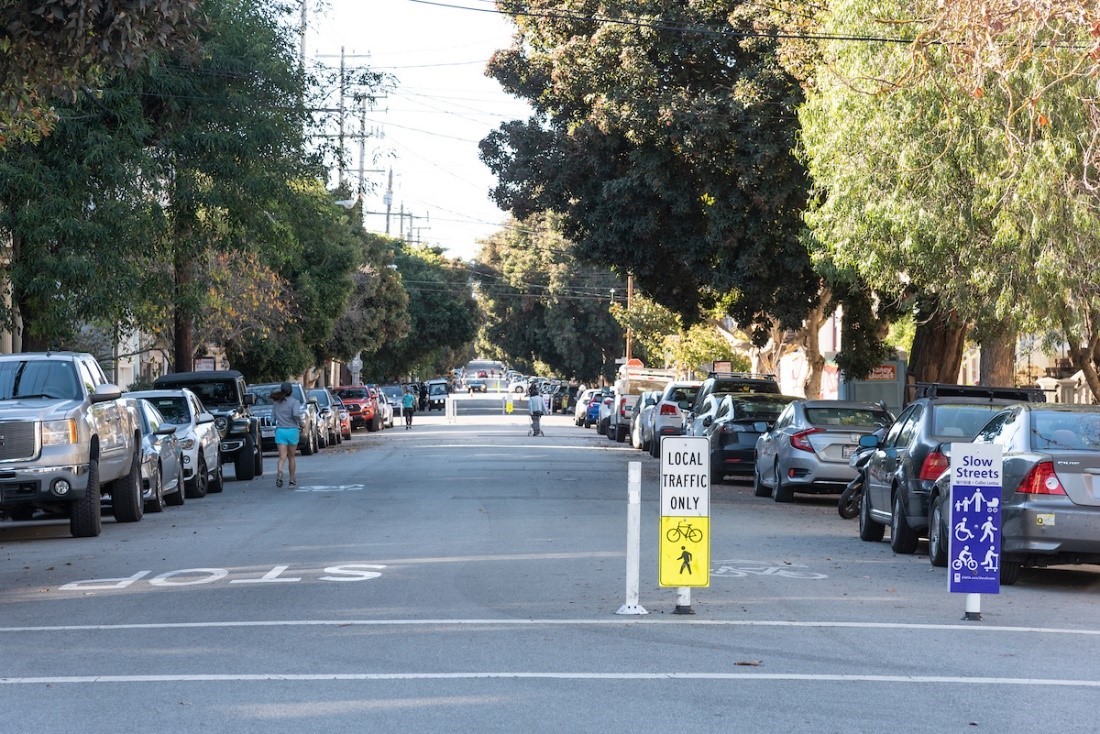 The transformation of Page Street from a congested to calm thoroughfare continues with the goal of making it safer for everyone.
The Slow Streets Program and other infrastructure upgrades are breathing new life into Page Street, creating a vibrant route connecting the Haight/Ashbury, Lower Haight and Hayes Valley neighborhoods. Widened sidewalks, a significant reduction in traffic and colorful, community-built street artwork have made Page a place where people want to walk, bike and live.
The tree-lined west end of Page Street serves as a gateway to Golden Gate Park. To the east, there have been numerous changes to the approach to Octavia Boulevard that are being welcomed by those who live in the area. There are now new sidewalk extensions and stormwater rain gardens at three locations near Octavia – including a decorative, traffic-calmed intersection at Page and Buchanan Streets.
Once a popular cut-through for cars to get to Octavia Boulevard and the freeway, Page Street’s recent transformation is the result of a process that took nearly a decade. The SFMTA began public outreach in 2014 to find ways to slow traffic and reduce the number of cars. The same year, the Planning Department designated Page Street as a Green Connection which paved the way for landscaping and urban design enhancements.
In 2016, an eastbound center-running bike lane from Laguna to Octavia opened with much fanfare, since it helps separate people biking downhill from the steady stream of right-turning vehicles. The lane was later extended a second block to Buchanan Street, but the issue of chronic congestion and turn conflicts at intersections remained.
The SFMTA worked closely with the community over several years to improve Page Street. The wider sidewalks and rain gardens were approved in 2018 as part of the Page Street Neighborway project. Initial improvements were focused on the stretch between Webster and Gough streets to address speeding, especially in the John Muir Elementary school zone, drivers and bicyclists running stop signs and traffic signals, steep grades at certain blocks and all-day congestion. An additional bikeway project that restricted access to Octavia Boulevard and the Central Freeway was implemented in February 2020.
During the COVID-19 pandemic emergency, Page became part of the pilot Slow Streets Program to limit car flow and open streets to expanded recreational use. With overwhelming community support of 85%, Page was adopted into the permanent Slow Streets program by the SFMTA Board this January. More robust traffic diverters were installed at all major signalized crossings, including Octavia, Divisadero, Masonic and Stanyan streets.
Today, we are seeing progress in the form of increased pedestrian and bicycle use and speed reductions. In the last two years, vehicle traffic on Page Street has gone down steadily, with an average daily vehicle volume of 1,120, down from 3,370, and an average speed of 16 mph. These numbers are getting closer to our recommended criteria of fewer than 1,000 cars per day with a median speed of 15 mph. There were also 39% fewer traffic collisions on Slow Page Street than before it became a Slow Street.
Our work is far from done. The community is hopeful that we can realize the full potential of “Slow Page.” Later this summer, we plan to install new signs to better communicate speed limits and restrictions at the approaches from cross streets.
While many of these changes have been implemented using quick build materials such as paint, posts and signs, we are also looking into what traffic restrictions we can add to the corridor and which ones can be made permanent. The recent completion of the neighborway project offers insight – and potentially lessons learned – into how adding infrastructure affects the Slow Streets experience. The potential for additional stormwater greening measures will also be studied. We expect to begin another round of public engagement focused on the western half of the corridor later this year into 2024.
The future of Page Street looks bright as progress continues. Evolving designs that prioritize people over traffic have helped foster a sense of community and encourage more public art and neighborhood-focused activity. This corridor is transforming into a safer, quieter residential street that offers a better quality of life for all of us who love this neighborhood.
Published July 14, 2023 at 10:57PM
https://ift.tt/e8ryYzZ
Comments
Post a Comment