How to Pay for Parking at The City's New Multi-Space Paystations

How to Pay for Parking at The City's New Multi-Space Paystations
By Pamela Johnson

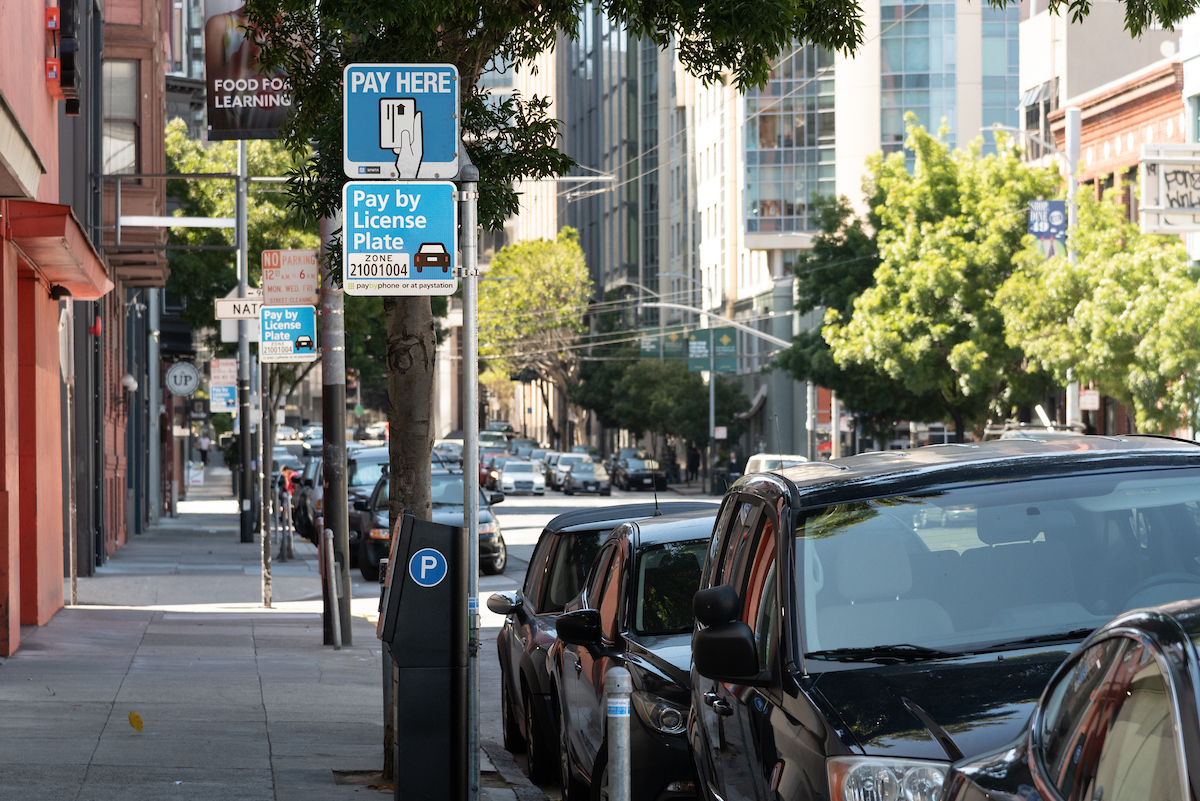
A Pay by License Plate system in San Francisco on a street with cars and trees.One of San Francisco's new paystations as the city moves away from its aging parking meters.

How drivers pay for street parking in San Francisco continues to evolve. In March 2022, the San Francisco Municipal Transportation Agency (SFMTA) began the Citywide Parking Meter Replacement Project to replace San Francisco's aging 27,000 parking meters. Half of the parking meters will be replaced with new single-space meters and the other half with multi-space paystations that use a brand-new pay-by-license-plate system. The project is expected to be completed by the end of 2024. 

San Francisco uses paid parking to create curb availability in commercial districts and high-demand neighborhoods. When parking meters are in operation, drivers spend less time circling the block looking for a space. Less circling means less congestion and fewer greenhouse gas emissions.  

To help drivers use the new multi-space paystations and pay-by-license-plate parking system, we’ve collaborated with SFGovTV to produce the instructional videos “How to Pay for Parking by License Plate” and “How to Pay for Parking with a Smartphone.” These videos are available in English, Spanish, Chinese and Filipino. The new paystations feature larger multilingual instruction panels in English, Spanish and simplified Chinese.  

The multi-space paystations replace outdated parking meters that relied on 3G communications technology phased out by wireless companies. They use state-of-the-art technology to validate parking payments and automatically transmit this information to our enforcement staff. Drivers no longer need to remember the space number where they parked, as the vehicle’s license plate number is used to verify that parking fees have been paid on a pay-by-license plate block. Payments can be made at paystations, on the pay-by-phone mobile app or by phone call. For more information on how to pay using each method, see the Ways to Pay section on our Parking Meters webpage. 

Benefits of the New Multi-space Paystations

  • More resistant to vandalism     

  • No need to display a parking receipt on the dashboard. 

  • No need to return to your car to feed the meter.

  • Payment can be made from any kiosk on the block where you are parked. 

  • You can print a receipt from a kiosk or get a digital receipt if paying by mobile device. 

  • You can leave and repark on the same block and not pay again if time remains from the original payment. 

  • Find instructions and follow prompts on larger, more legible full-color touch screens in multiple languages (simplified Chinese, English and Spanish)

  • More powerful batteries will increase reliability and reduce maintenance visits. 

Visit Citywide Parking Meter Replacement Project for more details including the locations of the multi-space paystations. 

Visit  Parking Meters | SFMTA to learn more about parking meters in San Francisco.  

Visit  Demand-Responsive Parking Pricing to view current parking meter rates and learn how to save money by finding cheaper parking a few blocks from your destination.  


Published August 08, 2023 at 10:37PM
https://ift.tt/fa4TCgs

Comments

Popular posts from this blog

150 Years Ago Today – The Cable Car is Born

150 Years Ago Today – The Cable Car is Born By Kelley Trahan August 2, 2023, marks the 150th anniversary of the world’s first successful cable railway, born right here in San Francisco. To celebrate the occasion, we bring you the story of Andrew Hallidie and the very first cable car company, the Clay Street Hill Railroad.  Andrew Hallidie (1834-1900) was a pioneering inventor and entrepreneur who changed urban transportation. In 1852, at the age of 18, Hallidie emigrated with his father from the United Kingdom to San Francisco during the California Gold Rush. His father, an engineer and inventor, had a wire rope patent that played a crucial role in his son's future success.   Portrait of Andrew Smith Hallidie in 1890. Inspired by his father's wire rope business, Hallidie developed a steel cable mineral mine hauling system in 1857. About a decade later, he designed a wire rope aerial tramway for transporting materials over mountainous terrain. Then, after a stint in bridg...

Shared Spaces are Here to Stay. Permit Renewals are Due January 15, 2023.

Shared Spaces are Here to Stay. Permit Renewals are Due January 15, 2023. By Anne Yalon Shared Spaces, amongst many other benefits, allows our residents and families to enjoy safe and social outdoor dining. Seen here are the the owners of Tio Chilo’s Grill and their children in the restaurant’s parklet on 24th Street in the Mission.  San Francisco’s popular Shared Spaces program allows merchants, restaurants and arts and culture organizations to use the curbside, sidewalk and other public spaces to conduct local business activities and stay afloat. What emerged as an economic lifeline during the pandemic is making San Francisco’s streets more energized, engaged and activated. Many of the Shared Spaces parklets have become central gathering places for the local community. “ Our parklet makes me feel like when I go to Mexico, where outdoor seating is everywhere. People end up joining their friends in our parklet. It is a space for our customers and our community," said Liz V...

Tenderloin Streets Transform During COVID-19

Tenderloin Streets Transform During COVID-19 By Kimberly Leung COVID-19 has disproportionately impacted people who live and work in the Tenderloin. As a result, the SFMTA has been working closely with District 6 Supervisor Matt Haney’s office, other city departments, the Tenderloin Traffic Safety Task Force and community members to address the public health issues and unique challenges in the neighborhood through innovative interventions.    The Tenderloin is home to many of our most vulnerable communities including historically marginalized groups such as people with disabilities, residents of SROs and supportive housing and limited-English proficient communities. With every single street in the Tenderloin on the city’s High Injury Network -- the 13 percent of San Francisco streets that account for 75 percent of severe traffic injury collision and fatalities -- thi...