
Taken with Transportation Podcast: More than a Meter Maid

Taken with Transportation Podcast: More than a Meter Maid
By Michael Roccaforte
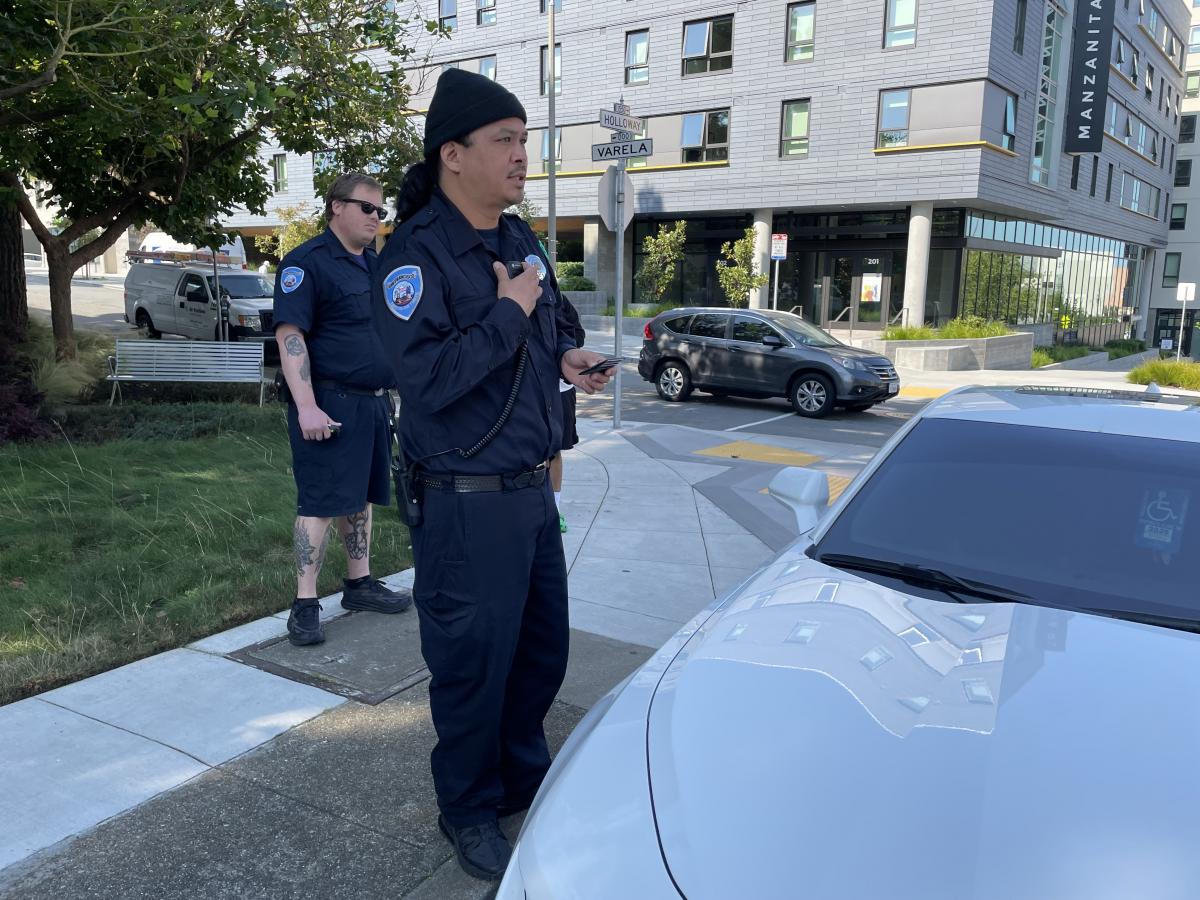
Two San Francisco Parking Control Officers inspect a vehicle on the side of the road.SFMTA Parking Control Officers Scott Ong and Todd Baxter inspect a car to make sure its Disabled Person Parking Placard is compliant. 

One of the most misunderstood roles at the SFMTA is that of the Parking Control Officer, or PCO. In this episode of our Taken with Transportation podcast, host Melissa Culross spends time on the streets of San Francisco with PCOs Scott Ong, Todd Baxter and Ruben Reveles, as well as Parking Enforcement Assistant Director and Captain Kent Chiu. She learns why parking enforcement is essential, what parking control officers do and discovers that they are much more than just so-called "meter maids."  

People often overlook the fact that PCOs help the public access parking. One violation that comes up in the episode is the misuse of Disabled Person Parking Placards. That happens when a driver uses a placard that was not issued to them. 

“These spaces are…they’re needed. The people that park there need them. And making sure that the people that are parking there should be there…it’s needed. So, we always want to make sure that the people that are needing the spot can always have the spot if it’s available,” says Parking Control Officer Todd Baxter. 

It’s a tough job, given that some people believe all PCOs do is write tickets, but Parking Control Officer Scott Ong knows he and Baxter are doing a good thing when they enforce disabled parking regulations. “The general public, I feel, they look at us like we are, I guess you can say monsters,” says Ong. “But on this detail, when we go and take a bad placard off of the street, people that really do need the spot, they see it, and they see what you’re doing, and they thank us for it.” 

The work our PCOs do is critical to keep San Francisco moving. Illegal parking can cause traffic disruptions and even create unsafe conditions on our streets. Parking Enforcement Assistant Director and Captain Kent Chiu describes how PCO duties go beyond parking and traffic control, whether they’re lending the public a helping hand or providing assistance during emergency situations. 

"If there’s any immediate hazard, like a fire, it’s something we get called to. If we can hold a perimeter for something like that, it’s even better for the public at that point,” says Chiu. “It’s an extra layer...and we can keep life flowing, whatever the situation is.” 

You can find “More than a Meter Maid” and all the episodes of Taken with Transportation at our podcast page (SFMTA.com/Podcast).   


Published November 02, 2023 at 02:06AM
https://ift.tt/TfbChZF

Comments

Popular posts from this blog

150 Years Ago Today – The Cable Car is Born

150 Years Ago Today – The Cable Car is Born By Kelley Trahan August 2, 2023, marks the 150th anniversary of the world’s first successful cable railway, born right here in San Francisco. To celebrate the occasion, we bring you the story of Andrew Hallidie and the very first cable car company, the Clay Street Hill Railroad.  Andrew Hallidie (1834-1900) was a pioneering inventor and entrepreneur who changed urban transportation. In 1852, at the age of 18, Hallidie emigrated with his father from the United Kingdom to San Francisco during the California Gold Rush. His father, an engineer and inventor, had a wire rope patent that played a crucial role in his son's future success.   Portrait of Andrew Smith Hallidie in 1890. Inspired by his father's wire rope business, Hallidie developed a steel cable mineral mine hauling system in 1857. About a decade later, he designed a wire rope aerial tramway for transporting materials over mountainous terrain. Then, after a stint in bridg...

Shared Spaces are Here to Stay. Permit Renewals are Due January 15, 2023.

Shared Spaces are Here to Stay. Permit Renewals are Due January 15, 2023. By Anne Yalon Shared Spaces, amongst many other benefits, allows our residents and families to enjoy safe and social outdoor dining. Seen here are the the owners of Tio Chilo’s Grill and their children in the restaurant’s parklet on 24th Street in the Mission.  San Francisco’s popular Shared Spaces program allows merchants, restaurants and arts and culture organizations to use the curbside, sidewalk and other public spaces to conduct local business activities and stay afloat. What emerged as an economic lifeline during the pandemic is making San Francisco’s streets more energized, engaged and activated. Many of the Shared Spaces parklets have become central gathering places for the local community. “ Our parklet makes me feel like when I go to Mexico, where outdoor seating is everywhere. People end up joining their friends in our parklet. It is a space for our customers and our community," said Liz V...

Tenderloin Streets Transform During COVID-19

Tenderloin Streets Transform During COVID-19 By Kimberly Leung COVID-19 has disproportionately impacted people who live and work in the Tenderloin. As a result, the SFMTA has been working closely with District 6 Supervisor Matt Haney’s office, other city departments, the Tenderloin Traffic Safety Task Force and community members to address the public health issues and unique challenges in the neighborhood through innovative interventions.    The Tenderloin is home to many of our most vulnerable communities including historically marginalized groups such as people with disabilities, residents of SROs and supportive housing and limited-English proficient communities. With every single street in the Tenderloin on the city’s High Injury Network -- the 13 percent of San Francisco streets that account for 75 percent of severe traffic injury collision and fatalities -- thi...