By Jeffrey Tumlin
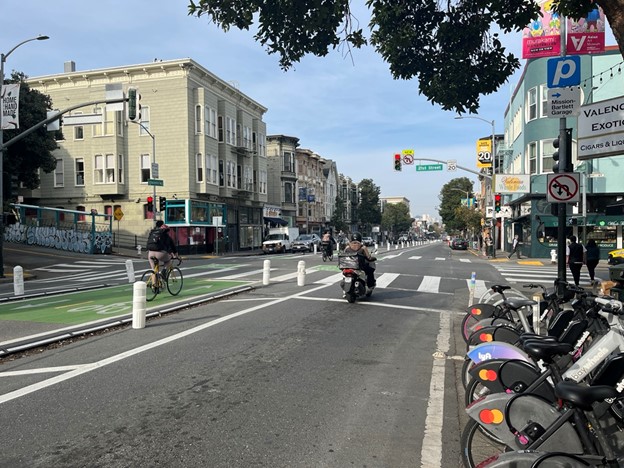
The center running bikeway installed in 2023 as part of the mid-Valencia pilot.
San Francisco is a high-density city. This helps neighborhoods like the Mission thrive because they are where people live, work, visit restaurants and shop at our small businesses. It’s where different communities intersect with different needs. It’s where we come together. It’s the best of urban living.
When we make decisions about improving our neighborhoods, we have to consider all of this. How can we advance goals that we all share, even when those goals conflict with each other? What’s happening right now on Valencia is a perfect example of this.
Valencia is one of our city’s amazing merchant corridors with incredible restaurants and retailers that draw people from all over San Francisco and beyond. It’s also a key artery for bicycle commuters – with thousands of bicyclists using Valencia every day to avoid the hills to the west and the bus and car traffic to the east. And it’s not particularly safe. Valencia is on our high injury network, which is the 12 percent of streets that account for 68 percent of severe and fatal traffic crashes.
To improve safety, we created a pilot program to use a center-running lane for bicyclists with a goal of advancing safety, but also preserving key support for our small businesses in the neighborhood. This pilot was developed in conversation with the merchants and residents after exploring other alternatives.
Before the pandemic, our plan had been to create a protected bike lane running along the curb. But Valencia changed during the pandemic. The street now has a plethora of Shared Spaces parklets, which have been a huge benefit for our neighborhoods by creating economic opportunities and more vibrant streets. The merchants asked us to find another option because a curb running bike lane would require many of those parklets – and much of the parking -- to be removed.
As we talked with the community, we realized that the most underutilized part of the street was the median. A bike lane placed in the median would preserve most of the parking and loading spaces and ensure that the business parklets could remain in place.
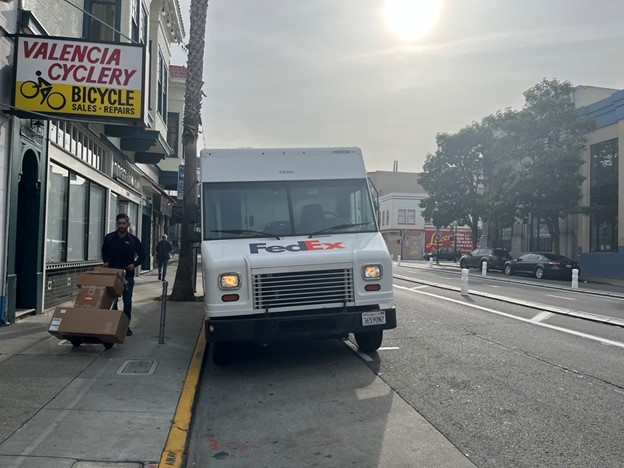
Loading zones have been expanded on Valencia to support businesses in the corridor.
When we opened the new bike lane, we also added significantly more space for the loading that’s so important to the businesses – for taxis and ride-hail services and for delivery trucks. We added more than 30 metered spaces on side streets to support customer turnover. In response to merchant concerns that there still wasn’t enough general parking, we recently started to allow customer parking at over one-third of the loading zones at certain times in the afternoons and at most of them in the evenings.
While the pilot looks promising, we’re still analyzing the data we’ve collected to date. Meanwhile, Valencia Street businesses are telling us that the new design isn’t working for them or their customers. We’ve heard mixed reviews from bike lane users – some say they feel much safer than before and enjoy the new protected space, others say that it’s still not safe enough.
The key point right now is that this is a pilot. We are trying something and seeing how it works. Pilots are meant to be evaluated and either adopted, adjusted, or redone with new information. So let’s look at what the potential options are for Valencia Street.
First, we could go back to the way things were. The problem with that is that it creates an unsafe street for bicyclists and will lead to collisions. Biking and driving on Valencia felt chaotic and unpredictable. Therefore, this option is not what we want to do.
Second, we could stick with the current pilot and keep making changes in response to community concerns. We’ll need to stay in close touch with the Valencia Street merchants and the bicyclists who aren’t excited about the center-running bike lane to make sure we’re being as responsive as they need us to be.
Third, we could go back to our original parking protected bike lane plan – meaning a bike lane running between the sidewalk and parked cars on the street. This design is more familiar to San Franciscans. The trade-off here is that this type of protected bike lane will require the removal of parklets and the loss of more than half of the curbside parking and loading. So that’s a conversation we’re starting to have.
There are no easy decisions when it comes to Valencia Street. So, we need to come together and be open minded as we discuss what’s best for the economic vitality of the neighborhood, for safety, and for the people who live and work on Valencia Street, as well as those who visit. That’s the work we are doing now, and we appreciate everyone who is involved and engaged in these conversations.
By continuing to listen and adjust, we can make sure Valencia succeeds as a place for people to be, to enjoy and to move.
Published December 15, 2023 at 05:20AM
https://ift.tt/6nJDFjc
Comments
Post a Comment