
Traffic Changes on Van Ness Begin September 14

Traffic Changes on Van Ness Begin September 14
By Nehama Rogozen

If you travel on Van Ness Avenue, get ready for your travel lane to shift starting next week.

Beginning on the evening of Monday, September 14, the Van Ness Improvement Project will begin shifting lanes on Van Ness Avenue so that work on the Bus Rapid Transit (BRT) system can continue in the middle of the street.

This summer, the project reached a significant milestone by completing the utilities phase and moving into the BRT buildout phase. The utilities phase focused on updating essential services that San Franciscans rely on, such as water and sewer systems, a firefighting system and street lighting. The new BRT buildout phase will include building out red transit lanes, putting in new medians and bus boarding islands, connecting new traffic signal lights,  installing plants and adding an irrigation system.

On the evening of Monday, September 14, southbound lanes between Pacific and Lombard streets will move over one lane, utilizing the lane closest to the curb. On the evening of Tuesday, September 15, the same thing will happen on the northbound lanes between Pacific and Lombard streets. Work will be performed from 9 p.m. to 7 a.m. Two lanes available in each direction after the switch.
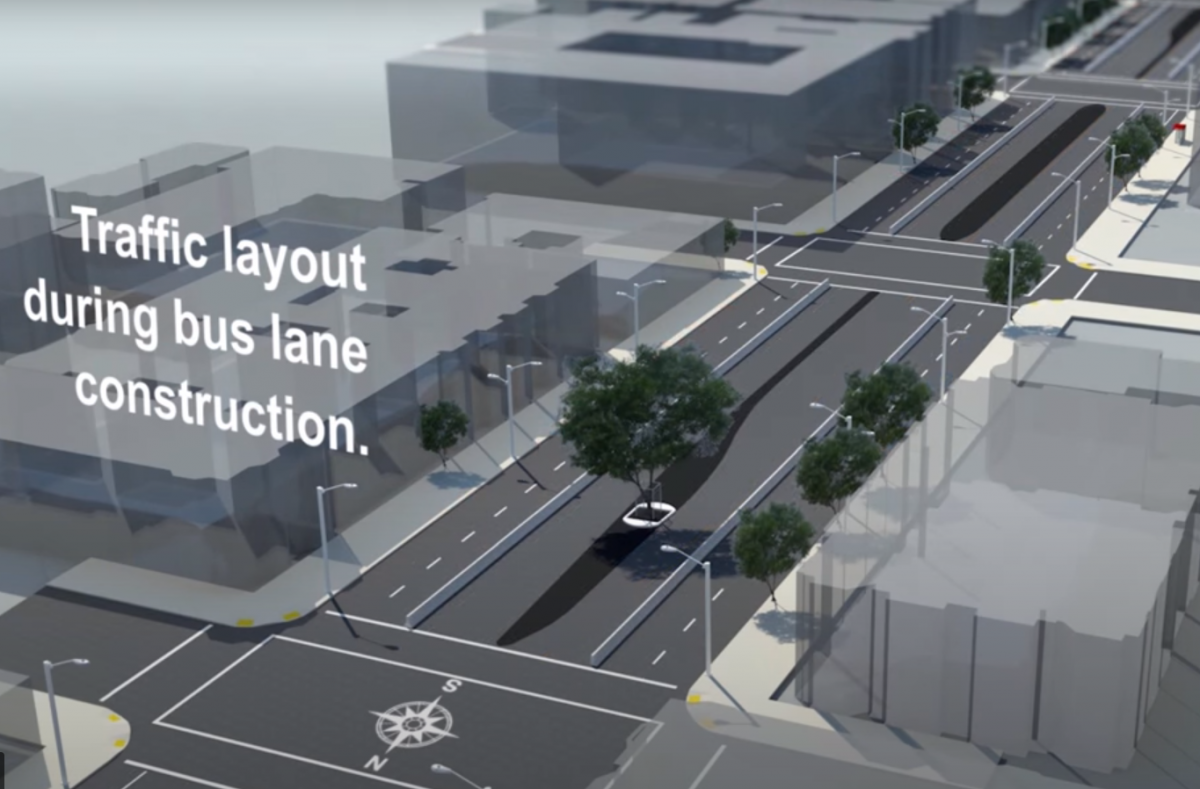
A diagram showing traffic layout during construction

Rendering: In order to work on the BRT elements and the new medians along Van Ness Avenue, traffic will shift to the outer two lanes.

To prepare for this traffic and construction switch, we encourage finding an alternate route early and avoiding Van Ness on Monday and Tuesday nights as we make the switch.

With these changes, safety fencing will be maintained as needed. Driveway access will be mostly restored, but there may be short tasks that require temporary driveway closures, in which case advance notice will be provided.

Project Background

The Van Ness Improvement Project is building San Francisco’s first Bus Rapid Transit system. This much-needed and globally-proven solution will improve transit service and address traffic congestion on Van Ness Avenue, a major north-south arterial. The project also includes extensive utility maintenance, civic improvements and safety enhancements that minimize the need for future construction and will revitalize this historic corridor.
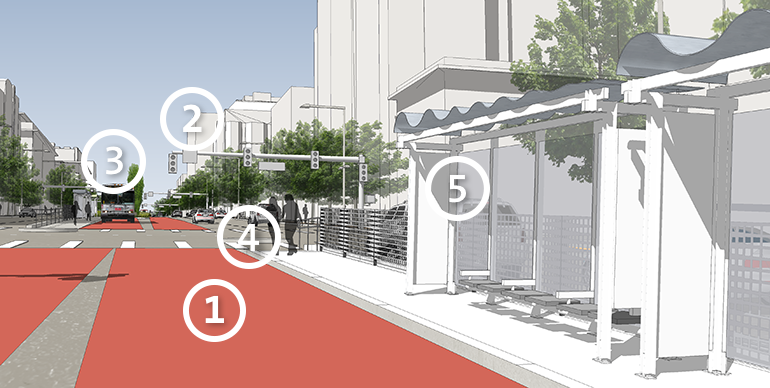
A diagram showing benefits of bus rapid transit

Features of Bus Rapid Transit on Van Ness include:

  1. Dedicated transit lanes that are physically separated from the other traffic lanes.
  2. Enhanced traffic signals optimized for buses.
  3. Low-floor vehicles and all-door boarding.
  4. Safety enhancements for people walking.
  5. Fully furnished boarding platforms that include shelters, seating and prediction displays.

For more information about the Van Ness Improvement Project and what to expect, or to sign up for project updates, please visit our website.


Published September 12, 2020 at 12:58AM
https://ift.tt/2Fe4jXn

Comments

Popular posts from this blog

150 Years Ago Today – The Cable Car is Born

150 Years Ago Today – The Cable Car is Born By Kelley Trahan August 2, 2023, marks the 150th anniversary of the world’s first successful cable railway, born right here in San Francisco. To celebrate the occasion, we bring you the story of Andrew Hallidie and the very first cable car company, the Clay Street Hill Railroad.  Andrew Hallidie (1834-1900) was a pioneering inventor and entrepreneur who changed urban transportation. In 1852, at the age of 18, Hallidie emigrated with his father from the United Kingdom to San Francisco during the California Gold Rush. His father, an engineer and inventor, had a wire rope patent that played a crucial role in his son's future success.   Portrait of Andrew Smith Hallidie in 1890. Inspired by his father's wire rope business, Hallidie developed a steel cable mineral mine hauling system in 1857. About a decade later, he designed a wire rope aerial tramway for transporting materials over mountainous terrain. Then, after a stint in bridg...

Shared Spaces are Here to Stay. Permit Renewals are Due January 15, 2023.

Shared Spaces are Here to Stay. Permit Renewals are Due January 15, 2023. By Anne Yalon Shared Spaces, amongst many other benefits, allows our residents and families to enjoy safe and social outdoor dining. Seen here are the the owners of Tio Chilo’s Grill and their children in the restaurant’s parklet on 24th Street in the Mission.  San Francisco’s popular Shared Spaces program allows merchants, restaurants and arts and culture organizations to use the curbside, sidewalk and other public spaces to conduct local business activities and stay afloat. What emerged as an economic lifeline during the pandemic is making San Francisco’s streets more energized, engaged and activated. Many of the Shared Spaces parklets have become central gathering places for the local community. “ Our parklet makes me feel like when I go to Mexico, where outdoor seating is everywhere. People end up joining their friends in our parklet. It is a space for our customers and our community," said Liz V...

Tenderloin Streets Transform During COVID-19

Tenderloin Streets Transform During COVID-19 By Kimberly Leung COVID-19 has disproportionately impacted people who live and work in the Tenderloin. As a result, the SFMTA has been working closely with District 6 Supervisor Matt Haney’s office, other city departments, the Tenderloin Traffic Safety Task Force and community members to address the public health issues and unique challenges in the neighborhood through innovative interventions.    The Tenderloin is home to many of our most vulnerable communities including historically marginalized groups such as people with disabilities, residents of SROs and supportive housing and limited-English proficient communities. With every single street in the Tenderloin on the city’s High Injury Network -- the 13 percent of San Francisco streets that account for 75 percent of severe traffic injury collision and fatalities -- thi...