By
This blog is co-authored by SFMTA Director of Transportation Jeffrey Tumlin and San Francisco Public Works Acting Director Alaric Degrafinried.
Less than a year after car-free Market Street closed the area to private vehicles to improve safety and transit performance and set the stage for construction of Better Market Street, city agencies involved in the project must adjust plans for the first phase of project construction from 5th to 8th streets.
Our plans for the project need to change not only because of the impact on the local economy and our department budgets due to COVID-19, but also because of the greater-than-anticipated success of car-free Market Street. When private vehicles were removed from Market Street, transit became up to 12% faster and the number of people biking increased by 25% – over 800 people per hour at peak. The original designs for a new sidewalk-level bikeway would not have enough capacity to keep up with the updated demand of people biking on Market Street.
The COVID-19 pandemic also required us to revise our plans because it is not only a health crisis but is also devastating the economy, including local businesses and the capital funds of all city agencies involved in this project. As local businesses work to recover, we need to minimize construction disruptions – especially on the sidewalks in front of their stores.
Given the economic challenges and changing demands we now face in San Francisco, our departments came together and made the tough decision to adjust the design for Better Market Street in order to move the project forward. As a city, we remain committed to working with our community partners and delivering the Better Market Street project to make this vital corridor safer, more resilient and more inviting for all.
Funding and Time Constraints
The full project from Octavia Boulevard to Steuart Street was estimated to cost over $600M when the project was approved. By the time the COVID-19 pandemic hit, the city had secured only approximately $200M to plan, design and construct the full project. The funding gap was going to be a challenge even before the current financial crisis decimated our department budgets. By postponing major changes to the sidewalks and limiting certain infrastructure upgrades, we expect to save over$60M for Phase 1 between 5th and 8th streets alone.
Construction must start in early 2021 due to the requirements of a federal BUILD Grant providing key funding for building the project. These grant funds are needed now more than ever so we must proceed as quickly and thoughtfully as possible to get started.
Goals and Plan for Phase 1 Construction: 5th to 8th Streets
The project goals remain to improve safety, transportation, accessibility, infrastructure and revitalize Market as the city’s preeminent civic space and ceremonial street. The first phase of construction between 5th and 8th streets is focused on four key components:
- Create a bike facility that will safely accommodate more people on bicycles
- Build new accessible boarding islands to improve the customer experience, transit functionality and capacity, and new wider curb ramps to upgrade sidewalk accessibility
- Upgrade and replace aging infrastructure like the rails, overhead lines, traffic signals, sewer and water lines, and repave the street
- Replace unhealthy trees and new street furnishings but postpone replacing the brick sidewalks or changing the sidewalk to minimize disruptions directly in front of local businesses
Changes for People Biking
The original sidewalk-level bikeway design is too expensive and won’t have enough capacity. It was designed to accommodate 2015 levels of people biking – half the people biking in 2020 pre-COVID, let alone the increases we expect to see in the future. As in our original plans, we remain committed to reducing conflicts between Muni and people on bikes.
Our new plan is to move all Muni buses to the center lane, reserving the curb lane for bikes to share with paratransit, taxis and commercial vehicles (note: Uber/Lyft are considered private vehicles and are not allowed on Market Street). By removing curbside transit stops we will also eliminate conflicts between buses and people on bikes.
The curb lane will have updated bike priority markings on the pavement, speed tables to discourage speeding and a raised buffer between lanes to discourage vehicles from changing lanes. Loading restrictions in the morning and evening peak commute hours continue to limit delivery vehicles and conflicts during the busiest times on Market Street.
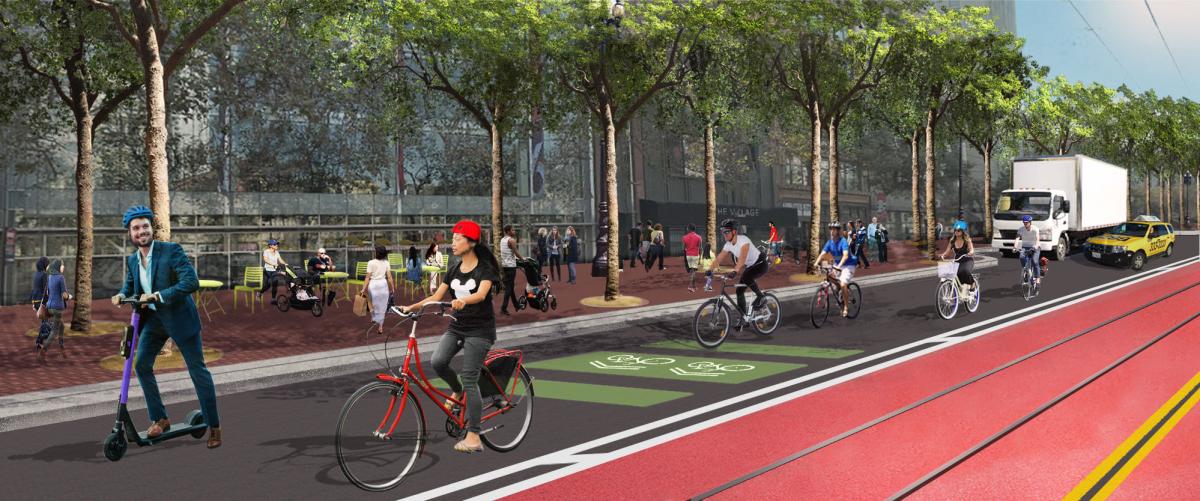
Graphic: The first phase of Better Market Street includes a bike-priority curb lane and center Muni-only lane. San Francisco Public Works
Accessibility and Transit
All Muni routes on Market Street between 5th and 8th streets will shift to the center in a Muni-only lane – taxis and other buses are not allowed. To reduce crowding for customers waiting, we plan to build new boarding islands that are twice as big as the current islands. The new islands at UN Plaza and at 6th Street will have new shelters with seating, be fully accessible, and include wheelchair ramps for F-line service.
New wider sidewalk curb ramps at intersections and across from boarding islands will also make the sidewalk more accessible.
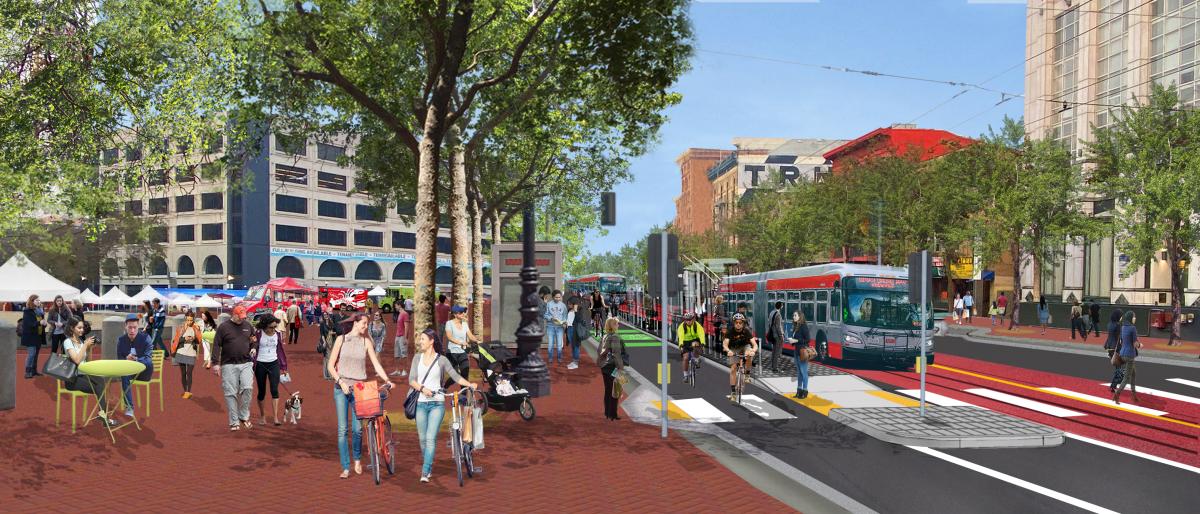
Graphic: Accessible center boarding island at UN Plaza. San Francisco Public Works
State of Good Repair
Better Market Street will replace the worn-down rails, BART grates in the street, and traffic signals, and fully repave the road. The project team plans to replace some water and sewer pipes that have reached end of life and reline others to extend their life. Lastly, some transit infrastructure is worn out and in need of replacing, including the traction power systems that provide electricity to vehicles, overhead lines and switches.
Plans for Better Market Street also still include construction of the F-Loop, which will improve Muni service with new rail along McAllister Street and Charles J. Brenham Place allowing the F Market & Wharves streetcars to return to the waterfront for faster service without limiting access to the Castro.
Postponing Major Sidewalk Work
By not widening the sidewalk, replacing light and overhead cable system poles and other utilities, or the red brick, we can significantly reduce immediate costs as well as disruptions to businesses along the street. We plan to revisit this segment between 5th and 8th streets further down the line when conditions improve and work with building developers to make sidewalk upgrades part of their work.
Public Meetings
We recognize that these are big changes. We are actively meeting with project stakeholders and city partners. We will hold a virtual open house from November 2 – 13 that will be available online for the public to visit. We will also hold virtual public meetings on November 4th at noon and November 9th at 4:30pm to share project details and hear feedback. For details please visit the Better Market Street project website.
Published October 29, 2020 at 04:29AM
https://ift.tt/35I8m7l
Comments
Post a Comment