By Jonathan Streeter
As a part of the SFMTA’s response to the COVID-19 pandemic, we implemented a number of temporary emergency projects designed to maximize Muni service in light of newly constrained resources. For example, we brought back the J Church in December 2020 as a surface only rail route between Balboa Park and Duboce Avenue as the first train service to be re-started since shelter in place began in March 2020. Throughout these efforts, we have worked with the public to modify and improve their design.
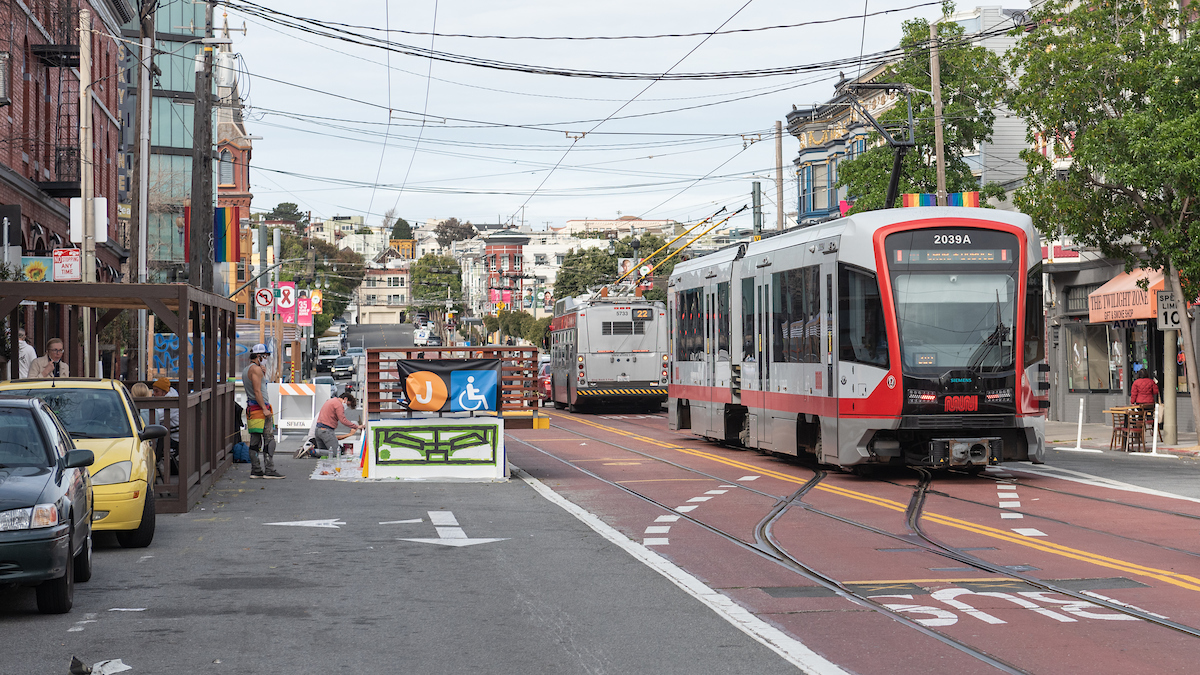
A 22 Fillmore bus and J Church light rail vehicle travel northbound on Church Street at Market
To provide better connectivity between the J Church and other Muni Metro lines, we created a temporary boarding island and ramp on Church Street south of Market, and added a temporary ramp to the island on Church Street just south of Duboce Avenue. This now serves customers transferring to the re-opened subway. We implemented this change after a public outreach process that included contacting every merchant in the project area, as well as neighborhood groups, elected officials and other stakeholders. The public was able to review our design and provide feedback regarding their questions and concerns.
The design for the new temporary transfer point for the J Church initially closed Church Street between Market and 15th streets to through traffic in both directions. In the southbound direction, closing Church Street to through traffic was necessary to accommodate the temporary boarding island and ramp, while in the northbound direction, the curb lane was closed to through traffic in collaboration with the citywide Shared Spaces program. This gave businesses on Church Street the opportunity to utilize the curbside lane to operate outdoors while indoor retail was either restricted or prohibited. We also provided commercial and passenger loading zones for residents, patrons, delivery vehicles and others to have continued local access to all of Church Street.
Since the project was implemented in August of 2020, we heard from a variety of businesses and residents that prohibiting northbound traffic across Market presented challenges. In addition to requiring alternate routes for reaching destinations north of Market Street, the lane closure also meant that any vehicle using a navigation app was unable to program pick-ups and drop offs on Church Street, despite the fact that it remained open to local traffic.
When the initial Shared Spaces permits expired on June 30 this year and businesses vacated parklets in the northbound curbside lane of Church Street, we canvassed merchants and other stakeholders and determined that the lane could now be reopened. We have sent orders to our sign shop to have the signage changed and have communicated with the navigation companies our plans to have the lane reopened. Beginning in mid-July, northbound through traffic will once again be permitted in the curbside lane on Church Street.
As a temporary emergency project, the new transfer point for the J Church is authorized until the city’s emergency order is lifted, at which point the project must be removed within 120 days unless it receives permanent approval through additional outreach and legislation. We are now evaluating whether and how this transfer might be made permanent and welcome the public’s participation in our J Church Transfer Project Survey.
Published July 02, 2021 at 05:11AM
https://ift.tt/3hl4K0U
Comments
Post a Comment