
Rolling Out the Red on Geary

Rolling Out the Red on Geary
By Liz Brisson

Transit lanes on Geary Boulevard east of Stanyan Street are about to receive the red carpet treatment. And with Geary Rapid Project construction nearing the finish line on time and on budget, it’s the perfect occasion for the corridor to be getting the ruby rollout.

But what’s so magical about the color red? In general, painting transit lanes red has been shown to improve compliance by about 50%. Studies of three downtown San Francisco streets found that red paint led to fewer violations by private vehicles, which reduces the number of collisions and makes Muni service more reliable.

And it makes sense: coloring transit lanes red makes it easier for drivers to know where they’re allowed to drive. By making transit lanes extra clear, you’re less likely to get a citation for unintentionally driving in a transit lane.

Learn about when it’s okay for drivers to access a transit lane.
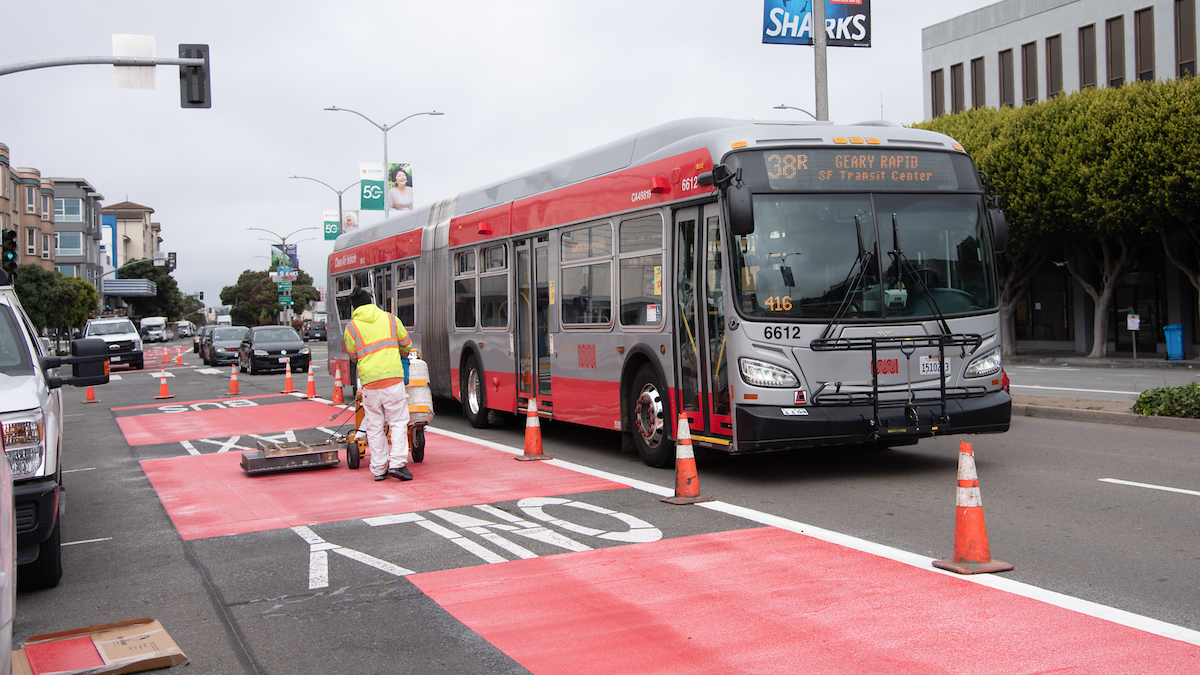
Photo of crew striping street with red paint on Geary
Red transit lanes mark the final step of the transit, safety and utility improvements that are being installed along the Geary corridor between Stanyan and Market streets as part of the Geary Rapid Project.

San Francisco is a leader in using red transit lanes to give buses and trains priority on the street. Following San Francisco’s success, many cities are now using this approach, including New York, Washington, DC, Portland, Seattle, Boston and more.

In the coming months you will start to see new red lanes installed along Geary Boulevard between Stanyan Street and Van Ness Avenue. Then later this fall, after utility and repaving work is completed, existing red lanes will be refreshed and new red lanes will be installed on Geary and O’Farrell streets east of Van Ness.

When the red treatments are completed, Geary will have gained almost 3.5 miles of red lanes along the corridor, bringing the citywide red transit lanes total to 22 miles, or about a 20% increase in red transit line mileage. 

Red lanes along Geary will add to the transit benefits that were realized when quick-build improvements—such as non-colored transit lanes, bus stop changes and traffic signal retiming—were made at the beginning of the Geary Rapid Project in late 2018. Those changes helped to speed up 38R Geary Rapid trips by up to 20% and improved reliability by 20%. In the coming months we’ll be crunching the numbers to understand the additional benefits of the red-colored transit lanes and other recently completed transit improvements like bus bulbs (sidewalk extensions at bus stops).
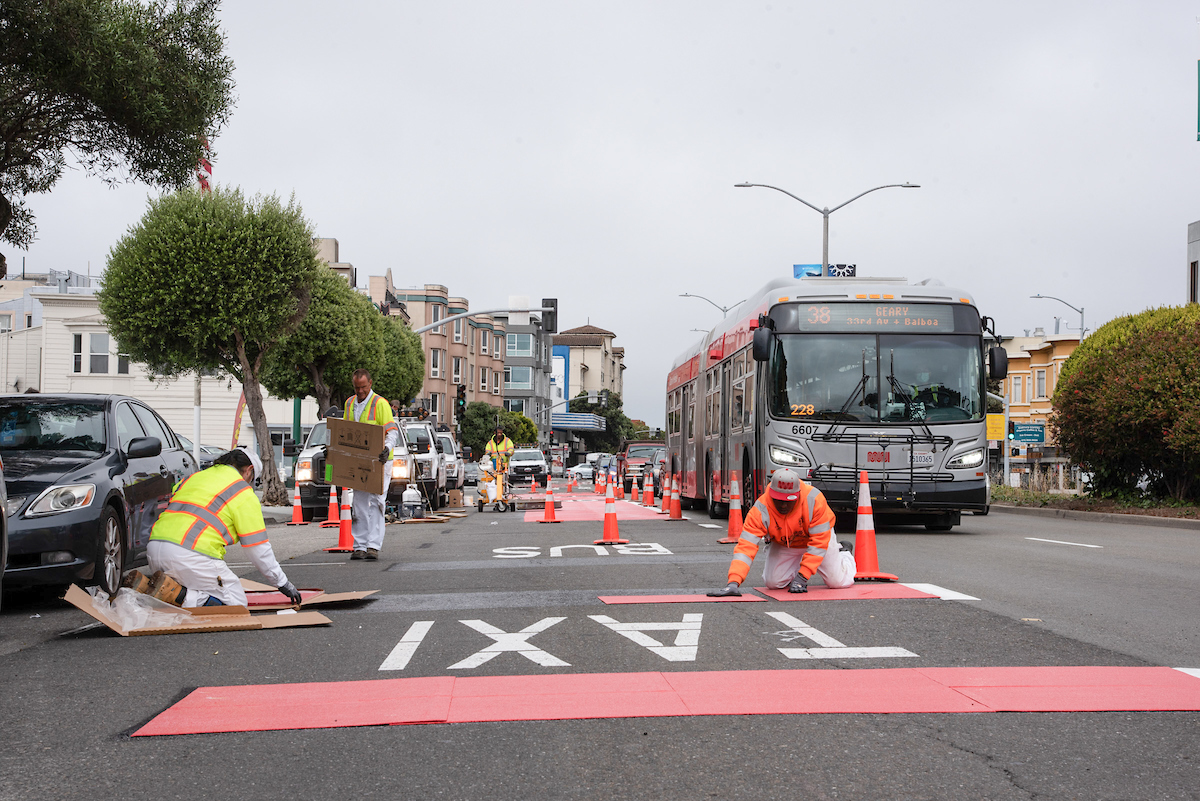
 

Photo of crew finishing red striping of Geary transit lane

Crews put the finishing touches on Geary Boulevard red lanes

Based on the success of San Francisco and other cities’ experiments, the Manual of Uniform Traffic Control Devices (MUTCD)—the national standards governing all traffic control devices—issued Interim Approval to use red transit lane treatments in late 2019. Now the 11th edition of the MUTCD is under development and is expected to include the treatment.


Published July 17, 2021 at 01:34AM
https://ift.tt/3z4ss8S

Comments

Popular posts from this blog

150 Years Ago Today – The Cable Car is Born

150 Years Ago Today – The Cable Car is Born By Kelley Trahan August 2, 2023, marks the 150th anniversary of the world’s first successful cable railway, born right here in San Francisco. To celebrate the occasion, we bring you the story of Andrew Hallidie and the very first cable car company, the Clay Street Hill Railroad.  Andrew Hallidie (1834-1900) was a pioneering inventor and entrepreneur who changed urban transportation. In 1852, at the age of 18, Hallidie emigrated with his father from the United Kingdom to San Francisco during the California Gold Rush. His father, an engineer and inventor, had a wire rope patent that played a crucial role in his son's future success.   Portrait of Andrew Smith Hallidie in 1890. Inspired by his father's wire rope business, Hallidie developed a steel cable mineral mine hauling system in 1857. About a decade later, he designed a wire rope aerial tramway for transporting materials over mountainous terrain. Then, after a stint in bridg...

Shared Spaces are Here to Stay. Permit Renewals are Due January 15, 2023.

Shared Spaces are Here to Stay. Permit Renewals are Due January 15, 2023. By Anne Yalon Shared Spaces, amongst many other benefits, allows our residents and families to enjoy safe and social outdoor dining. Seen here are the the owners of Tio Chilo’s Grill and their children in the restaurant’s parklet on 24th Street in the Mission.  San Francisco’s popular Shared Spaces program allows merchants, restaurants and arts and culture organizations to use the curbside, sidewalk and other public spaces to conduct local business activities and stay afloat. What emerged as an economic lifeline during the pandemic is making San Francisco’s streets more energized, engaged and activated. Many of the Shared Spaces parklets have become central gathering places for the local community. “ Our parklet makes me feel like when I go to Mexico, where outdoor seating is everywhere. People end up joining their friends in our parklet. It is a space for our customers and our community," said Liz V...

Virtual Parade and New Central Subway Art Ring in Lunar New Year

Virtual Parade and New Central Subway Art Ring in Lunar New Year By Sophia Scherr We are entering the year of the Ox, typically symbolizing hard work, positivity, and honesty. This year the SFMTA will continue the tradition of celebration with the virtual San Francisco Chinese New Year Parade   on February 20th at 6 pm on KTVU. Celebrating Lunar New Year and the San Francisco Chinese community has been a long-standing tradition for many of us. In 1849, San Francisco’s population swelled to 50,000 and many of the new residents were Chinese immigrants, coming to work in gold mines or on railroad lines. By the 1860’s, the Chinese were eager to share their culture with others and the annual tradition of parade and pageantry was born. A variety of other cultural groups throughout the city were invited to participate, and they marched down what today are Grant Avenue and Kearny Street with colorful flags, banners, lanterns, and drums and firecrackers to drive away evil spirits. The c...