By Shalon Rogers
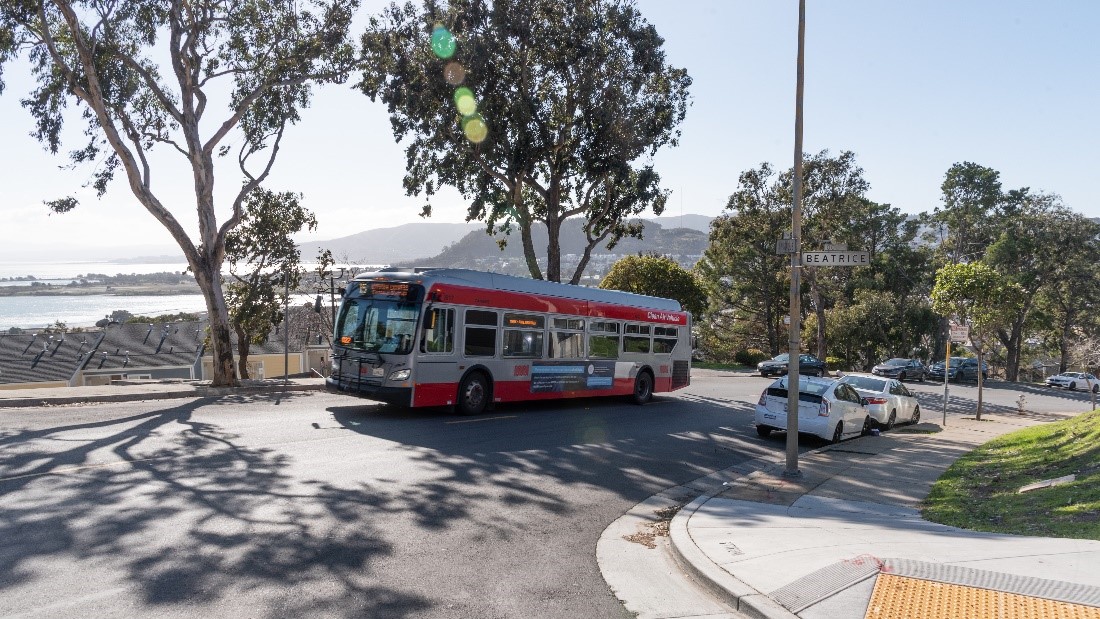 The 15 Bayview Hunters Point Express is one of Muni’s newest routes.
What should Muni service be like in 2022? Now’s your chance to weigh in.
The SFMTA is planning to increase Muni service in early 2022. As we add more Muni service, what is the best way to do so? Should we simply restore the seven all-day bus routes that are not currently running just the way they were before the pandemic? Should we improve the frequency and capacity of buses on high-ridership lines? How can we make Muni service better than it was? That’s what we need your help to figure out.
SFMTA is pursuing a number of ways to gather feedback from the public on the best path for Muni service moving forward including a series of public meetings, specific stakeholder outreach, and surveys in English, Chinese, Spanish, Filipino, Russian and Vietnamese.
Three alternatives for Muni service in 2022
To begin the discussion on what the 2022 Muni Service Network should look like, we’ve laid out three alternatives including: a Familiar alternative, a Frequent alternative and a Hybrid alternative. Each alternative has advantages and disadvantages. It should be noted that the return of service for the 10 Townsend and 28R 19th Avenue Rapid is included in all three alternatives.
The Familiar alternative brings back the all-day Muni routes that have yet to be restored at their pre-pandemic frequencies: the 2 Clement, 3 Jackson, 6 Haight/Parnassus, 21 Hayes, and 47 Van Ness (in addition to the 10 Townsend and 28R 19th Avenue Rapid, which will be restored under all of the scenarios).
The Frequent alternative increases service on high ridership Muni lines, improving reliability and connections to grocery stores, hospitals, schools and diverse workplaces, while decreasing wait times and crowding, made possible by restoring just two of the seven pre-pandemic Muni routes that we suspended in 2020.
The Hybrid alternative aims to balance the Familiar and the Frequent scenarios and restores five of the seven pre-pandemic routes.
Find Out More
To help customers better understand these three scenarios, SFMTA has created a StoryMap that explains in more detail what each option would look like. After reviewing the site, customers can then take a survey to provide their feedback, which can be completed online or by calling a hotline.
Additionally, SFMTA will be hosting a set of virtual open houses where staff will present the three options and offer participants an opportunity ask questions and provide feedback. We will also hold virtual office hours when project staff will be available to answer questions about the three different options in a casual setting.
Youth are particularly encouraged to join our Virtual Office Hours with SFMTA staff on Thursday, September 23 at 6 p.m. to find out how the three scenarios for Muni service would change how they get to school and to activities around San Francisco. Youth will be able to ask questions and get answers from SFMTA staff about what matters to them most about Muni service in 2022.
Virtual Open Houses (attend one)
- Saturday, September 18 at 11 a.m.
- Wednesday, September 22 at 6 p.m.
- Thursday, September 23 at 11 a.m.
Virtual Office Hours (attend as-needed)
- Monday, September 20 at 11 a.m.
- Thursday, September 23 at 6 p.m. **Youth-centered Office Hours**
The feedback gathered from the survey, combined with transit data, will be used to develop a proposal for the 2022 Muni Service Network. The proposal will then be presented to stakeholders for fine tuning before being brought to the SFMTA Board for consideration later this year.
Published September 07, 2021 at 10:51PM
https://ift.tt/38U1u8J
Comments
Post a Comment