By Jonathan Streeter
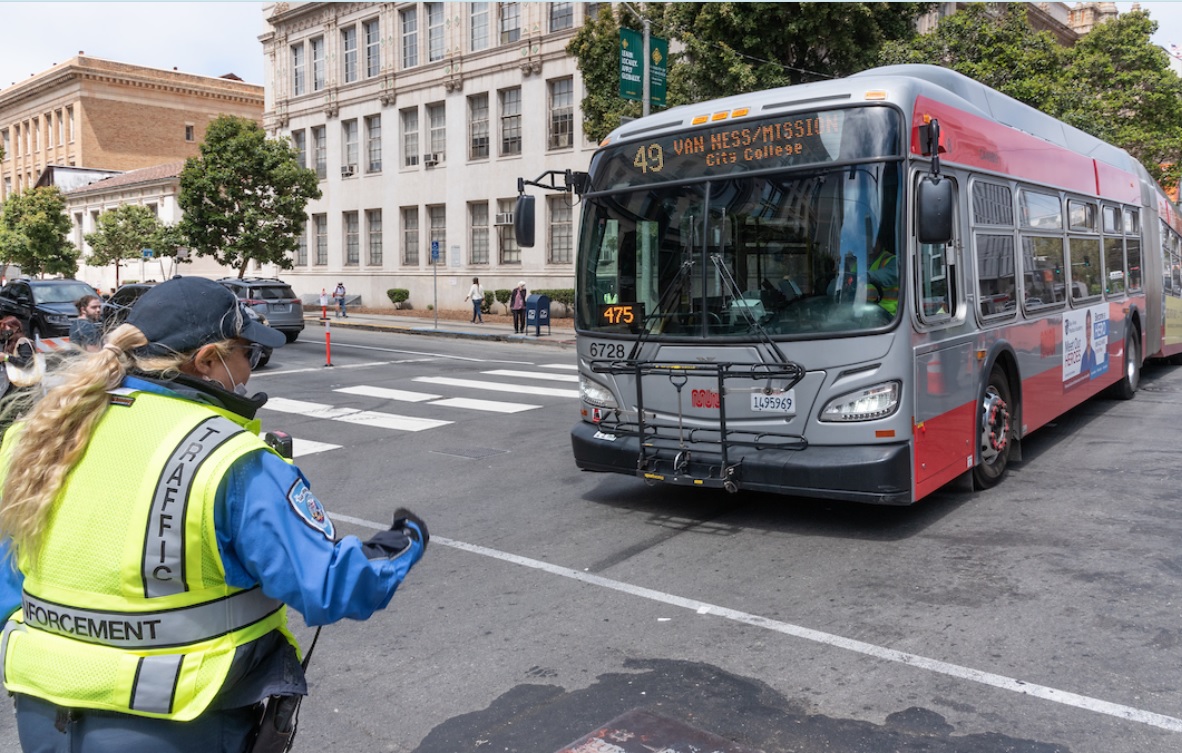
Our goal for Muni in 2021 was to match the service we offer with the changing travel patterns of an unpredictable era, as San Franciscans grappled with a second year of the COVID-19 pandemic. To achieve this, we expanded on the core routes that formed the nucleus of our early 2020 pandemic network by adding and improving service in key areas throughout San Francisco. We focused on access in neighborhoods where essential workers live, as well as on adding service in busy corridors and even creating new lines.
At the beginning of the year, even with our reduced schedule, 91% of San Franciscans were within two or three blocks of a Muni stop. This included 100% of residents in San Francisco’s neighborhoods identified by the Muni Service Equity Strategy. By summer 2021, we added enough additional service so that 98% of San Franciscans were within two or three blocks of a Muni stop.
To the relief of many, and as an early sign of the city’s return to some sense of normalcy, we brought back Muni Metro service in the subway in May 2021, with access to all stations from Embarcadero through to West Portal. The SFMTA worked to address longstanding subway congestion issues that were a major cause of delay pre-pandemic by exclusively running two-car trains in the subway, including a combined KT Ingleside Third, and as-needed shuttle service. In doing so, we were able to increase capacity and improve on-time performance over the course of the year. The J Church is scheduled to return to the subway in February 2022 while efforts to address longtime subway service challenges continue.
To help support the economic recovery of the city, local tourism and small businesses we also brought cable cars back to the hills of San Francisco in September 2021 after extensive maintenance and testing. These iconic cars not only serve as a symbol of our city, they also provide an important link on steep streets between downtown and Fisherman's Wharf, as well as to Cathedral Hill.
On the street, San Francisco traffic returned to near pre-pandemic levels. To keep transit service fast and reliable for essential workers and those with the fewest transportation choices, we implemented temporary emergency transit lanes (TETLs). These lanes are dedicated to Muni vehicles to help keep our customers moving, as well as helping other buses and, in most cases, taxis.
Of the nearly 10 miles of lanes initially implemented, almost six miles of these transit lanes have been made permanent because of their success in protecting transit travel-time savings. That’s the fastest expansion of transit lanes in the city’s history! These transit lanes give nearly two-thirds of Muni riders priority on congested streets and improve the speed and reliability of bus service; getting you to your destination faster.
A significant aspect of transportation in 2021 was the continued shift by Muni riders toward using buses and trains for essential trips and to stores, appointments, schools and recreational destinations rather than to downtown for office work. We responded to these changes by modifying routes.
For example, we launched the temporarily combined route —the 36/52 Special — which served the hilltop neighborhoods of Forest Hill, Miraloma and Sunnyside in a loop between Forest Hill Muni Station and Glen Park BART Station before service was restored to the 36 Teresita and 52 Excelsior in August. As travel patterns shifted over the year, SFMTA’s transit planners developed creative solutions to meet San Francisco’s evolving transportation needs with available resources.
The SFMTA continued to face resource limitations in 2021 that curtailed our ability to bring service back to our original network. Without enough operators and other key staff, we had to make tough choices about which lines to serve and how much frequency to provide. Muni ridership has also not fully recovered. As of December 2021, ridership throughout the network is still at about only half of pre-pandemic levels.
We asked San Franciscans in fall 2021 what we should prioritize when we’re able to add more Muni service in 2022. Based on feedback from meetings, emails, phone conversations and more than 4,500 survey responses, we developed a plan that focuses on restoring connections and meeting the needs of all San Franciscans, especially people with disabilities and seniors. We also heard a call for increased frequency to reduce crowding and wait times on high ridership Muni lines. That proposal was approved by the SFMTA Board of Directors on December 7, 2021.
Throughout the year, Muni customers have shown that they are increasingly ready to return to riding buses and trains and are eager for our network to serve all their desired destinations in San Francisco. We are grateful for the cooperation of the public with revised schedules, mask mandates and other changes that the pandemic has necessitated. We are also incredibly grateful to the people who drive our vehicles through city streets with professionalism, courtesy and safety every single day.
To read more about how we “met the moment” review our 2021 Annual Report.
Published December 30, 2021 at 04:15AM
https://ift.tt/3qCDUpy
Comments
Post a Comment