By Kharima Mohamed
Due to the nationwide AT&T 3G shutdown on February 22, 2022, over 650 NextMuni displays that are currently utilizing AT&T 3G modems will no longer be able to display real-time Muni vehicle arrival predictions or other information. The push-to-talk buttons at shelters using 3G modems will also be inoperable. This outage will NOT impact online real-time information provided on mobile and web formats.
To address this situation, the SFMTA is:
-
Expediting delivery and installation of new replacement displays procured under the Next Generation Customer Information System (CIS) project.
-
Upgrading modems in existing displays from 3G to 4G to maintain predictions while awaiting the new replacement displays.
-
Providing physical static signage at affected stops and platforms indicating how riders can obtain real-time information in other formats, including by web, text and phone.
As part of the Next Generation Customer Information System project, the SFMTA is ordering over 700 new Liquid Crystal Display (LCD) displays to display real-time information at Muni transit shelters. Approximately one-third of these displays will be double-sided to provide additional visibility at the highest-ridership stops and major transfer points.
The LCD displays will replace existing NextBus Light Emitting Diode (LED) displays, many of which have been in service for two decades and have reached the end of their lives. These LED displays are no longer manufactured.
An extensive public outreach effort helped provide the new display’s overall design and other Customer Information System elements.
Key features of the new displays include:
-
24-inch LCD screens with vandal-resistant tempered glass
-
Americans with Disabilities Act (ADA) compliant text-to-speech capability
-
Larger and clearer text
-
Letters and characters in multiple languages
Unfortunately, the pandemic and global supply chain issues have impacted the manufacturing and delivery of the new replacement displays and brackets to mount these displays. Our display supplier has shipped over 150 of these displays. Once brackets arrive, the SFMTA will coordinate with Clear Channel and start to install them. This effort is currently anticipated for late February and will continue into the spring.
Manufacturing and installation will continue for all display types – including double-sided shelter displays for higher ridership stops, surface rail station signs, and underground rail station displays – for another year. Our contractor, Cubic, is working with its suppliers to reduce this timeline contingent upon easing of global supply chain issues. The SFMTA is prioritizing display installations in shelters based on serving equity neighborhoods/or routes, as well as less frequent services where customers experience the longest waits. The rationale for those priorities is to minimize inconvenience for as many customers as possible with an emphasis on equity populations.
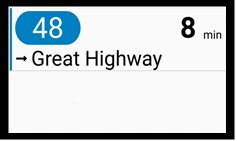
Preliminary design of the shelter display indicating estimated vehicle arrival time and route destination.
Physical signage at affected stops and platforms providing alternative methods to obtain real-time information:
- The SFMTA will install physical weatherproof multilingual signs at potentially impacted shelters and platforms to inform riders how they can alternatively access predictions, which will remain available through mobile, web and phone.
- To provide customers with context-sensitive information and maximize convenience, the posted signs will provide available channels where customers can access location-specific predictions for routes serving their stop.
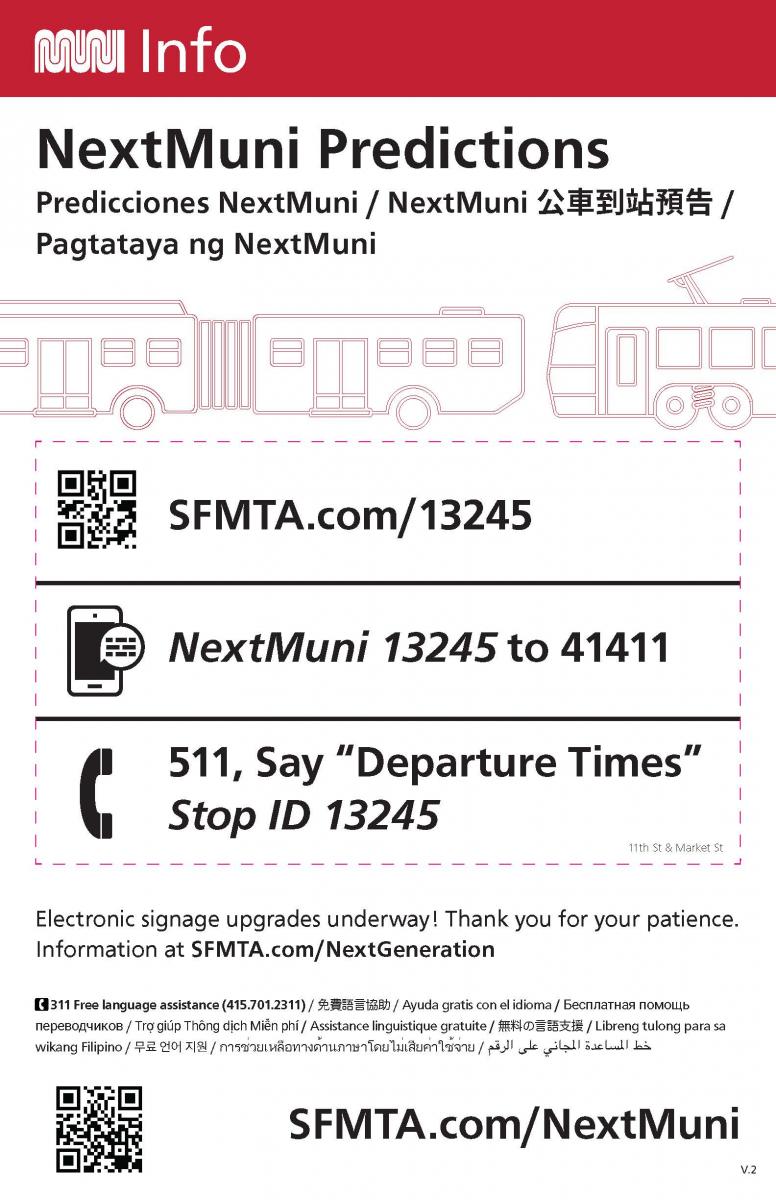
Printed sign at stops where real-time information on NextMuni displays will not be available due to AT&T’s nationwide 3G decommissioning; information will still be available through mobile, web online means and phone.
Options to access information include:
-
SFMTA.com Stop Pages – The posted signs will include a URL and QR (Quick Response) code that will enable customers to access specific stop pages on the SFMTA website that include predictions for routes serving that location. Each page has a convenient short URL of its stop ID. For example, Market and 11th can be found at SFMTA.com/13245.
-
SFMTA.com/NextMuni – The SFMTA will enable geolocation on a new page of our website, SFMTA.com/NextMuni. Based on a user’s location, this page returns the nearest stop pages to find applicable predictions. The page will also include a lookup for address, intersection and places of interest as well as a map interface for users that do not wish to use geolocation.
-
511 Voice Response – Customers will be able to dial 511 and enter or say the stop ID to receive applicable predictions.
-
SF 3-1-1 Operator Assistance – Customer Service Representatives are available to provide predictions and multilingual support 24 hours a day, 7 days a week via telephone, and TTY (via 711).
-
SMS (Short Message Service) Text – Customers may also text the stop ID to 41411 to receive predictions.
Additionally, the SFMTA’s Twitter account, @sfmta_muni provides real-time alerts about Muni service disruptions and provides predictions. During staffed hours, the SFMTA will inform customers when their next departure is if they tweet their location, route and direction.
The SFMTA will continue to monitor the situation with AT&T’s 3G decommissioning and adjust plans if necessary. We will work with Cubic to expedite delivery and installation of new CIS displays.
In the meantime, we are soliciting feedback from key stakeholders on the design of the new CIS display as we fine-tune how information will be displayed and focused on improving prediction quality for riders. These improvements, anticipated to go live in Fall 2022, include minimizing ghost buses, improving terminal departure predictions, indicating vehicle location and supporting headway-based operations on routes.
Published February 12, 2022 at 06:52AM
https://ift.tt/KwV51ty
Comments
Post a Comment