By Erin McMillan
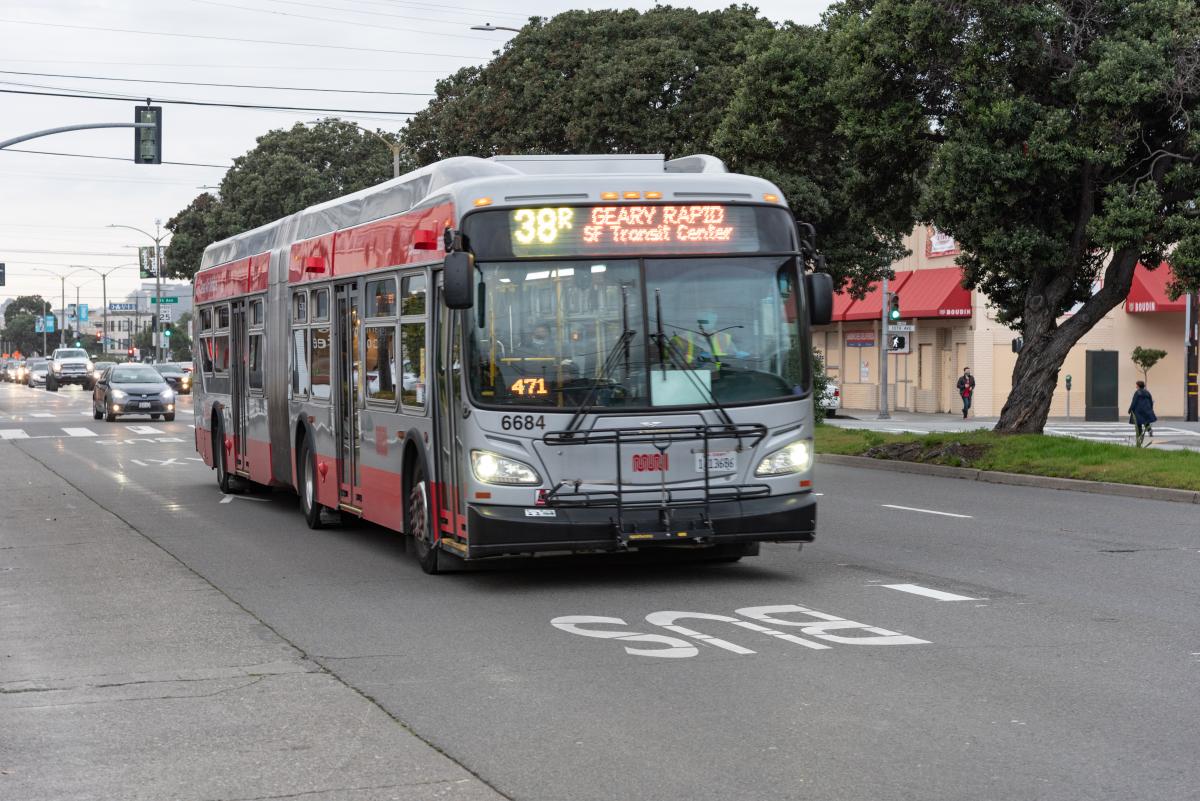
The 38R Geary Rapid reaping the benefits of the Temporary Emergency Transit Lane on Geary Boulevard.
Today marks the start of Transit Month! Every year we look forward to celebrating Transit Month by looking back at all the successes of the previous year—and also by thinking of our upcoming opportunities to continue to improve Muni.
Over the past year, we have made a series of improvements through our Muni Forward program that reduced travel times, wait times and crowding:
- Reduced travel time by up to 31% on key bus routes as part of the Temporary Emergency Transit Lanes program, giving more riders the benefit of the transit lanes faster.
- 10 miles of transit lanes were made permanent benefitting the T Third, 1 California, 14 Mission, 19 Polk, 27 Bryant, 38 Geary, 43 Masonic and the 44 O’Shaughnessy. This cool animation shows how transit priority is improving Muni travel times citywide!
- As part of the TETL program, last October, the San Francisco Transit Riders gave us an award to honor the “Fastest Expansion of Transit Lanes in San Francisco History.”
- Started bus rapid transit service on Van Ness Avenue, with initial weekday travel time savings of up to 35% on northbound trips, equating to 9 minutes a trip. And southbound, up to 22% travel time savings, or 5 minutes on a trip.
- Completed the Geary Rapid Project, which improved one of the city’s busiest corridors with much-needed safety improvements and more reliable bus service for the 38 Geary and 38R Geary Rapid’s over 56,000 daily customers.
- Installed the one of a kind urban high-occupancy vehicle (HOV) lanes along Park Presidio Boulevard and Lombard Street that expands the capacity of those streets to carry more people with the same number of lanes.
- Reduced collisions on California Street by 64% for all modes and 89% for transit as measured in the evaluation of the California Street Safety Project.
- Began implementing spot improvements to the top ten corridors where Muni experiences delay as part of the Transit Delay Hot Spots Program. The improvements feel small but benefit the full route.
- Continued construction of transit reliability improvements on 19th Avenue, Taraval Street, 16th Street, Mission Street in SoMa, and along the 27 Bryant in the Tenderloin.
To see locations where Muni Forward improvements have been made across the city, check out this interactive Photo Map. Whether targeted spot locations, or along major corridors, improvements to the Muni network benefits everyone.
And looking ahead, we have started planning for Muni Forward improvements to the J Church, K Ingleside, M Ocean View, N Judah, 29 Sunset and 38 Geary. For some Muni lines, we hope to implement quick-build improvements as soon as next year! To support this work, and other work across the SFMTA, we were recently awarded $116 million from the California State Transportation Agency of the Transit and Intercity Rail Capital Program (TIRCP). Be on the lookout for more improvements coming soon!
Of course, that’s not all we’re doing to improve transit: we’ve been restoring service across the system, rehabilitating our subway system, and we’re putting the final touches on the Central Subway. Read more about our progress on enhancing transit service and safety in San Francisco.
Happy Transit Month, Muni riders! And for more information on the San Francisco Transit Riders Ride Along & Rally Wednesday, September 7 from 8 am - 10 am, please visit San Francisco Ride Along & Rally.
Published September 01, 2022 at 11:49PM
https://ift.tt/ZV42TM3
Comments
Post a Comment