By Jeremy Menzies
Beginning in January 2023 full service on the new T Third extension 2023 will run from Sunnydale to Chinatown every day. In this two-part blog series, we will look back at some of the history of the T Third Street line. Part 1, published last month goes through the first 100+ years. In Part 2, we look at the recent history of the T Third and Central Subway projects from the 1980s to today.
The Call for Better Transit: 1980s-90s
In the decades following World War II, the neighborhoods along the southern end of 3rd Street became more economically depressed and transit service declined. Residents felt cut off from the rest of the city as bus service did not meet their needs.
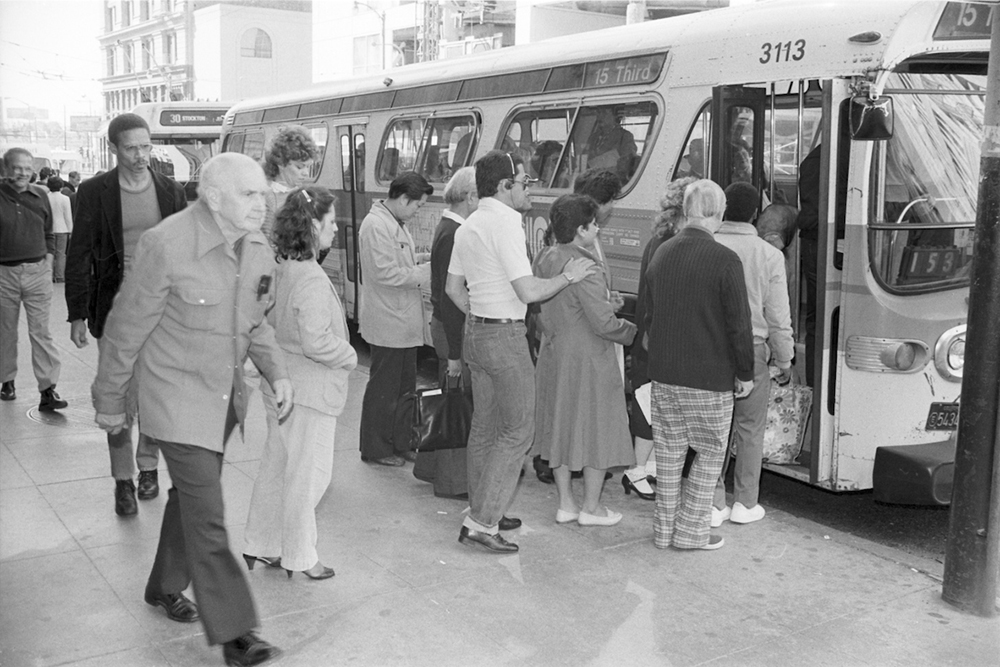 People boarding a 15 Route bus on 3rd Street near Market in 1983. Bus service on the 15 provided critical north-south service through the City’s busiest areas.
In the late 1980s, the city was looking to revitalize the Mission Bay, Dogpatch, and Bayview and reliable transit was critical to this goal. Early outreach and research resulted in the 1993 Bayshore Transit Study. This initial plan solicited community input on several possible solutions on how to improve transit to these neighborhoods. Two years later in 1995, the Four Corridor Plan built upon the Bayshore Transit Study and elevated 3rd street as the top priority for San Francisco’s long-range transit plan. It was clear that residents, particularly in Bayview, wanted rail service to return to 3rd Street.
T Third Phase 1: 1990s-2007
These reports and outreach formed the backbone of the Third Street Light Rail Project, which would be built in two initial Phases. Phase 1 involved extending Muni Metro service from 4th and King to Bayshore Boulevard along 3rd Street. Phase 2 would focus on the 4th and Stockton corridors to extend the service into Chinatown and possibly North Beach.
By the end of the ‘90s, funding was coming in to make Phase 1 a reality. Early plans for the T also included a new rail maintenance facility, Muni Metro East, as well as a turnback loop in Mission Bay and a direct connection to the Bayshore Caltrain Station. Due to various factors during preconstruction planning, the Mission Bay Loop and Bayshore Caltrain connection were dropped from the T Line plan.
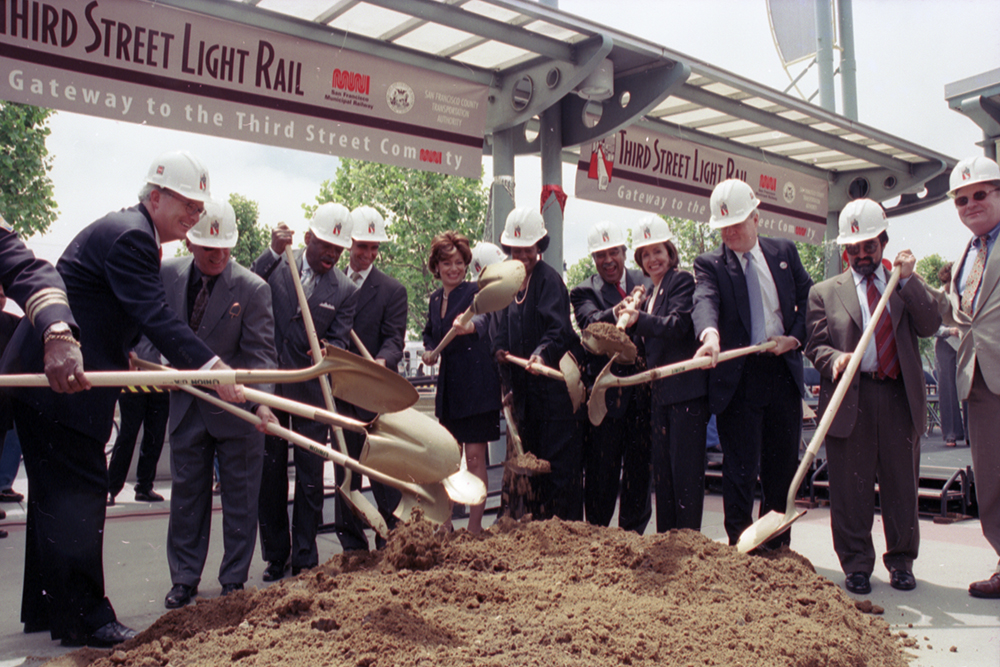
A groundbreaking ceremony for T Third construction was held on May 28, 2002 at the 4th and King Caltrain Station.
Construction of 5.1 miles of new tracks, overhead power lines, lighting, stations, and a variety of other improvements took five years to complete. On January 13, 2007, free weekend shuttle service commenced on the new line and full weekday service started on April 7. Just one year later in 2008, the Muni Metro East rail yard opened, boosting Muni’s ability to serve the new line. For the first time in 50 years, rail service returned to the eastern waterfront.
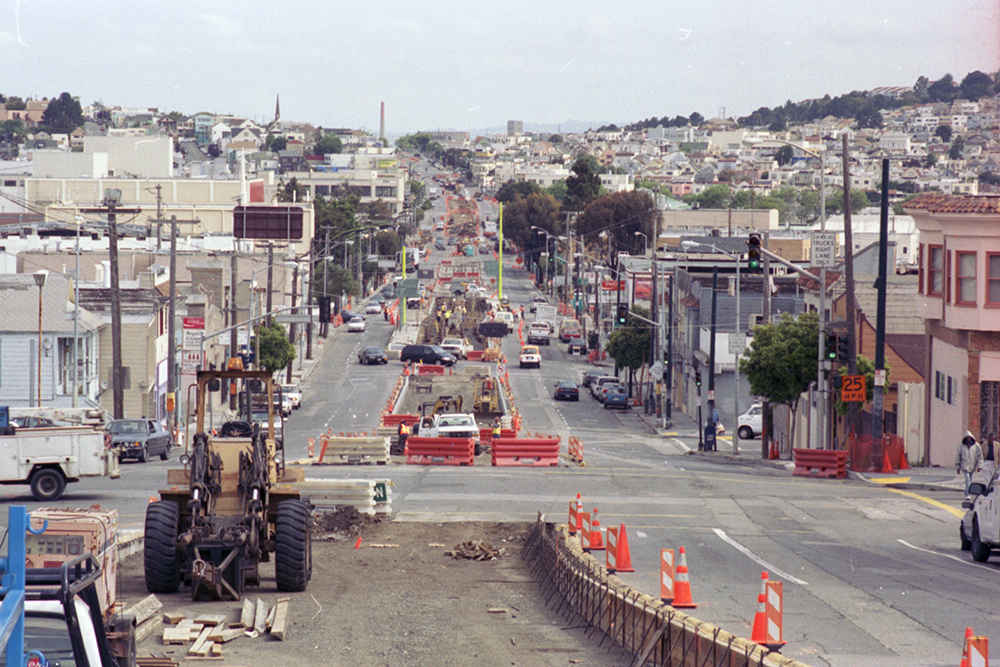 View north along 3rd Street at Jamestown Avenue during construction in 2004.
T Third Phase 2: Central Subway
Planning and outreach for Phase 2 of the T Line had already begun when the line opened in 2007. The Central Subway Project was created to address the transit needs of Chinatown, Union Square and South of Market. Construction would extend the T nearly two miles and build the first new subway in the city since the 1970s.
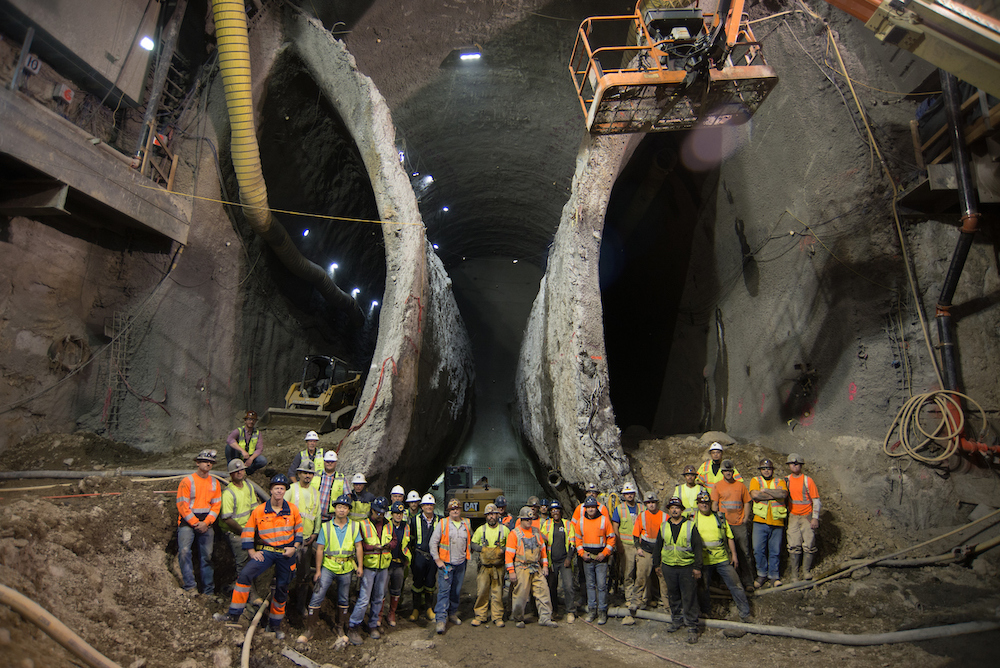 This 2016 photo, taken inside the excavation for Chinatown Station shows the massive scale of the Central Subway Project.
Early proposals showed the Central Subway traveling north on 3rd Street and along Geary where it would turn up Stockton to end in Chinatown. Going south, the line would branch and exit the tunnel on 4th Street. The challenges of construction along 3rd and at Market Street resulted in a plan to run the line on 4th and Stockton streets. It was also decided to tunnel underneath the Market Street Subway/BART tunnels using special tunnel boring machines instead of more conventional construction methods.
The official groundbreaking ceremony took place on February 9, 2010. The arduous process of building a subway with four stations through San Francisco’s densest neighborhoods began soon after. Despite an intensive construction period with project delays and cost increases, the Central Subway opened for service on November 19, 2022.
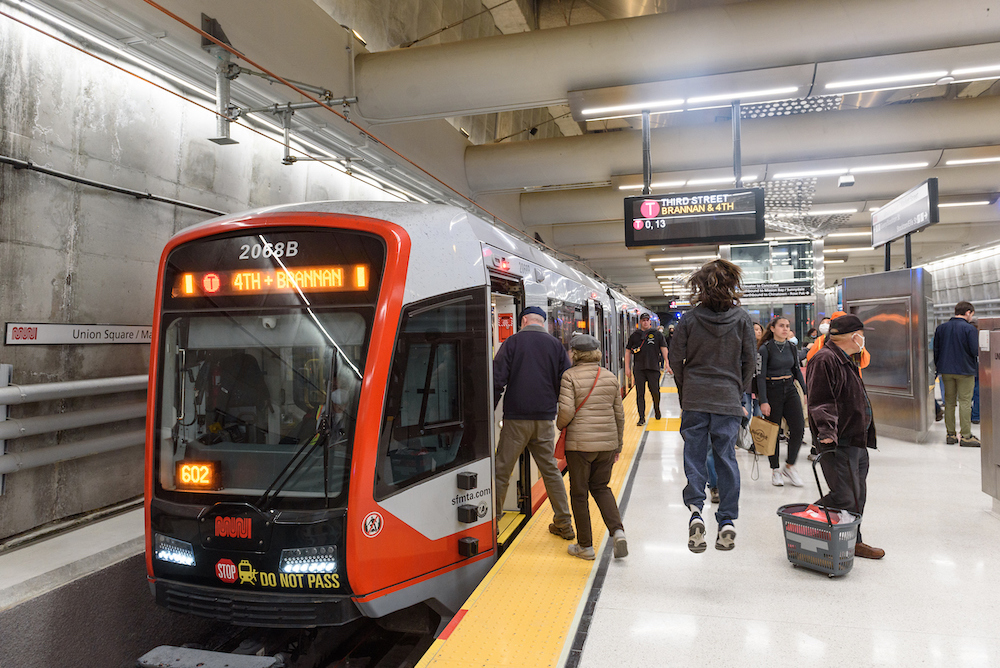 Opening day of the Central Subway on November 19, 2022. Thousands of people came out to see and ride in the long-awaited subway.
Over 30 years in the making, the T Third line follows in the footsteps of the first horsecars that ran over 160 years ago. However, this is not the end of the line for the T. Planning is already underway on the T Third Phase 3 extension. Aimed at expanding service beyond 3rd Street, this extension will mark yet another chapter in San Francisco’s transportation history.
Published December 16, 2022 at 12:52AM
https://ift.tt/LpuqYzs
Comments
Post a Comment