A Decade of Rolling out the Red Carpet for Riders

A Decade of Rolling out the Red Carpet for Riders
By Cassie Halls

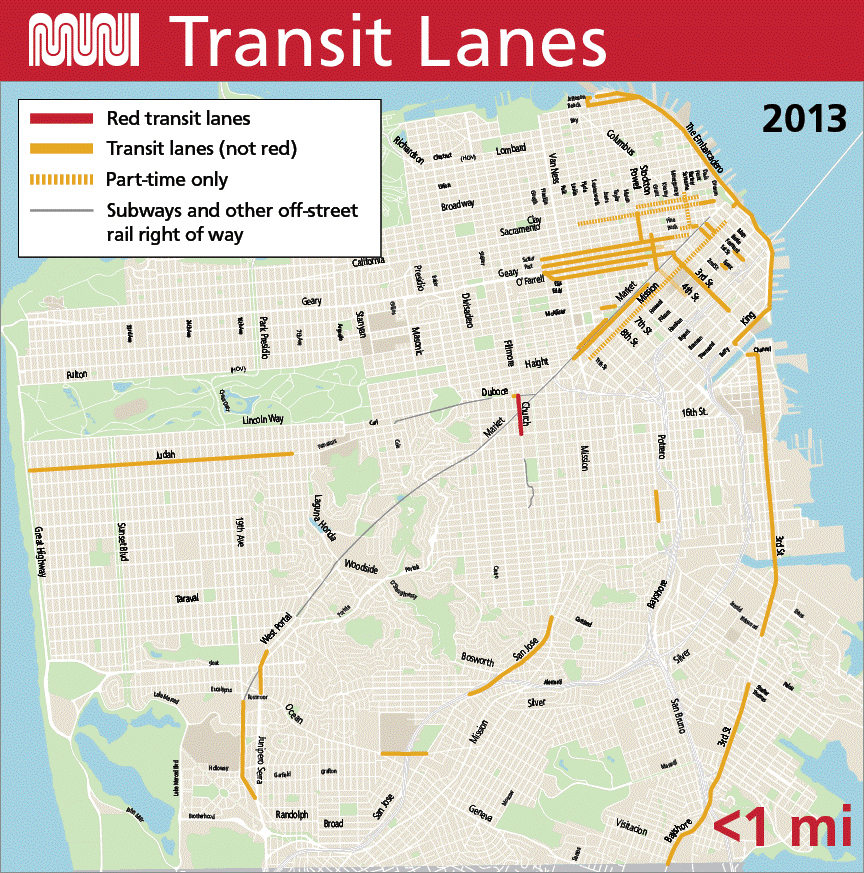
 A map showing the expansion of transit lanes in San Francisco from 2103 to 2023, as well as lanes that are coming soon. A summary of key highlights from the map is included in the following link.

An animated map showing the expansion of red transit lanes in San Francisco. View as a PDF. Accessible version of the expansion of red transit lanes: 

Red Transit Lanes Over Time in San Francisco from 2013 to 2023 

There is nothing quite like looking out the window at gridlock traffic while your bus coasts down a red transit lane. This may feel like an “only in San Francisco” pleasure – after all, San Francisco was one of the first U.S. cities to “roll out the red carpet” by painting bus lanes red. But red transit lanes have now become a popular way to keep buses out of traffic in more than 25 cities across the country. 

The SFMTA is celebrating a decade since the installation of San Francisco’s first red transit lane on Church Street on March 23, 2013. You can help us celebrate by riding that first red transit lane between Duboce and 16th Streets on Muni’s 22 Fillmore and J Church along with thousands of other weekday riders. As you whiz past traffic, you may feel the estimated 14% time savings afforded by the red color.  

If you drive, help us celebrate by keeping transit lanes clear. Remember, double parking in transit lanes is camera enforced. Transit lanes are an essential tool to keep Muni moving on San Francisco’s busy streets.  

Dedicated transit lanes started popping up in the city as early as the 1970s following the adoption of the city’s Transit-First Policy (which happens to be turning 50 this month). As of 2023, over 20 lane miles of transit lanes now also have the red treatment, in addition to 55 miles of transit and bus/HOV lanes without red paint.  
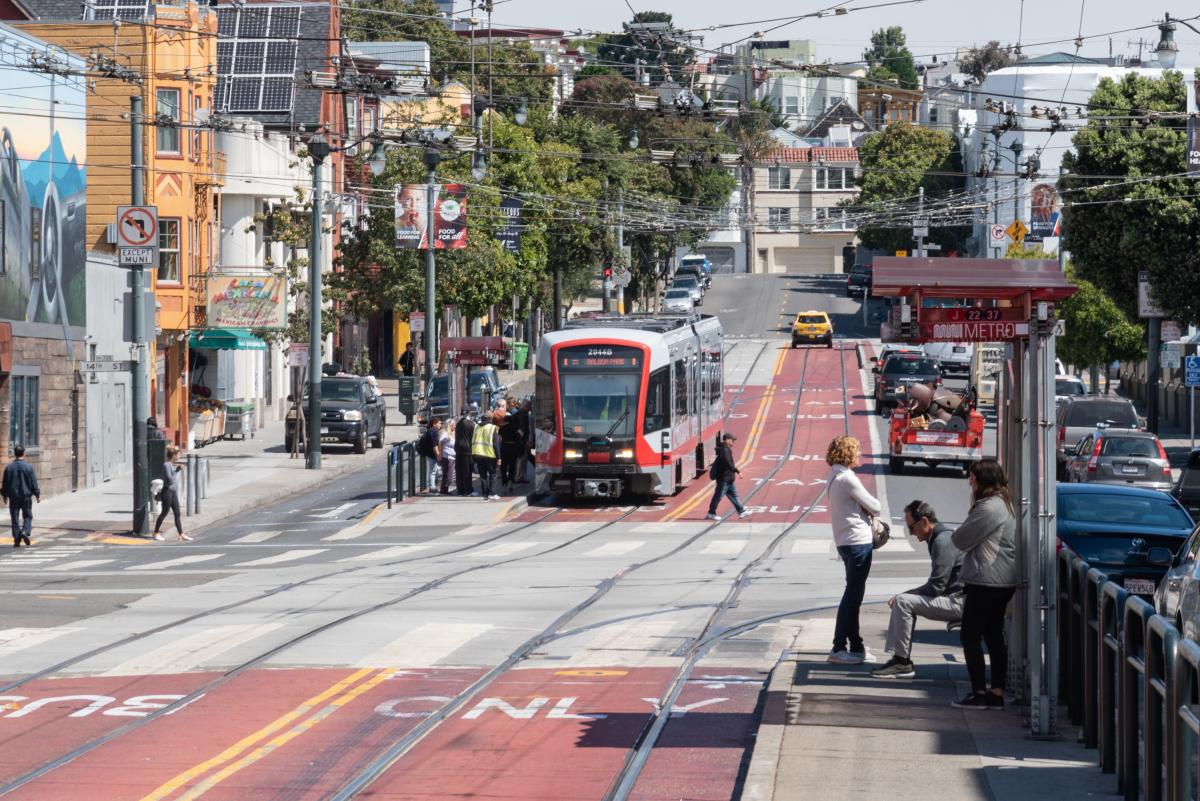
J Church using red transit lanes and picking up passengers on a boarding island on Church at Market Street.

J Church train using red transit lanes on Church at Market Street. 

Although often the most visible, transit lanes are one of more than 20 tools in our toolbox to improve transit reliability and reduce delays. With Muni Forward, we’ve built more than 80 miles of transit corridor reliability improvements to keep Muni moving — with upgrades like bus bulbs for faster boarding and traffic signals that stay green for transit.  

As an early adopter of red transit lanes, the SFMTA helped lay the groundwork to change federal guidelines to make it easier to paint lanes red. This is because red colorization has led to a 55% improvement in motorist compliance and is a cost-effective way to reduce delays. We have to say they’re looking great for their age! 

We know that despite our best efforts, Muni buses and trains are sometimes stuck in traffic and transit lanes are occasionally blocked. That is why we continue to innovate to bring improvements to our riders. Last year we colorized six miles of transit lanes in the Van Ness Improvement Project, Geary Boulevard Improvement Project, and along Mission Street in SoMa, 4th Street and Stockton Street. We also continue to install Muni Forward transit priority projects across the city and push for further compliance improvements through an education campaign for motorists. The SFMTA was also recently awarded a state grant to deploy new next-generation camera technology as a part of the transit lane enforcement program. 

Stay tuned for more red transit lanes and other reliability improvements in the year ahead.  


Published March 22, 2023 at 02:05AM
https://ift.tt/VP0XY5k

Comments

Popular posts from this blog

150 Years Ago Today – The Cable Car is Born

150 Years Ago Today – The Cable Car is Born By Kelley Trahan August 2, 2023, marks the 150th anniversary of the world’s first successful cable railway, born right here in San Francisco. To celebrate the occasion, we bring you the story of Andrew Hallidie and the very first cable car company, the Clay Street Hill Railroad.  Andrew Hallidie (1834-1900) was a pioneering inventor and entrepreneur who changed urban transportation. In 1852, at the age of 18, Hallidie emigrated with his father from the United Kingdom to San Francisco during the California Gold Rush. His father, an engineer and inventor, had a wire rope patent that played a crucial role in his son's future success.   Portrait of Andrew Smith Hallidie in 1890. Inspired by his father's wire rope business, Hallidie developed a steel cable mineral mine hauling system in 1857. About a decade later, he designed a wire rope aerial tramway for transporting materials over mountainous terrain. Then, after a stint in bridg...

Shared Spaces are Here to Stay. Permit Renewals are Due January 15, 2023.

Shared Spaces are Here to Stay. Permit Renewals are Due January 15, 2023. By Anne Yalon Shared Spaces, amongst many other benefits, allows our residents and families to enjoy safe and social outdoor dining. Seen here are the the owners of Tio Chilo’s Grill and their children in the restaurant’s parklet on 24th Street in the Mission.  San Francisco’s popular Shared Spaces program allows merchants, restaurants and arts and culture organizations to use the curbside, sidewalk and other public spaces to conduct local business activities and stay afloat. What emerged as an economic lifeline during the pandemic is making San Francisco’s streets more energized, engaged and activated. Many of the Shared Spaces parklets have become central gathering places for the local community. “ Our parklet makes me feel like when I go to Mexico, where outdoor seating is everywhere. People end up joining their friends in our parklet. It is a space for our customers and our community," said Liz V...

Tenderloin Streets Transform During COVID-19

Tenderloin Streets Transform During COVID-19 By Kimberly Leung COVID-19 has disproportionately impacted people who live and work in the Tenderloin. As a result, the SFMTA has been working closely with District 6 Supervisor Matt Haney’s office, other city departments, the Tenderloin Traffic Safety Task Force and community members to address the public health issues and unique challenges in the neighborhood through innovative interventions.    The Tenderloin is home to many of our most vulnerable communities including historically marginalized groups such as people with disabilities, residents of SROs and supportive housing and limited-English proficient communities. With every single street in the Tenderloin on the city’s High Injury Network -- the 13 percent of San Francisco streets that account for 75 percent of severe traffic injury collision and fatalities -- thi...