Take Muni’s Safety Survey!

Take Muni’s Safety Survey!
By Greer Cowan

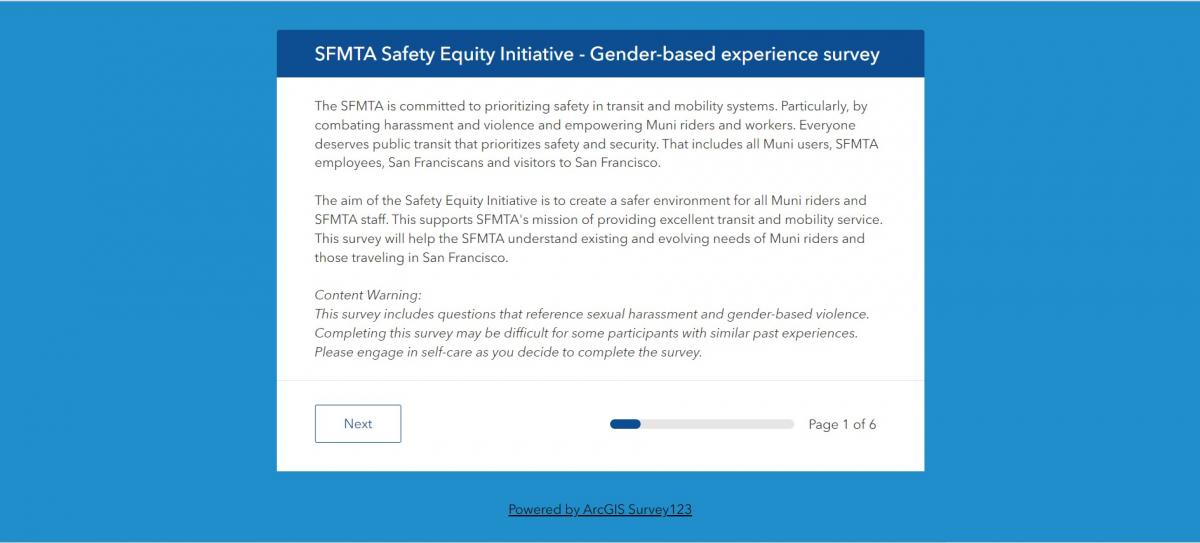
 "Image of the survey introduction. The accessible text of this introduction is available by following the links below.

Everyone should feel safe on Muni. Help make Muni safer by taking the SFMTA’s survey about personal safety and harassment in the Muni system.  

As part of the MuniSafe Safety Equity Initiative launched in August 2022, the SFMTA has partnered with the UCLA Institute of Transportation Studies to better understand Muni riders’ experiences and develop safety recommendations, tools and policies aimed at preventing harassment and assault on Muni. 

Take the 5-minute survey 

Survey information will also help the SFMTA understand Muni customers’ specific safety needs and challenges, and help us identify valuable trends and patterns so we know where, when and how harassment shows up in the Muni system. 

Incidents often go unreported, but the SFMTA is working to change that with new reporting options. As of October 2022, Muni customers can report incidents of  harassment by calling 311, using the 311 mobile app or using the Muni Feedback form at SFMTA.com/MuniFeedback. Each report is investigated by the SFMTA’s Safety and Security Division, and Muni operators are made aware as necessary. 

The SFMTA is committed to the safety, rights and dignity of all riders and working to combat the disturbing and unacceptable  violence we’ve seen on transit. In recent months, we have seen terrible incidents of anti-Asian verbal and physical violence, derogatory hate speech like racial and homophobic slurs, and increased anti-Semitism. In addition, gender-based harassment is one of the most expansive and persistent forms of violence. It is especially pervasive on transit, most often impacting women, girls and gender-expansive people of all ages, abilities, races and ethnicities, cultural and language groups. Studies show that women often feel unsafe on transit, which impacts how often they ride, when they ride and if they ride at all. This is especially true for women and girls from Black, Asian, Latinx, Indigenous and other communities of color. 

Harassment and safety issues on transit can cause women and gender-expansive people – people who don’t conform to traditional gender roles – to shift their travel behavior by traveling at different times of day, choosing longer routes where they feel safer or using rideshares or private vehicles when they can afford to. 

To learn more about the Safety Equity Initiative visit our project page at SFMTA.com/SafetyEquity.  


Published March 03, 2023 at 04:21AM
https://ift.tt/Elj6cUh

Comments

Popular posts from this blog

150 Years Ago Today – The Cable Car is Born

150 Years Ago Today – The Cable Car is Born By Kelley Trahan August 2, 2023, marks the 150th anniversary of the world’s first successful cable railway, born right here in San Francisco. To celebrate the occasion, we bring you the story of Andrew Hallidie and the very first cable car company, the Clay Street Hill Railroad.  Andrew Hallidie (1834-1900) was a pioneering inventor and entrepreneur who changed urban transportation. In 1852, at the age of 18, Hallidie emigrated with his father from the United Kingdom to San Francisco during the California Gold Rush. His father, an engineer and inventor, had a wire rope patent that played a crucial role in his son's future success.   Portrait of Andrew Smith Hallidie in 1890. Inspired by his father's wire rope business, Hallidie developed a steel cable mineral mine hauling system in 1857. About a decade later, he designed a wire rope aerial tramway for transporting materials over mountainous terrain. Then, after a stint in bridg...

Shared Spaces are Here to Stay. Permit Renewals are Due January 15, 2023.

Shared Spaces are Here to Stay. Permit Renewals are Due January 15, 2023. By Anne Yalon Shared Spaces, amongst many other benefits, allows our residents and families to enjoy safe and social outdoor dining. Seen here are the the owners of Tio Chilo’s Grill and their children in the restaurant’s parklet on 24th Street in the Mission.  San Francisco’s popular Shared Spaces program allows merchants, restaurants and arts and culture organizations to use the curbside, sidewalk and other public spaces to conduct local business activities and stay afloat. What emerged as an economic lifeline during the pandemic is making San Francisco’s streets more energized, engaged and activated. Many of the Shared Spaces parklets have become central gathering places for the local community. “ Our parklet makes me feel like when I go to Mexico, where outdoor seating is everywhere. People end up joining their friends in our parklet. It is a space for our customers and our community," said Liz V...

Tenderloin Streets Transform During COVID-19

Tenderloin Streets Transform During COVID-19 By Kimberly Leung COVID-19 has disproportionately impacted people who live and work in the Tenderloin. As a result, the SFMTA has been working closely with District 6 Supervisor Matt Haney’s office, other city departments, the Tenderloin Traffic Safety Task Force and community members to address the public health issues and unique challenges in the neighborhood through innovative interventions.    The Tenderloin is home to many of our most vulnerable communities including historically marginalized groups such as people with disabilities, residents of SROs and supportive housing and limited-English proficient communities. With every single street in the Tenderloin on the city’s High Injury Network -- the 13 percent of San Francisco streets that account for 75 percent of severe traffic injury collision and fatalities -- thi...