By Katie Heuser
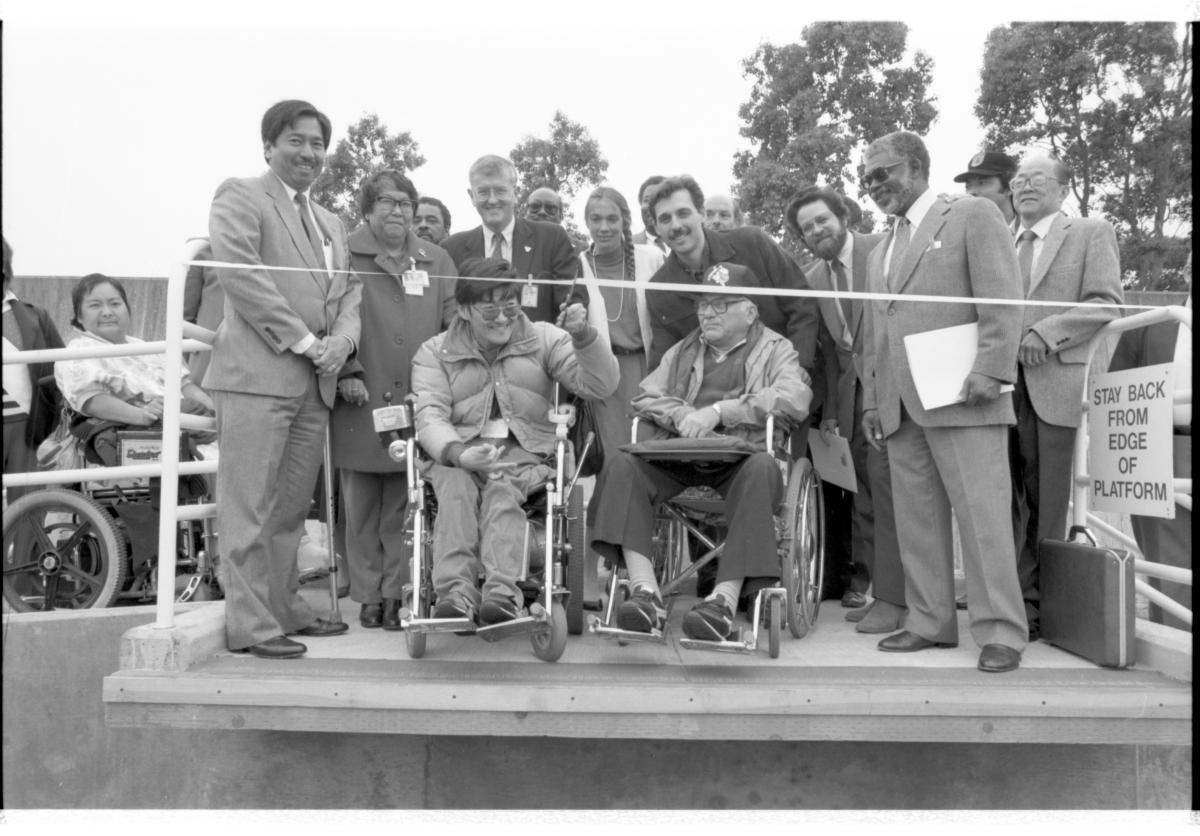 Disability rights activist Bruce Oka leads the ribbon cutting ceremony for an accessibility ramp on the K Ingleside platform in 1989.
Did you know one in ten San Franciscans has at least one kind of disability? July is Disability Pride Month, and San Francisco joins the celebration every year to honor the disability community and mark the anniversary of the Americans with Disabilities Act (ADA). The ADA, which turns 33 on July 26, is the landmark civil rights law that prohibits discrimination on the basis of disability.
The disability rights movement has a long history in the Bay Area, and much of that activism has focused on accessible transportation. You can hear more about the evolution of San Francisco’s accessible transportation on our podcast, Taken with Transportation. During July and all year round, we honor the experiences, achievements and struggles of people with disabilities, and celebrate how disability is a rich part of human diversity.
Staff across the SFMTA are responsible for making our programs, policies and services accessible to older adults and people with disabilities. We work to go beyond legal accessibility requirements to provide safe and efficient service to all. For example, we require scooter companies to provide adaptive scooters. We provide free Muni for seniors and people with disabilities, and those who are unable to independently ride public transit can use paratransit. Since 1978, we have worked to improve and expand paratransit services.
To address the evolving and diverse transportation needs of people with disabilities and older adults in San Francisco, we are developing an Accessibility Strategy. This strategy will guide the agency in our mission to ensure that older adults and people with disabilities can get to where they need to go safely, reliably and affordably.
There are three phases to the Accessibility Strategy.
-
Phase One, the Needs Assessment, begins with a history of accessible transportation services in San Francisco. It discusses the local populations of older adults and people with disabilities and their unique needs. The document examines transit, paratransit, street infrastructure and newer transportation options like scooters and bikeshare.
The Needs Assessment documents San Francisco’s successes in making these modes accessible to all and identifies additional work that needs to be done. The Accessible Services group analyzed existing agency strategies, rider surveys and performance data and consulted with community members to understand opportunities for improvement. The Needs Assessment will be available for public feedback later this summer. To receive updates on this work, including how to provide feedback, please email AccessibilityStrategy@sfmta.com.
-
Once the Needs Assessment is adopted, the Accessibility Strategy work will focus on Phase Two, the development of Goals and Actions. These goals and actions will provide a guide for how to address the issues and opportunities that have been identified. Your input on the Needs Assessment will be very important during Phase Two work.
-
Phase Three (Implementation & Performance Measurement) will help us measure the progress of the Accessibility Strategy. It will also set expectations for how we communicate this progress within the agency, to our partners and to the public.
Stay with us for more news on the Accessibility Strategy and how the SFMTA is working to support transportation for all. We invite you to learn more about transportation for people with disabilities and older adults in San Francisco by visiting our webpage or contacting our Mobility Management Center.
Published July 27, 2023 at 12:25AM
https://ift.tt/29d6wmo
Comments
Post a Comment