By Mark Dreger
We're excited to share an update on the Franklin Street Quick-Build Project, an effort to enhance traffic safety on Franklin Street between Broadway and Lombard Streets. This roadway stretch was the site of 38 collisions between 2017 and 2021, including the tragic loss of a Sherman Elementary School paraeducator in November 2021. Our data-driven approach focuses on several key safety improvements, and we are ready to share the evaluation results and the next steps to bring further safety changes to Franklin Street.
The project includes the implementation of a suite of safety measures focused on the intersections where neighborhood stakeholders expressed most concerns during the outreach process.
-
Painted safety zones (PSZs) have been installed to increase pedestrian visibility at crosswalks by keeping the corners of intersections clear.
-
Slow-turn wedges have been added to encourage drivers to turn at safer speeds and at angles that make people crossing more visible.
-
Daylighting, or removing parking spaces next to intersections, was used to keep areas near crossings clear. This ensures that parked cars don’t prevent drivers and pedestrians from seeing each other.
-
Right-turn-on-red restrictions have been applied to keep crosswalks clear and minimize conflicts between people driving and walking.
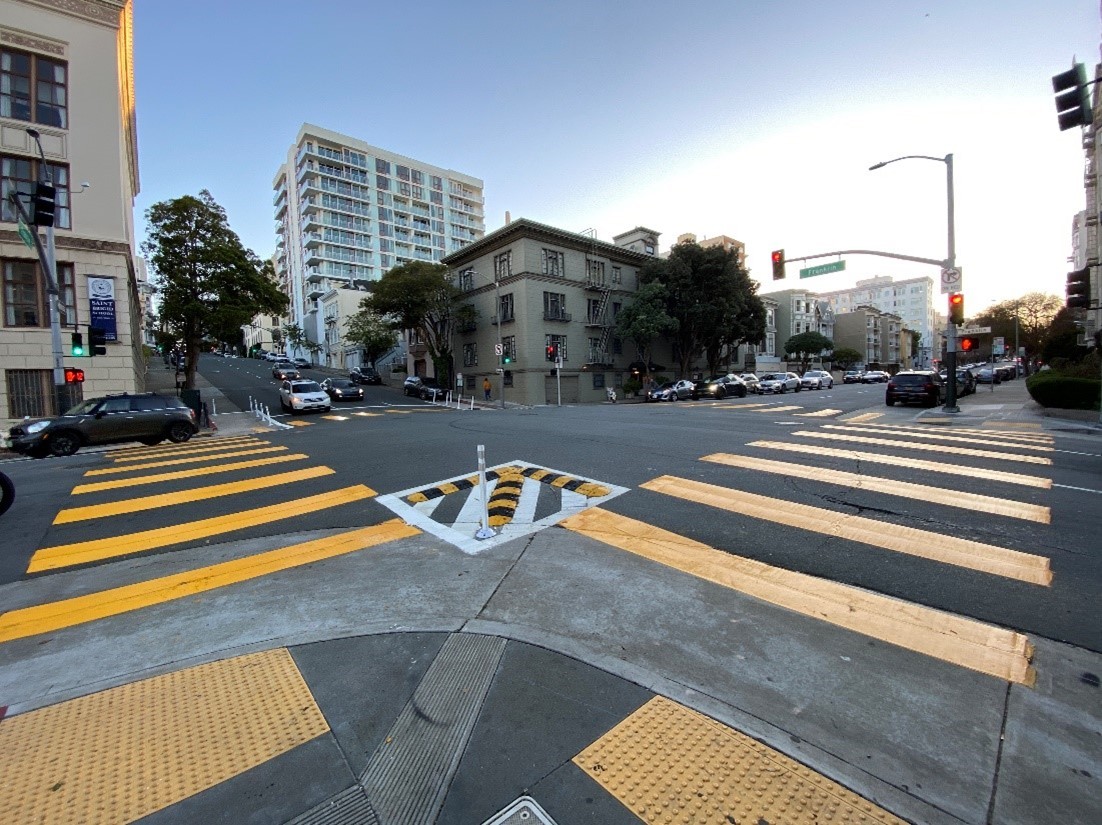 A slow-turn wedge at the intersection of Franklin and Broadway implemented as part of the Franklin Street Quick-Build Project.
The initial results offer some signs of progress:
-
Reduced close calls: After implementation, there were no recorded 'close calls' between people driving and people walking in crosswalks, compared to three such incidents before.
-
Right-turn compliance: Drivers complied with the new right-turn restrictions 94% of the time, indicating that drivers are adhering to the new rules.
However, there are areas where the project did not yield significant changes:
-
Driver yielding rates: Drivers yielded to pedestrians 60% of the time after these changes were implemented, as opposed to 61% before.
-
Vehicle speeds: Both turning and mid-block speeds remained largely unaffected by the changes. Turning speeds are holding at approximately 10-11 mph, which is below the 15-mph safety threshold set by the National Association of City Transportation Officials (NACTO), and mid-block speeds remain slightly above the 25-mph speed limit.
What's Next
While the project did improve intersection safety, it was not effective at reducing speeds along Franklin Street. The corridor is on the Vision Zero High-Injury Network – the 12% of streets that account for 68% of severe and fatal traffic collisions. So, in line with our commitment to Vision Zero, we’re taking the following steps to further increase safety on Franklin Street.
-
Road diet: We plan to reduce Franklin from three lanes to two between Broadway and Lombard Street. This lane reduction should reduce mid-block speeds. People driving more slowly are more likely to see people crossing the street and have time to yield to them.
-
Enhanced intersection designs between Market Street and Broadway: The remainder of Franklin Street from Market Street to Broadway will see enhanced intersection designs using the Quick-Build Toolkit — including painted safety zones, slow-turn wedges and daylighting — creating a uniformly safer walking experience along the corridor.
-
Long-term projects: Our team is brainstorming how to incorporate more significant changes with future projects on and around Franklin Street.
Improving traffic safety is an evolving process and we're committed to making Franklin Street safe and accessible for everyone. While the project has made some headway, it's clear that more work is needed. We appreciate the community's ongoing involvement and look forward to your continued support as we embark on the next steps.
For more information on the Franklin Street Quick-Build Project, please visit our project website (SFMTA.com/FranklinQB) or contact our project team by email at FranklinQB@sfmta.com.
Published September 13, 2023 at 10:37PM
https://ift.tt/GJKaREv
Comments
Post a Comment